
The Magazine That Dared to Ask: Was Hulkamania Dying?
How Pro Wrestling Illustrated's May 1986 issue captured the exact moment when doubt cracked through the golden age
In May 1986, as Hulk Hogan stood atop the wrestling world like a golden colossus, Pro Wrestling Illustrated published something dangerous.
Not a scandal. Not an exposé. Just a question.
"Is Hogan's reign nearing its end?"
For fans clutching that glossy issue in arena parking lots and convenience store aisles, columnist Peter King's "King's Court" feature read like heresy. Hogan was professional wrestling in 1986—the face of Vince McMahon's national conquest, the man who'd turned regional territories into footnotes and made wrestling a pop culture juggernaut. To suggest his invincibility might be cracking wasn't just bold journalism. It was a gamble that PWI knew its readers would devour, debate, and re-read until the pages wore thin.
This wasn't hyperbole for newsstand sales. King had evidence. At Madison Square Garden, Randy Savage had done the unthinkable: he'd left Hogan on his knees. And in the AWA, Stan Hansen had ground Rick Martel into dust through sheer attrition, proving that even beloved champions crumble under the weight of the belt.
The May 1986 issue didn't just report wrestling news. It captured the exact moment when Hulkamania—still ascendant, still printing money—began showing its first hairline fractures.
Historical Context
Publication: Pro Wrestling Illustrated
Issue Date: May 1986
Featured Column: "King's Court" by Peter King
Key Figures: Hulk Hogan (WWF Champion), Randy Savage, Stan Hansen, Rick Martel, Ric Flair
Historical Significance: First major publication to question Hogan's dominance at the height of Hulkamania
When Wrestling Stopped Being Regional and Started Being Everything
By 1986, the wrestling landscape had fractured and reassembled into something new. Vince McMahon's WWF had abandoned the territorial gentleman's agreements that had governed the sport for decades, raiding talent from the AWA and NWA with checkbook aggression. Hulk Hogan, who'd captured the WWF title from the Iron Sheik in January 1984, had become more than a champion—he was the centerpiece of a cultural phenomenon that sold out arenas, moved action figures, and turned Saturday morning cartoon slots into promotional vehicles.
But King's column opened with a reminder that wrestling history is littered with fallen titans. Bruno Sammartino carried the belt for years before age and exhaustion caught him. Bob Backlund's endurance eventually cracked. Pedro Morales, Jack Brisco—every name on the championship lineage told the same story: the belt doesn't just elevate. It drains.
The burden of defending that ten pounds of leather and gold, night after night, city after city, against hungrier and younger challengers—this was the curse King spotlighted. And in Randy Savage, who'd exploded into WWF in 1985 with a combination of athletic violence and manic charisma, Hogan faced something he hadn't encountered before: a wrestler the crowd wanted to see win.
The Photographs That Told the Real Story
Pro Wrestling Illustrated succeeded where WWF's in-house magazines couldn't because it walked the tightrope between kayfabe storytelling and genuine analysis. While WWE publications existed solely to hype upcoming cards, PWI editors treated wrestling with the seriousness of boxing writers studying Ali or sportswriters dissecting the NFL. The magazine's photography reinforced this authority.
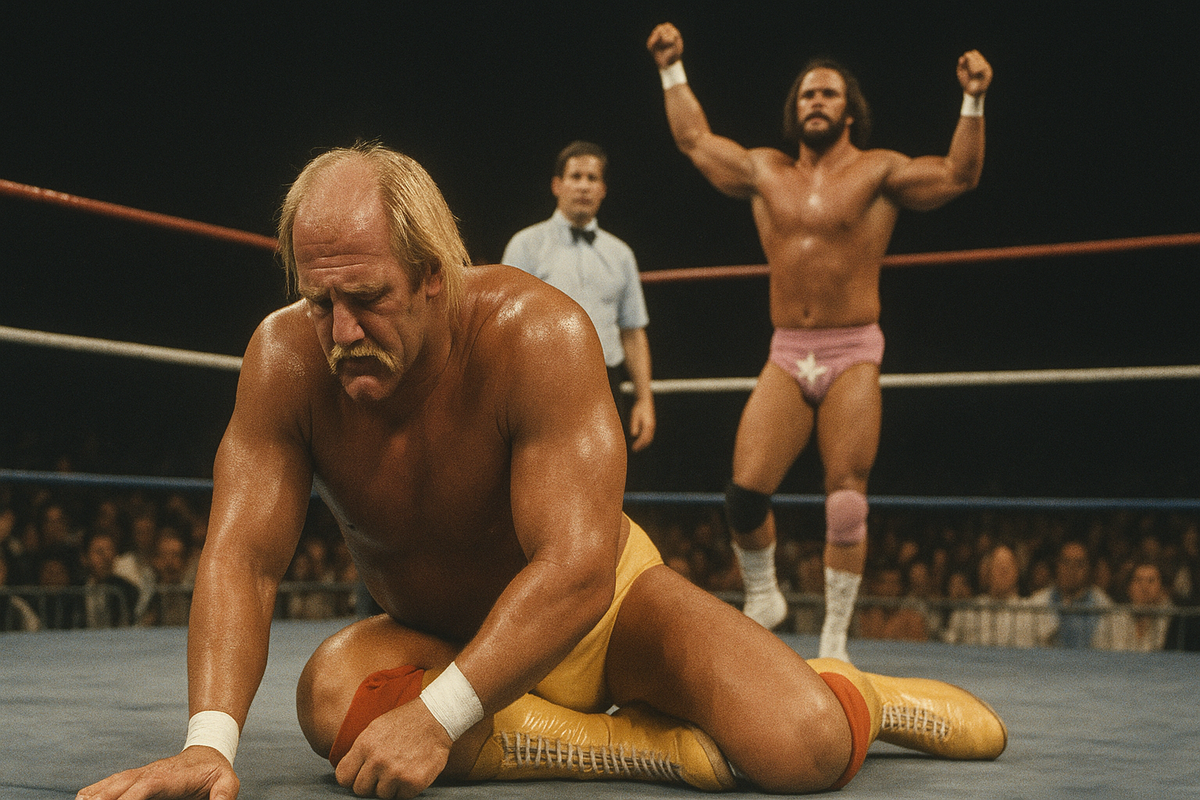
The King's Court spread featured an image that burned itself into fan memory: Hulk Hogan on his knees before Randy Savage at Madison Square Garden. Not pinned. Not bloodied. But humbled—the champion reduced to something less than invincible. For readers accustomed to seeing Hogan flexing with the title held high, this single photograph rewrote the narrative.
King reinforced the warning with another image: Stan Hansen driving Rick Martel into the canvas with a suplex during their AWA battles. The parallel was deliberate and devastating. Martel, like Hogan, had been portrayed as a heroic champion beloved by fans. Hansen, relentless and punishing, had worn him down through sheer persistence until Martel's reign collapsed. The visual message was clear—this is what happens when a challenger refuses to quit and a champion's body begins betraying him.
PWI's genius lay in this presentation. It made wrestling feel like a sport where outcomes mattered, where history had weight, and where fans could study the evidence and draw their own conclusions.
Six Arguments for Hogan's Inevitable Fall
King didn't rely on speculation. He built his case methodically:
The Title as Millstone
Championships don't just validate greatness—they accelerate decline. The constant defenses, the travel carnage, the accumulation of injuries that never fully heal. King positioned the belt itself as Hogan's enemy, a burden that would eventually crush him as it had every predecessor.
The Hansen Precedent
Before turning to Hogan, the column dissected Stan Hansen's systematic destruction of Rick Martel in the AWA. This wasn't filler—it was a case study. Hansen had shown that even a popular, athletic champion could be broken if a challenger kept coming, kept hitting, kept refusing to accept defeat.
Garden Humiliation
What King described as "more than a countout defeat" represented something worse than a loss—it was a symbolic breaking. Hogan, kneeling before Savage in Madison Square Garden, looked vincible. For the first time, the armor showed gaps.
Savage as Apex Predator
Randy Savage wasn't just another challenger cycling through. King identified him as the man most likely to take the belt, noting his crowd reactions rivaled Hogan's and his in-ring intensity exceeded it. This wasn't a heel pushed by management—this was organic fan investment in a potential regime change.
The Flair Factor
Outside WWF's bubble, Ric Flair represented a different kind of threat. King's mention of the NWA champion emphasized ring psychology and strategic endurance—qualities that might outlast Hogan's power-based offense in a theoretical dream match.
Shifting Allegiances
Most damning of all, King suggested the WWF audience itself was tiring of Hulkamania. The fans who'd chanted Hogan's name were beginning to redirect that energy toward Savage. When the crowd turns, no champion survives.
Each argument compounded the others. King wasn't predicting when Hogan would fall—he was explaining why the fall was inevitable.
Why This Issue Became Wrestling Scripture
Decades later, the May 1986 Pro Wrestling Illustrated endures as more than memorabilia—it's a primary historical document.
The timing was perfect. Published at Hulkamania's absolute zenith, before WrestleMania had become an institution, before the Monday Night Wars, the magazine captured the first moment of doubt. And it proved prescient: the Hogan-Savage dynamic King spotlighted would indeed culminate at WrestleMania V in 1989, when Savage defended the title against his former ally in one of wrestling's defining matches.
The photography remains iconic. Those images of Hogan humbled and Hansen dominant are visual shorthand for the mid-'80s wrestling zeitgeist—the moment when kayfabe still held power and fans believed what they saw in the ring carried real stakes.
For collectors, this issue represents the golden age of wrestling journalism, when PWI served as the sport's record-keeper and conscience. At a time before internet spoilers and behind-the-scenes podcasts, these magazines shaped how fans understood their heroes. The rankings, the analysis, the photography—PWI was where wrestling became legitimate in the eyes of its audience.
The Magazine as Time Machine
Like LIFE's combat photography or Rolling Stone's Gonzo journalism, Pro Wrestling Illustrated endures because it elevated its subject matter. Every page of the May 1986 issue pulses with urgency—the sense that something significant is happening and someone needs to document it properly.
For wrestling historians, these magazines are irreplaceable. They capture not just match results but the cultural conversation around wrestling during its explosive growth. They preserve the debates that happened in school cafeterias and arena concourses, the arguments over who was truly the best in the world.
PWI made wrestling matter. And in May 1986, by daring to question Hulk Hogan's immortality, it proved that even gods need good journalists.
Collector Significance
Historic Timing
Published at the height of Hulkamania, it captured the first serious doubts about Hogan's reign at the exact moment when wrestling transformed from regional to national phenomenon.
Prescient Analysis
By spotlighting Hogan vs. Savage, it foreshadowed the legendary rivalry that would climax at WrestleMania V in 1989, making it an essential document of wrestling's greatest era.
Iconic Photography
The images of Hogan humbled by Savage and Hansen overpowering Martel remain visual touchstones of the mid-1980s wrestling landscape.
Cultural Artifact
For collectors, this issue represents the golden era of wrestling magazines, when PWI was the fans' bible and shaped the national conversation about the sport.
Own the Moment When Hulkamania Cracked
If your collection spans the golden age of professional wrestling—Hogan's reign, Savage's ascent, the territorial wars that gave way to national domination—this issue belongs in your archive. It's not just a magazine. It's the document that captured doubt at the height of certainty, that spotted the fractures before the earthquake.
Browse Pro Wrestling Illustrated Magazine CollectionFrom the 1970s through the 1990s, these magazines chronicled wrestling's transformation from regional curiosity to cultural phenomenon. They documented the rivalries, rankings, and rhetoric that made the sport unforgettable.