
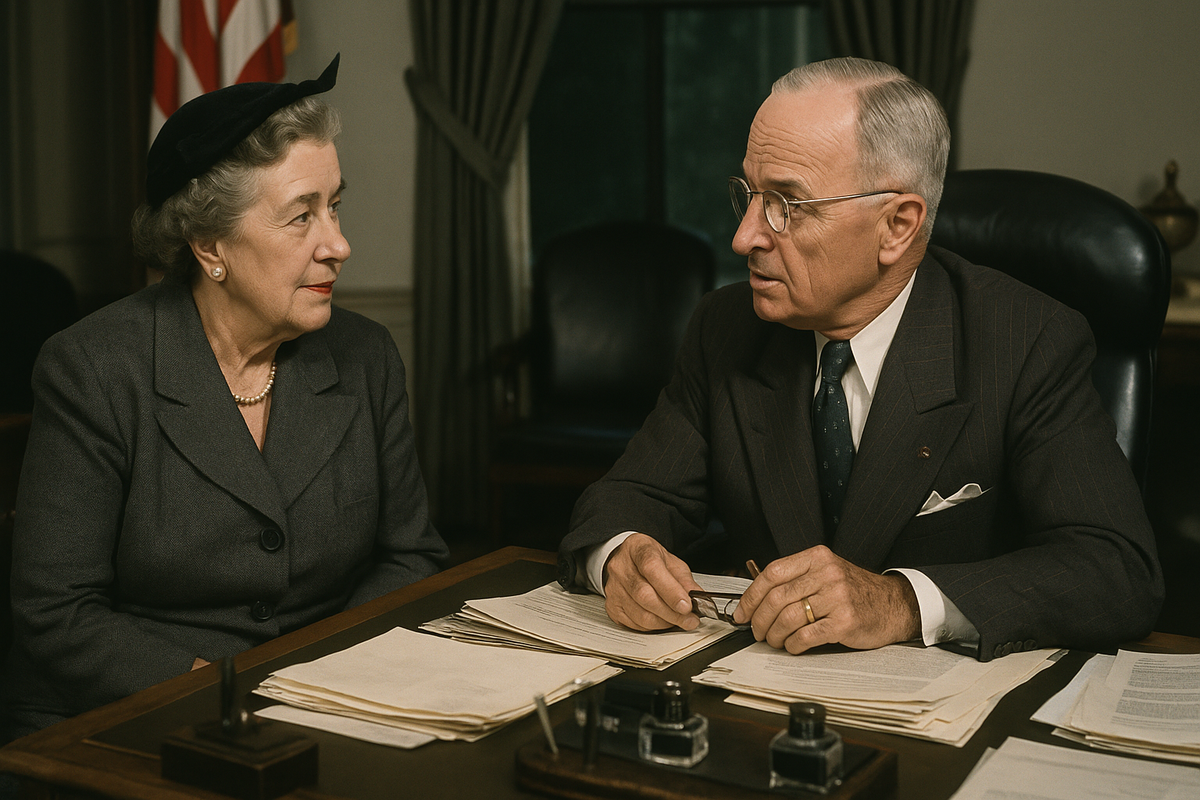
The Grandmother Who Made a President Blink
How India Edwards and The Saturday Evening Post Redefined Women's Political Power in 1951
On July 7, 1951, millions of Americans opened The Saturday Evening Post expecting Norman Rockwell nostalgia and summer recipes. What they got instead was a profile titled "The Lady Who Told Off the President"—and the lady in question wasn't apologizing.
India Edwards was a grandmother. She was also the most formidable political operative Harry S. Truman had ever faced across a desk. When the President dismissed her demands to appoint women to federal judgeships, she didn't write a strongly worded letter. She came back the next morning with more names.
This wasn't a puff piece about a plucky volunteer. It was a bulletin from the front lines of a war most Americans didn't know was being fought: the battle to force the postwar establishment to share power with the women it had thanked for their wartime service—and then told to go home.
The Smoke-Filled Room Had a New Occupant
World War II had cracked open possibilities. Women riveted bombers, decoded enemy transmissions, and kept the nation running while men fought overseas. When victory came in 1945, the cultural script called for a tidy return to domesticity—aprons, suburbs, the nuclear family as Cold War propaganda.
India Edwards read that script and set it on fire.
As executive director of the Women's Division of the Democratic National Committee, Edwards wielded a weapon more powerful than protest: access. She knew which senators owed their elections to women volunteers. She knew which governors needed the women's vote in 1952. And she knew that Truman, for all his decisiveness on Berlin and Korea, could be worn down by a woman who refused to leave his office.
Her argument was surgical: America claimed to lead the free world against Soviet tyranny, yet barred half its population from meaningful power. How could Washington lecture Moscow about human dignity while women remained tokens in its own government?
Truman respected her—because she never begged. She negotiated.
Archive Context
Historical Figure: India Edwards, Executive Director of the Women's Division, Democratic National Committee
Issue Date: July 7, 1951
Archive Source: The Saturday Evening Post
Cover Artist: Stevan Dohanos
Feature Article: "The Lady Who Told Off the President"
The Magazine That Brought Main Street to Washington
The Saturday Evening Post wasn't The New Republic or Foreign Affairs. It was the magazine your dentist kept in the waiting room, the one your father read after Sunday dinner. Its July 7, 1951 cover—a Stevan Dohanos painting of a small-town Fourth of July band concert—promised Americana at its most reassuring.
Then you turned the page and met India Edwards.
This juxtaposition wasn't accidental. The Post's genius lay in smuggling uncomfortable truths into comfortable living rooms. The same issue that celebrated brass bands and bunting also asked its readers to reckon with a question: What if the women who organized your church socials and PTA meetings deserved a federal judgeship?
The magazine was betting that Middle America was ready for the answer. Edwards was proof they'd been ready all along—they just needed someone to make the case without apology.
What Edwards Actually Won
Persistence isn't glamorous. It's returning to the Oval Office with a revised list after yesterday's rejection. It's spending weekends reviewing résumés of qualified women lawyers while male columnists dismiss you as a "petticoat politician."
Edwards didn't theorize about equality. She installed it:
Federal Judgeships
Women presiding over courtrooms where, a decade earlier, they couldn't serve on juries in many states.
Executive Appointments
Women drafting policy, not just typing it.
Ambassadorships
Women representing American interests abroad—a direct rebuke to the idea that diplomacy required a man's handshake.
Bridging Generations
Operating in the gap between the suffragists of the 1920s and the feminists of the 1960s.
She operated in the gap between the suffragists of the 1920s—who won the vote but not the seats—and the feminists of the 1960s, who would demand structural change. Edwards didn't wait for structure to change. She moved the furniture while the architects argued.
The Post profile captured her at the height of her influence, when even Truman had learned that underestimating "the lady" was a mistake you made only once.
Why This Issue Became a Landmark
Some magazines age into kitsch. Others age into evidence.
The July 7, 1951 Saturday Evening Post sits at the intersection of art, politics, and cultural inflection. Stevan Dohanos—whose covers rank alongside Rockwell's as defining images of mid-century America—painted the bandstand. Inside, editors gave seven pages to a story about a woman systematically dismantling male political monopoly.
Collectors recognize what that combination represents: the exact moment when the postwar consensus began to crack. The cover says, "Everything is fine." The Edwards profile says, "Not for everyone."
That tension—between the America that wanted to believe it had returned to normal and the America that women like Edwards were actively reshaping—makes this issue irreplaceable for anyone studying how cultural change actually happens. Not through manifestos, but through magazine profiles read over breakfast in Omaha and Atlanta and Portland.
The Artifact in Your Hands
History textbooks summarize. Primary sources testify.
Holding the July 7, 1951 issue means holding the moment when India Edwards' name appeared in millions of homes, when her fight for appointments became part of the national conversation, when readers had to decide whether the grandmother in the story was a troublemaker or a trailblazer.
It's a record of who was arguing for power, how they argued, and which media gatekeepers amplified their voices. The ink hasn't faded. The arguments haven't aged.
For collectors, this is more than ephemera. It's proof that the battles we think of as "modern"—representation, access, the right to be taken seriously in rooms where decisions are made—were being waged by women whose grandchildren are now in their seventies.
Collector Significance
Historical Documentation
Primary source evidence of women's postwar political advocacy during the Truman administration, preserved in the nation's most widely-read magazine.
Cultural Intersection
Rare combination of Stevan Dohanos cover art and groundbreaking political journalism—nostalgic Americana meeting uncomfortable social change.
Artistic Provenance
Dohanos covers command serious collector attention, ranking alongside Norman Rockwell as defining images of mid-century American illustration.
Research Value
Essential primary source for scholars of women's history, Cold War politics, and 20th-century media's role in social movements.
Explore the Archive
Thousands of original Saturday Evening Post issues spanning the Great Depression, World War II, the Civil Rights Movement, and the cultural revolutions of the 1960s are available in our collection. Each one is a window into how Americans understood their moment—before historians told them what it meant.
Browse The Saturday Evening Post Magazine CollectionThe Legacy in Print
India Edwards didn't live to see a woman president. She didn't see Title IX or Roe or the current composition of the Supreme Court. What she did see—what this magazine preserves—was the beginning.
She proved that change doesn't require waiting for permission. It requires showing up, again and again, with the names of qualified women and the patience to outlast every excuse.
The July 7, 1951 Saturday Evening Post documented that patience. It gave Edwards' fight the one thing every political movement needs: visibility.
And visibility, as it turned out, was the first step toward inevitability.