
Into Germany: The Allies Breach the Siegfried Line and Bring the War to Nazi Soil
How Life Magazine's October 2, 1944 Issue Brought the Invasion of Germany Into American Homes
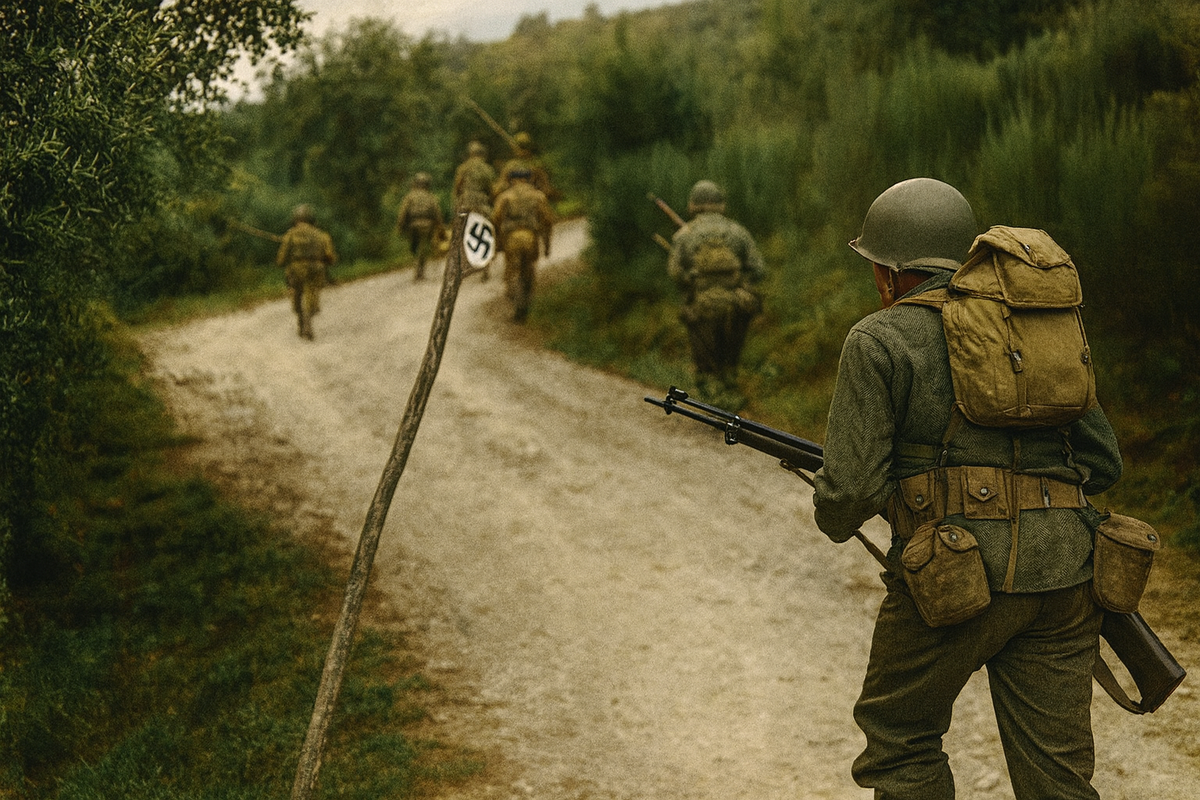
October 2, 1944. A mother in Des Moines unfolded her weekly Life Magazine at the kitchen table. Her son was somewhere in Europe—his last letter postmarked two weeks ago from Belgium. She turned past the advertisements for Palmolive and Lucky Strike, and there it was: American soldiers crossing into Germany itself, rifles raised, moving past a stark swastika marker that divided occupation from invasion.
For the first time, the war had come home in a new form. Not liberation. Invasion.
When Americans picked up this issue of Life, they weren't just reading the news—they were witnessing the psychological turning point of the European theater. The magazine's cover and interior photo-essay, "First Battle of Germany Begins," delivered what no radio broadcast or newspaper column could: visual proof that Allied forces had breached the Reich's borders and were fighting on Nazi soil.
This wasn't triumph. It was the beginning of the end—bloody, uncertain, and irreversible.
The Strategic Chessboard: Autumn 1944
By fall, the Allies had shattered German lines across France and Belgium. Paris had been liberated in August. Patton's tanks were roaring eastward. But momentum had delivered them to the threshold of something far more formidable than any hedgerow or river crossing: the Siegfried Line.
Stretching from the Swiss border to the Netherlands, the Westwall—as the Germans called it—was a defensive system of reinforced bunkers, interlocking fields of fire, concrete dragon's teeth tank obstacles, and minefields designed to bleed attackers white before they reached the Rhine. Hitler had staked Germany's survival on it.
Life captured the scope and brutality of the campaign in stark terms. "From end to end the western front," the article reported, Allied forces were engaged in "bloody and desperate battles" that would determine whether the war ended in 1944 or dragged into 1945.
In the north, British and American airborne divisions had seized Nijmegen but failed catastrophically at Arnhem—a reminder that audacity without support meant slaughter.
In the center, General Hodges' First Army clawed toward Aachen and Prüm, fighting house to house through villages where civilians cowered and Wehrmacht soldiers fired from basements.
In the south, Patton and Patch drove into the heaviest tank battles since Normandy, trading steel and lives in the Lorraine mud.
The Siegfried Line was more than concrete and wire. It was a threshold. Crossing it meant the Allies were no longer liberators—they were conquerors pressing into the enemy's heartland.
Historical Record
Publication: Life Magazine
Issue Date: October 2, 1944
Featured Article: "First Battle of Germany Begins"
Military Context: U.S. First Army crossing into Germany near Grosskampenberg
Commanding Officer: General Courtney Hodges, First Army
Life as Witness: The Power of the Image
By 1944, Life Magazine had become America's visual conscience. Its editors understood what text alone could never convey: that a single photograph could collapse the distance between a farmhouse in Iowa and a foxhole in Germany. For families with men overseas, Life was the closest thing to standing beside them.
The Cover Photo
The October 2 cover remains one of the war's most iconic images. No drama. No staged heroism. Just American infantry advancing cautiously up a dirt road, weapons ready, past a swastika road marker half-buried in the autumn grass. The moment was raw and immediate—the kind of documentary power that made Life indispensable.
Inside the Feature
The photo-essay unfolded with the pacing of a film reel, each image a frame in a larger narrative:
Crossing into Grosskampenberg — U.S. troops from Hodges' First Army entered the small border village where Belgium, Luxembourg, and Germany converged. Civilians stood frozen in doorways. A mother pulled her child inside, wary of soldiers and cameras alike. The captions noted the silence—no cheers, no flowers, only the cold arithmetic of invasion.
American Scouts Near Prüm — Soldiers moved through mist-shrouded fields toward the fortified line, their postures tense, eyes scanning treelines. The uncertainty was palpable.
Jeep Unloading at a German Farmhouse — GIs prepared equipment while villagers watched from windows. War and domestic life collided in uneasy proximity.
Infantry on German Roads — Columns of men trudged forward, backs bent under packs, faces obscured by helmets. The visual weight of exhaustion required no explanation.
Each photograph was paired with captions that contextualized without editorializing—letting readers see the advance as it happened, not as propaganda required it to be remembered.
What American Readers Learned
Life's October 2 issue delivered both information and revelation. Among its most crucial insights:
The Siegfried Line's Lethality
Described as one of the most formidable defensive barriers ever constructed, its concrete pillboxes and anti-tank obstacles represented the Reich's last shield. Breaking through would cost thousands of lives.
Civilian Encounters
German villagers met American troops with silence or resignation, a population trapped between fear of the Nazis and uncertainty about occupation. No jubilant crowds here—only survival.
German Counterattacks
The article detailed how Wehrmacht forces often launched desperate charges, sometimes advancing shoulder to shoulder in suicidal waves, suffering catastrophic losses but slowing the Allied advance.
The Arnhem-Nijmegen Axis
Life explained how the airborne gambit in Holland tied into the broader strategy to outflank the Siegfried Line—and why its failure meant the war would grind on through winter.
The Psychological Shift
For the first time, Americans saw their soldiers not as liberators but as invaders. The moral clarity of Normandy had given way to the moral complexity of occupation.
Why Life's War Coverage Still Matters
Life endures because its war issues were never just journalism—they were time capsules sealed with urgency. Every page carries the weight of a moment when the outcome was unknown and the stakes were existential. Unlike today's endlessly updated news feeds, these magazines were read carefully, discussed at dinner tables, and preserved in attic trunks.
They remain powerful because they offer something digital media cannot: presence. The ability to see the war as it was first reported, without historical revision, without the comfort of knowing how it ended.
Why Collectors Prize This Issue
Among vintage Life magazines, the October 2, 1944 edition ranks as one of the most historically significant and collectible wartime issues.
A Historic First
This was the first major Life issue to document U.S. forces crossing into Germany itself, making it a primary source for one of the war's pivotal moments.
Iconic Cover Photography
The image of infantry advancing past the swastika marker is one of the Western Front's defining visual documents—reproduced in documentaries, textbooks, and museums.
Personal Connection
For descendants of veterans who fought in the European theater, this issue represents a tangible link to family history—the same pages their grandparents might have studied in 1944.
Strong Market Demand
Issues covering D-Day, the Liberation of Paris, and the first battles in Germany consistently command premium prices among serious collectors. This issue checks every box.
Holding the October 2, 1944 Life is not nostalgia. It's holding a primary historical document—the very magazine that brought the invasion of Germany into millions of American homes as it happened.
For Collectors and Historians
If you're building a collection, researching the war, or honoring the memory of someone who lived through it, vintage Life magazines offer something profoundly rare: the chance to experience history as it was first understood.
Browse Life Magazine CollectionFrom the 1930s through the 1970s, Life documented war, culture, politics, science, and daily life with unmatched photographic storytelling. Each issue is a window into a moment—preserved in real time, unfiltered by hindsight.
Holding History
The October 2, 1944 issue of Life Magazine remains one of the most significant wartime publications ever produced. Its coverage of the First Battle of Germany gave American readers both hope and realism: the Allies had crossed into Hitler's homeland, but victory would still demand sacrifice.
Today, this issue stands as a prized artifact—valued not only for its iconic photographs but for its role in shaping how a generation understood the war's most critical turning point.
To hold a copy is to hold what Americans held in 1944—the very magazine that showed them what it looked like when their soldiers entered Germany.
For anyone who values history, vintage Life magazines are more than reading material. They are artifacts, witnesses, and guardians of memory.