
The Mother's Magazine That Published a Manifesto
Robert F. Kennedy's 1968 Defense of American Youth in Ladies' Home Journal
In January 1968, between the pot roast recipes and the spring fashion previews, Ladies' Home Journal dropped a political hand grenade into the laps of American mothers.
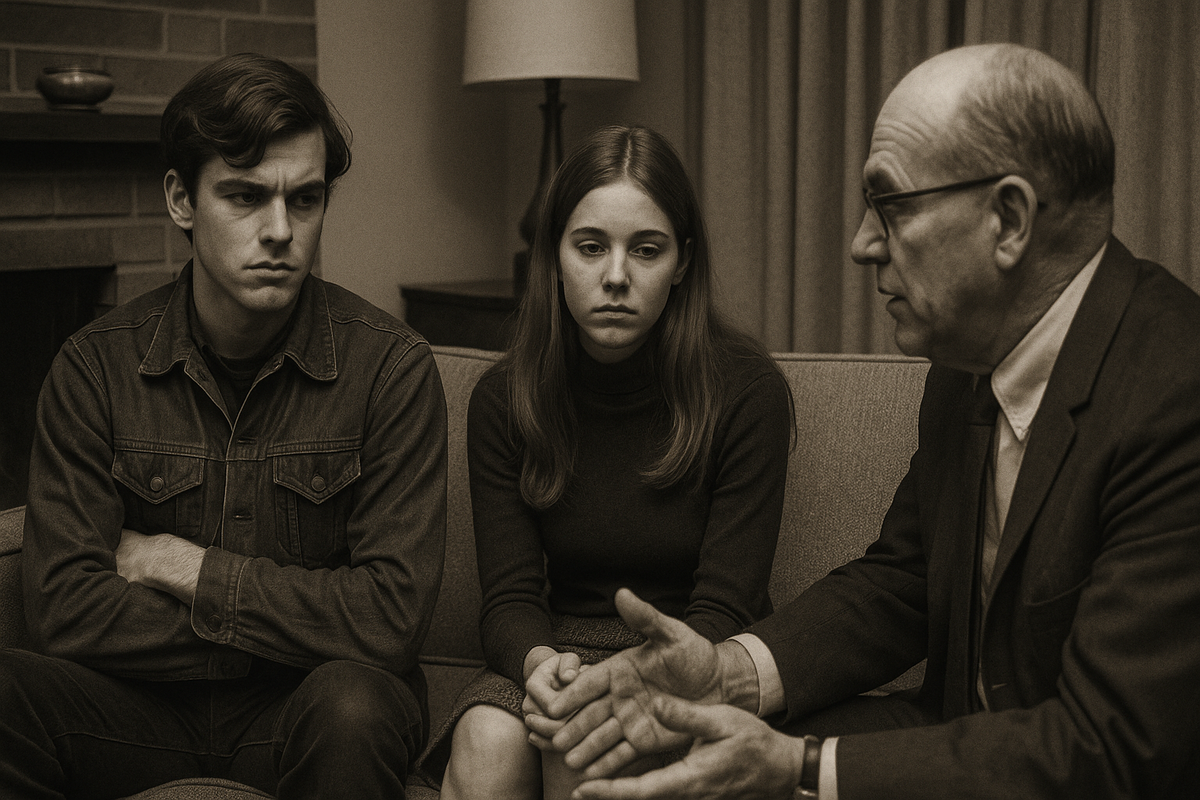
Senator Robert F. Kennedy—brother of the slain president, potential challenger to Lyndon Johnson, and one of the most polarizing figures in American politics—was given the magazine's platform to do something unexpected: defend the very young people tearing the country apart. His essay, "What Our Young People Are Really Saying," appeared in a publication read by millions of women whose sons were burning draft cards, whose daughters were marching in protests, and whose dinner tables had become Cold War zones of generational conflict.
This was not a concession speech. It was a plea for understanding, published in the one place where it might actually matter—the hands of the mothers trying to hold their families together.
Archive Details
Historical Figure: Senator Robert F. Kennedy
Issue Date: January 1968
Article Title: "What Our Young People Are Really Saying"
Archive Source: Ladies' Home Journal
Historical Context: Published four months before Kennedy's assassination in June 1968
When the Living Room Became the Battleground
By 1968, the "generation gap" had metastasized from catchphrase to national emergency. The Vietnam War was incinerating American sons at a rate of 16,000 per year. College campuses were erupting in protests. The Civil Rights Movement, once led by the measured oratory of Martin Luther King Jr., was fracturing toward the militant rhetoric of Stokely Carmichael and H. Rap Brown. Psychedelic drugs were no longer confined to bohemian enclaves—they were showing up in suburban bedrooms. Rock music had become a vehicle for dissent.
For parents who had survived the Depression and stormed the beaches of Normandy, the revolt of their children felt like betrayal. The values they had fought to preserve—duty, patriotism, deference to authority—were being rejected wholesale. And yet here was Robert Kennedy, in the pages of Ladies' Home Journal, arguing that the rebellion was not pathology but prophecy.
"It would be tempting, but wrong, to trace all the problems of our disaffected youth to Vietnam," Kennedy wrote, adapting passages from his 1967 book To Seek a Newer World. "The challenge is deeper and broader… Societies confident of their wisdom and purpose are not afflicted with rebellions of the young."
The diagnosis was radical: America's youth weren't rebelling against their country. They were rebelling because their country had lost its way.
Why Ladies' Home Journal Mattered
To understand the audacity of this editorial choice, you have to understand what Ladies' Home Journal was in 1968. Founded in the 19th century, it had become one of the highest-circulation magazines in America—a fixture in middle-class homes, shaping opinions on everything from child-rearing to civic duty. It was not The New Republic. It was not Ramparts. It was the magazine your mother read while waiting for the meatloaf to finish.
And yet by the late 1960s, Ladies' Home Journal had quietly positioned itself as a bridge between domesticity and national crisis. The editors framed Kennedy's contribution as part of a series addressing "America's No. 1 family crisis—the war between parents and their disillusioned sons and daughters." This was not political abstraction. This was happening in your house, and the magazine knew it.
The decision to publish Kennedy's essay was a recognition that the revolution wasn't just in the streets—it was in the living room, the kitchen, the bedroom. And the mothers reading Ladies' Home Journal were the ones who would either close the gap or watch it widen into a chasm.
Kennedy's Case for Youth: Idealism, Not Nihilism
Kennedy opened with a historical argument designed to disarm his critics. Youth rebellion, he reminded readers, was as American as independence itself. Thomas Jefferson was 33 when he wrote the Declaration of Independence. Henry Knox commanded artillery at 26. Alexander Hamilton fought for the revolution at 19. The nation, Kennedy argued, had always relied on the energy and vision of the young.
He then turned to contemporary examples of youth idealism: Peace Corps volunteers serving in impoverished nations, students in the Northern Student Movement working for civil rights, young people tackling poverty in Appalachia. These were not nihilists. They were believers.
But Kennedy did not sanitize the moment. He acknowledged the "dark currents"—the rise of psychedelic drugs, the violent riots, the apocalyptic rhetoric of figures like Carmichael and Brown. He noted that some young people had adopted "strange new heroes" and were embracing radicalism that threatened to turn rebellion into ruin.
What Kennedy asked of his readers was not denial, but perspective. He urged parents to see their children not as threats but as inheritors of a tradition of American idealism—one that, if guided rather than condemned, could renew the nation.
It was a gamble. Kennedy was betting that mothers, who had the most to lose in the generational conflict, might also have the most to gain from empathy.
The Visual Grammar of Urgency
The presentation of Kennedy's article was deliberate. The opening spread featured a full-page portrait of the senator—face turned in contemplation, lit to convey gravity. This was not the soft-focus portraiture of celebrity profiles. This was photojournalism.
The typography reinforced the urgency. Bold pull quotes interrupted the text, isolating Kennedy's most provocative claims: his warning not to blame everything on Vietnam, his insistence that the crisis was structural, not generational. The design language was stark, sober, and entirely unlike the pastel cheerfulness of the beauty pages that followed.
This tonal shift was the magazine's secret weapon. Ladies' Home Journal could pivot seamlessly from sewing patterns to civil rights, from kitchen design to political philosophy. It was a mirror of American life in all its contradictions—proof that domesticity and dissent were not mutually exclusive.
What This Issue Reveals About 1968
Holding the January 1968 Ladies' Home Journal today is like holding a snapshot of a nation on the edge. The issue captures the precise moment when the personal became inescapably political, when mothers could no longer ignore the fact that the world their children were inheriting was fundamentally different from the one they had known.
Kennedy's essay distills the anxieties and aspirations of that moment: respect for youth's energy and imagination, fear of their radicalism, hope that dialogue might prevent rupture, and the creeping suspicion that the rebellion was justified. He wrote with the urgency of someone who believed the country could still be saved—if only parents and children could find a way to speak to each other.
Four months later, Robert Kennedy was dead, shot in a Los Angeles hotel kitchen after winning the California primary. The hope he represented—that empathy might bridge the divides tearing the country apart—died with him.
Key Themes in Kennedy's Essay
Youth Idealism in History
Jefferson, Hamilton, and Knox as reminders of youthful leadership in founding the nation.
Service and Sacrifice
Recognition of Peace Corps volunteers and civil rights workers as embodiments of idealism.
Dark Currents
Acknowledgment of drugs, riots, and radicalism as destructive elements within the youth movement.
Family Crisis
The generational divide framed as America's central domestic emergency.
Respect and Admiration
Kennedy's call for adults to recognize youth's energy and imagination as assets, not threats.
Structural Crisis
Rebellion attributed not just to Vietnam, but to society's broader failure to inspire its young.
Why Collectors Seek This Issue
For collectors of vintage periodicals, the January 1968 Ladies' Home Journal is more than ephemera. It is a historical artifact of the first order.
Historical Timing
Published just months before Kennedy's assassination, the article captures his thinking at the apex of his political influence and the height of national turmoil.
Political Rarity
Few women's magazines of the era featured such high-level political commentary on youth rebellion, cultural revolution, and the future of American democracy.
Cultural Documentation
The issue stands as a time capsule of the generation gap—one of the defining crises of the 1960s—presented in real time for an audience living through it.
Collector Demand
Issues tied to Kennedy family members, particularly those published in the months before tragedy, are among the most sought-after by historians and political memorabilia collectors.
The Archive of Everyday Crisis
What makes vintage Ladies' Home Journal issues so valuable is their breadth. In the same issue that carried Kennedy's manifesto on youth rebellion, readers also found fashion spreads, beauty advice, short fiction, recipes, and features on home management. This juxtaposition—the intimate alongside the cataclysmic—is precisely why the magazine shaped American culture for generations.
For historians, these issues reveal how ordinary families encountered extraordinary times—not through textbooks or evening news broadcasts, but in the familiar pages of their monthly magazine, delivered to the mailbox alongside the bills and the grocery circulars.
Preserve the Archive
If you collect vintage women's magazines or seek primary sources on 1960s cultural history, issues like the January 1968 Ladies' Home Journal are irreplaceable.
Browse Ladies' Home Journal Magazine CollectionThe January 1968 Ladies' Home Journal, featuring Robert F. Kennedy's "What Our Young People Are Really Saying," remains one of the most historically charged publications of a decade defined by upheaval. At a time when the generation gap threatened to destroy families, Kennedy urged understanding, perspective, and hope—published in the one place where it might actually reach the people who needed to hear it most.
To hold this magazine today is to hold a fragile moment of possibility: the belief that empathy might still win, that parents and children might still speak, and that the country might still be saved. History proved otherwise. But for one month in 1968, the hope was there—printed on glossy paper, bound with recipes and fashion ads, and delivered to millions of American homes.