
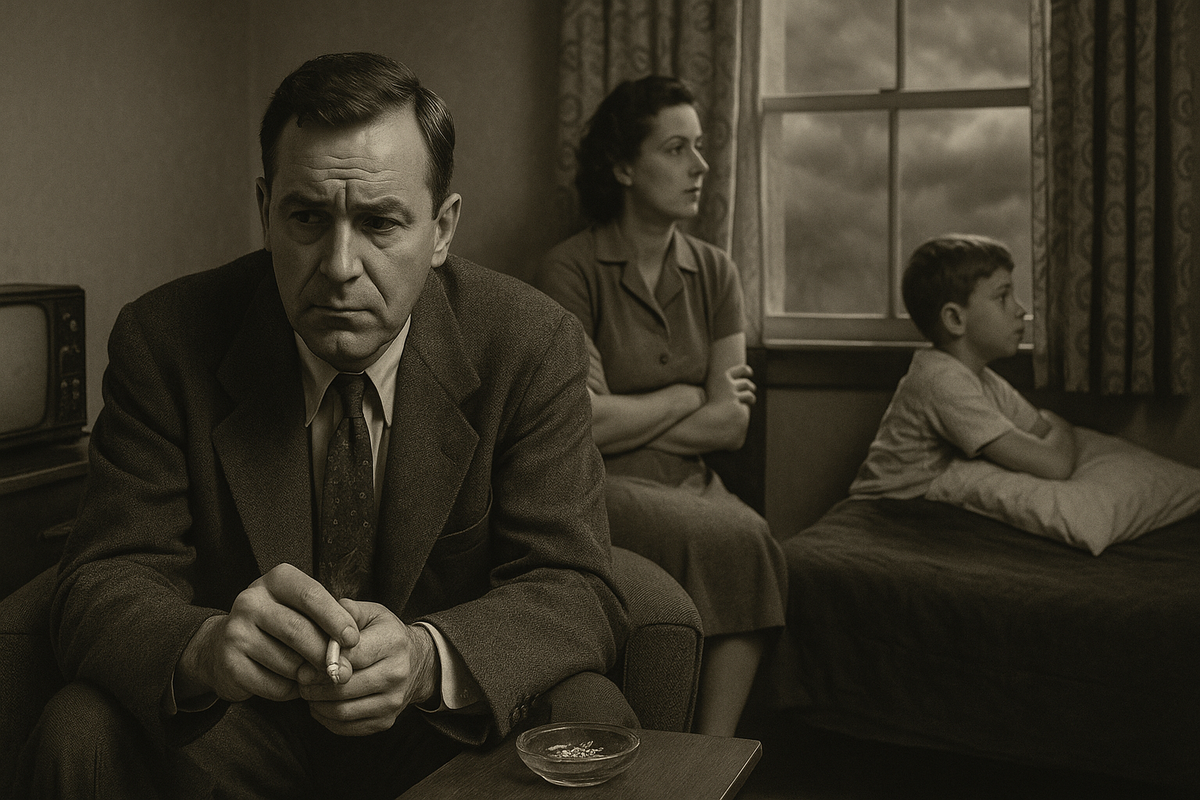
The Day America Learned to Fear the Wind
Inside The New Yorker's July 16, 1955 exposé on nuclear fallout—the story that shattered Cold War complacency
When readers opened The New Yorker on July 16, 1955, they expected wit, cartoons, perhaps a short story by John Cheever. What they got instead was a reckoning.
Buried in the "Reporter at Large" section was an article titled "Fallout"—a word that, until recently, had been confined to classified briefings and physics journals. Now it was entering the American lexicon, and with it came a truth the government had tried to soften: the radioactive dust from Nevada's bomb tests wasn't staying in the desert. It was drifting into milk. Into wheat fields. Into children's bones.
This wasn't sensationalism. It was The New Yorker doing what it did best—translating the unspeakable into the undeniable.
For a generation raised on victory parades and promises of atoms for peace, the revelation was seismic. The nuclear age, it turned out, didn't announce itself with mushroom clouds alone. It arrived silently, on the wind.
The Context: Operation Teapot and the Illusion of Safety
By mid-1955, the Cold War had become a contest of obliteration. The United States and the Soviet Union were detonating hydrogen bombs as casually as countries once fired cannons. Just months earlier, Operation Teapot—a series of fourteen nuclear tests at the Nevada Test Site—had concluded. These weren't small-scale experiments. They were rehearsals for Armageddon, designed to test blast effects on mannequin families in suburban mock-ups, on canned food, on livestock.
The Atomic Energy Commission reassured the public: perfectly safe, perfectly controlled. But physicists were beginning to whisper. Strontium-90, a radioactive isotope with a half-life of nearly thirty years, was showing up in places it shouldn't. Cesium-137 was accumulating in ecosystems. Fallout, scientists realized, didn't respect borders or blast zones. It traveled.
And Americans, trusting their morning milk and evening news, had no idea.
Archive Details
Publication: The New Yorker
Issue Date: July 16, 1955
Featured Article: "Fallout" (Reporter at Large)
Cover Artist: Garrett Rea
Historical Context: Operation Teapot nuclear testing series, Cold War arms race escalation
Why The New Yorker Could Tell This Story
By 1955, The New Yorker occupied a singular position in American letters. It wasn't a newspaper chasing scoops. It wasn't a glossy promoting consumer comfort. It was something rarer: a magazine that assumed its readers were intelligent, skeptical, and willing to sit with uncomfortable truths.
Where other outlets soft-pedaled atomic policy, The New Yorker stripped away the euphemisms. The "Fallout" piece dissected scientific disputes, quoted researchers who questioned official safety thresholds, and explained—without hysteria—how invisible particles could lodge in human tissue and remain radioactive for decades.
This was journalism as civic duty. At a time when Cold War orthodoxy demanded patriotic optimism, The New Yorker offered something more valuable: honesty wrapped in prose so precise it couldn't be dismissed as alarmism.
For families reading this issue in July 1955, the effect was visceral. The article didn't ask them to panic. It asked them to think—about what their government wasn't saying, about what scientists were debating behind closed doors, about whether progress and peril had become inseparable.
The Cover: Garrett Rea's Quiet Unease
Flip to the cover, and you'll find no mushroom clouds. No propaganda. Just a boy in bed, staring through his window at a riot of green leaves and bright birds.
At first glance, it's pastoral. Innocent. But look again.
The child isn't outside playing. He's confined, enclosed, separated from the natural world by glass. The lush foliage presses close—alive, vibrant—but also crowding, almost suffocating. It's an image of containment, of something beautiful but unreachable. The boy's gaze is wistful, maybe wary.
This is The New Yorker's visual genius. Garrett Rea didn't illustrate the article's content; he illustrated its mood. The cover captures the central paradox of the nuclear age: the world outside looks untouched, but the boundary between safety and exposure has become dangerously thin.
Collectors prize this cover not just for its aesthetic—though it's stunning—but for its thematic weight. It's one of those rare moments when image and editorial intent fuse perfectly, creating an artifact that transcends journalism and becomes art.
What the Article Revealed
The "Fallout" piece dismantled four pillars of Cold War complacency:
The Invisibility Problem
Unlike the instant devastation of Hiroshima, fallout was gradual, silent, cumulative. You couldn't see it. You couldn't taste it. But it was there, riding weather patterns, settling into soil, entering the food chain.
The Scientific Divide
Government physicists downplayed risks. Independent researchers countered that any increase in radiation exposure could raise cancer rates. The article laid bare this conflict, refusing to pick sides but making clear the stakes of uncertainty.
The Public as Guinea Pigs
Fallout didn't respect test site boundaries. Communities hundreds of miles from Nevada were exposed. Milk from dairy farms showed elevated strontium-90. The American public, it seemed, had become subjects in an uncontrolled experiment.
The Global Dimension
Fallout was crossing oceans. Radioactive particles from Pacific tests were detected in rainfall over Europe. The arms race wasn't just geopolitical theater—it was reshaping the planet's atmosphere.
Each revelation built on the last, constructing a narrative that was impossible to ignore: the Cold War had consequences beyond diplomacy and deterrence. It was rewriting biology itself.
The Long Echo
What makes this issue endure is its refusal to age. Swap "fallout" for "microplastics" or "forever chemicals," and the structure of the story remains: invisible threat, official minimization, scientific alarm, public awakening. The specifics change. The pattern doesn't.
The New Yorker understood that its role wasn't just to report news but to create a record—one that future generations could excavate to understand not just what happened, but how it felt to live through it.
That's why these magazines matter. They're not archives in the academic sense. They're witnesses.
Why Collectors Seek This Issue
Historical Inflection Point
This issue captures the moment when nuclear anxiety shifted from abstract dread to concrete concern. Fallout became real.
Journalistic Landmark
The article represents mid-century investigative reporting at its finest—rigorous, literary, unafraid to challenge official narratives.
Artistic Merit
Rea's cover has aged into iconography. It's reproduced in Cold War retrospectives, cited in design histories, studied in journalism courses.
Cultural Artifact
Own this issue, and you own more than paper. You hold the anxieties of an era—the cartoons that tried to laugh through them, the ads that sold normalcy, the prose that dared to say: something is wrong.
For historians of the Cold War, students of journalism, or anyone fascinated by how media shapes public consciousness, this isn't just a collectible. It's a document of awakening.
For Collectors and Historians
If you collect Cold War artifacts, study mid-century journalism, or simply appreciate the intersection of art and anxiety, the July 16, 1955 issue of The New Yorker belongs in your collection.
Browse The New Yorker Magazine CollectionOriginal editions—the same ink, the same paper, the same history.
Coda
On July 16, 1955, The New Yorker published a story about invisible dust. But what it really published was a mirror—one that reflected America's realization that progress could poison, that safety was a construct, and that the future was no longer guaranteed.
That mirror hasn't stopped reflecting. The questions it raises—about government transparency, scientific responsibility, and the hidden costs of power—remain as urgent now as they were then.
History doesn't repeat. But it does whisper. And sometimes, if you listen closely enough to the pages of an old magazine, you can still hear it.