
Jack Ruby, the Kennedy Aftermath, and Esquire's Bold Reimagining of History
When comic-book legend Jack Kirby illustrated America's darkest moment for a prestigious magazine
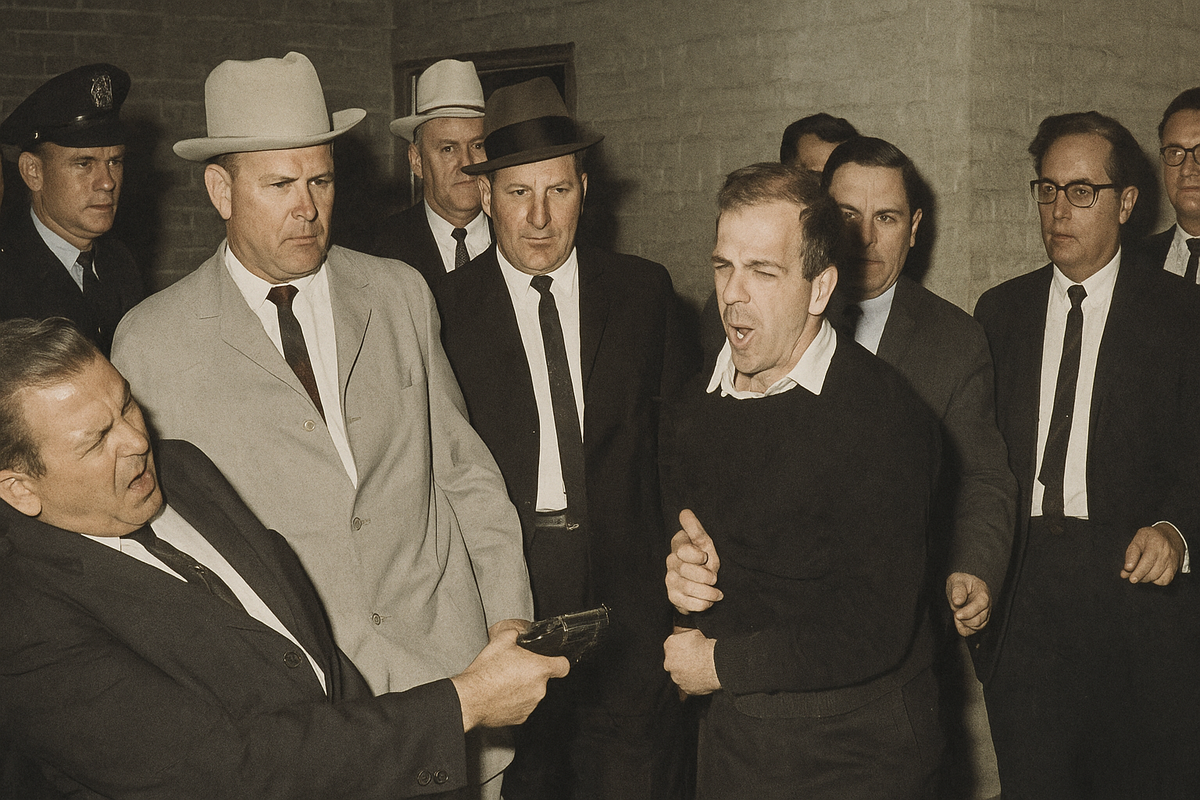
November 24, 1963. A basement corridor in Dallas. Flashbulbs pop. And then, in front of rolling cameras, a pudgy nightclub owner lunges forward and fires a single shot into Lee Harvey Oswald's abdomen, killing the only man who could answer for President Kennedy's assassination.
Four years later, Americans opening their May 1967 Esquire found that moment frozen in an unexpected medium: a full-color comic strip drawn by Jack Kirby, the architect of Marvel's universe, his trademark dynamism now applied to national tragedy. Paired with incisive reportage by Garry Wills and Ovid Demaris, "You All Know Me! I'm Jack Ruby" did something no major magazine had attempted—it turned a wound still raw in the American psyche into sequential art.
It was audacious. It was controversial. And it remains one of the most daring editorial experiments in American magazine history.
Archive Details
Historical Figure: Jack Ruby (Jacob Leon Rubenstein)
Issue Date: May 1967
Publication: Esquire Magazine
Authors: Garry Wills & Ovid Demaris
Illustrator: Jack Kirby
Archive Source: Original Magazines Collection
The Moment and the Man
By 1967, the Warren Commission's tidy narrative had already fractured. Vietnam was unraveling. Cities were burning. And Jack Ruby—that footnote who became a headline—represented everything unresolved about November 22, 1963. His televised execution of Oswald hadn't brought closure. It had detonated questions.
Was Ruby a grief-stricken patriot or a mob errand boy? A publicity hound or a pawn in something larger? The man who shouted "You all know me!" as he pulled the trigger had ensured that no one would ever truly know him—or what he'd silenced forever.
Esquire understood that Ruby wasn't just a killer. He was a mirror reflecting American paranoia, spectacle, and the uncomfortable marriage of violence and celebrity. The magazine's decision to revisit those 46 hours between Kennedy's death and Oswald's murder tapped directly into a nation's unhealed trauma.
When Journalism Met the King of Comics
The text itself—authored by Wills, who would later win the Pulitzer Prize, and crime writer Demaris—painted Ruby in unflinching detail: a hustler obsessed with status, fiercely loyal to Dallas, perpetually on the margins despite his connections to cops and reporters. He ran the Carousel Club, a second-tier joint featuring strippers and neon, and spent those final hours in a documented frenzy—calling friends, watching television coverage, moving through the city like a man possessed.
But Wills and Demaris alone wouldn't have made history.
Jack Kirby did that.
Kirby—the man who gave the world Captain America, the Fantastic Four, and the visual grammar of modern superhero comics—brought his explosive visual style to bear on documentary reality. His panels captured Ruby's movements almost minute by minute: the pacing, the phone calls, the moment of the shooting rendered with the same kinetic force he'd used for cosmic battles. Kirby's thick ink lines and dramatic angles transformed reportage into something visceral, immediate, unsettling.
This was not illustration. This was translation—history filtered through the visual language of pop culture, raising uncomfortable questions about how Americans consumed tragedy. In 1967, the juxtaposition was shocking. Today, it reads as prophecy.
Esquire at the Height of Its Powers
Under editor Harold Hayes, Esquire had evolved beyond lifestyle monthly into cultural laboratory. This was the magazine publishing Gay Talese, Tom Wolfe, and Norman Mailer—the nerve center of New Journalism, where reportage borrowed fiction's tools and high art collided with popular culture.
The Ruby feature embodied this fearless hybridity. One spread featured traditional black-and-white text and police mugshots. Turn the page: Kirby's full-color panels exploded across the layout. The design itself argued that understanding America required embracing its contradictions—the serious and the spectacular, the literary and the lowbrow, the documented and the imagined.
Esquire wasn't just covering Jack Ruby. It was demonstrating how fractured national memory had become, how spectacle had colonized even our darkest moments. The magazine that set trends in men's fashion was also mapping the psychology of a country that had watched its president murdered and his accused killer executed on live television within 48 hours.
What the Feature Reveals
Why Mid-Century Magazines Endure
These publications weren't designed to last, yet they've become archives of how Americans thought, argued, dressed, and processed their reality. Unlike the ephemeral scroll of digital media, they remain physical evidence—artifacts you can hold, smell, study.
Each issue captures not just events but atmosphere: the weight of certain concerns, the temperature of cultural debates, the visual language of persuasion and style. They show us what mattered before history decided what should have mattered.
The May 1967 Esquire matters because it shows a magazine willing to treat tragedy as both serious history and cultural spectacle—to acknowledge that by 1967, those categories had become inseparable.
Why Collectors Covet This Issue
Holding this issue means possessing a moment when American journalism took a risk—when a prestigious magazine decided that understanding national trauma required breaking every convention.
Explore the Archive
For those seeking this issue or others from Esquire's groundbreaking era, the hunt itself becomes part of the experience. From the 1930s through the 1970s, Esquire documented American masculinity, politics, and culture with unmatched sophistication and daring.
Whether you're building a Kennedy collection, studying New Journalism's evolution, or simply drawn to moments when American media took genuine risks, the May 1967 issue represents something increasingly rare: journalism that trusted its audience to handle complexity, contradiction, and the uncomfortable fusion of art and tragedy.
Browse Esquire Magazine CollectionThe Artifact Endures
"You All Know Me! I'm Jack Ruby" remains a high-water mark of American magazine journalism—a moment when sharp reportage, comic-book dynamism, and cultural analysis converged to examine a wound the nation hadn't yet healed.
It was journalism as art, history as spectacle, tragedy as pop culture. It was exactly the kind of experiment that could only happen in 1967, at a magazine bold enough to believe that understanding America meant breaking the rules about how stories should be told.
For anyone who values the intersection of media, history, and cultural risk-taking, this issue isn't just reading material. It's evidence of what American journalism once dared to be.