
The Double Life: When Jackie Robinson Played Himself in Hollywood While Opening the 1950 Season
How Life Magazine captured baseball's greatest pioneer juggling fame, family, and the fight for equality—all in a single issue
May 8, 1950. Americans unfolded their weekly Life Magazine expecting the usual—war updates, fashion spreads, perhaps another Truman profile. Instead, they found Jackie Robinson living two lives simultaneously.
Not metaphorically. Literally.
Robinson was opening the baseball season at Ebbets Field while starring in a Hollywood film about his own barrier-breaking career. He spent mornings sliding into home plate for the Dodgers, afternoons recreating those same slides for movie cameras. The feature, "Jackie Robinson's Double Play," captured something unprecedented: a man famous enough to portray himself, living fast enough to need a stunt double for his own life.
This wasn't celebrity puff piece journalism. This was Life Magazine documenting the exact moment when American sports, cinema, and civil rights collided on one man's shoulders.
Archive Details
Historical Figure: Jackie Robinson
Issue Date: May 8, 1950
Archive Source: Life Magazine
Feature Title: "Jackie Robinson's Double Play"
Cultural Context: Early Civil Rights Era, Post-War America
The Weight of 1950
Three years earlier, Robinson had detonated Major League Baseball's color line. By 1950, he'd already claimed Rookie of the Year, pushed the Dodgers to a pennant, and forced white America to watch a Black man dominate their national pastime every single day.
But Life's editors understood something deeper. Robinson wasn't just an athlete—he was a stress test for American democracy itself.
The timing mattered. World War II's rhetoric about freedom had faded into the reality of Jim Crow laws still governing half the country. Segregation remained legal. Lynchings still occurred. Yet here was Jackie Robinson, not only competing in a white sport but trusted by Hollywood to play himself in a major motion picture—The Jackie Robinson Story—an honor even white stars rarely received.
Life Magazine didn't bury this irony. They amplified it through image and caption, turning Robinson into both a triumph and a question: If this man can star in his own movie, why can't he eat at the same lunch counter as his teammates?
Photojournalism as Time Machine
Life Magazine's genius wasn't writing. It was showing.
The May 8 issue deployed its photographers like battlefield correspondents, capturing Robinson across four dimensions:
The Warrior: Robinson jawing at umpires, his face twisted in competitive fury. Stealing bases with a violence that made white players nervous. Life's captions noted his calculated restraint—how he channeled rage into performance, avoiding the "incidents" that would give segregationists ammunition.
The Actor: On set with director Al Green, Robinson recreated the racist taunts he'd endured just three years earlier. The cameras captured his discomfort during a romantic scene with Ruby Dee—particularly when his wife Rae appeared on set. Life's wry observation: the only moment Robinson looked truly nervous all week.
The Father: Jackie Jr. and baby Sharon on his lap. The magazine revealed the man behind the icon: exhausted, pulled in ten directions, trying to be present for his children while the nation dissected his every move.
The Son: Robinson returning to Pasadena with Jackie Jr., standing in Brookside Park where he once chased foul balls as a kid. Old friends dealing cards around a kitchen table. Life understood that Robinson's story wasn't bootstrap mythology—it was about community, persistence, and the distance between a California playground and a Brooklyn diamond.
For 1950 readers, these weren't just photographs. They were proof that Robinson existed beyond statistics and headlines. He was real. He was home. He was theirs.
The Magazine Life Didn't Feature on Its Cover
Life's May 8, 1950 cover featured something else entirely—typical for a magazine juggling world affairs, Hollywood glamour, and political crises. But flip inside, and the Robinson feature dominated with the force of a lead story.
Every caption carried narrative weight:
"Taunting the umpire at Ebbets Field…" captured a man who'd earned the right to fight back.
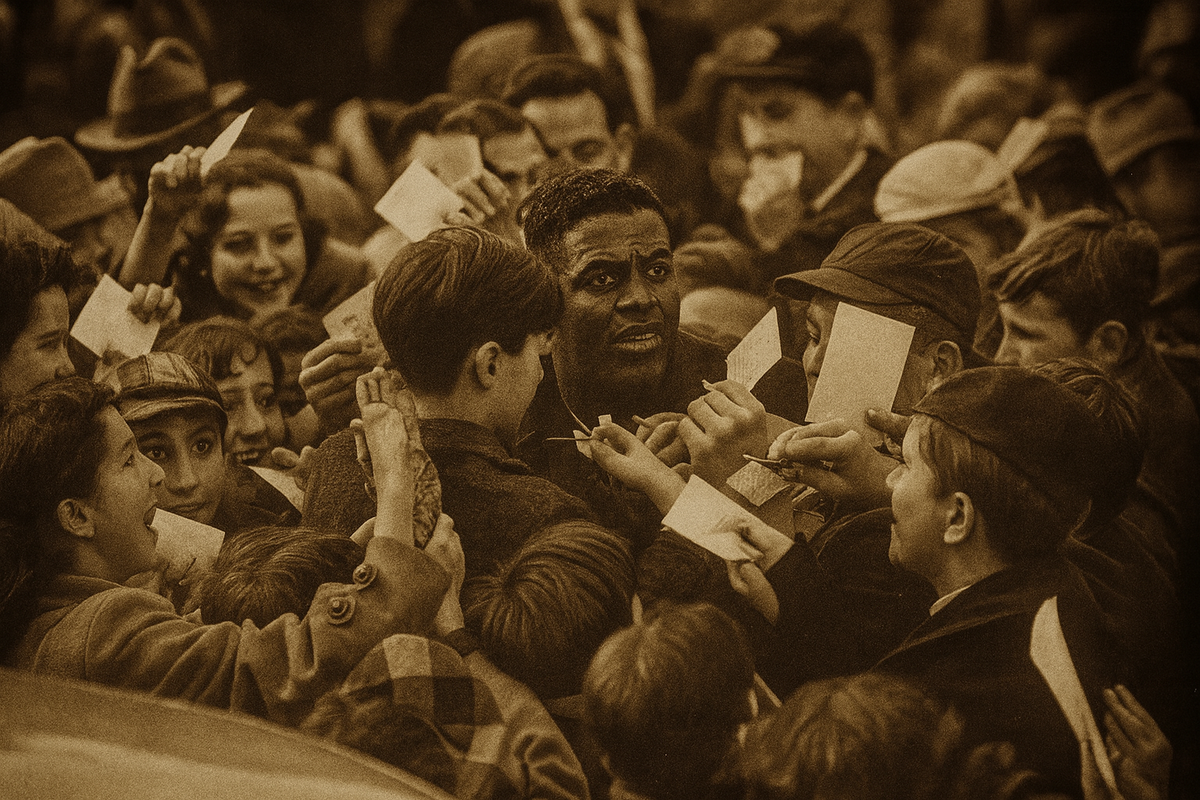
"The hard life of a baseball star: there is desperation in his smile as he faces mob of autograph hunters…" showed fame as burden.
"Two children, Jackie Jr. and baby Sharon, keep Jackie busy at home." reminded America that pioneers still change diapers.
This was Life's signature move: athletic glory and domestic intimacy in the same frame. No other publication in 1950 could make you feel the electricity of a stolen base and the quiet of a father's evening in a single spread.
Five Moments That Define the Feature
The Autograph Swarm
Robinson surrounded by reaching hands at Ebbets Field, his smile containing equal parts gratitude and exhaustion. Fame as both validation and cage.
Hollywood's Mirror
Cameras rolling as Robinson re-enacts the racial abuse he endured, forcing white directors and crew to witness—and profit from—America's ugliness.
Father and Son in Frame
Intimate shots with Jackie Jr. and Sharon, humanizing a figure the press often treated as symbol rather than man.
Pasadena Pilgrimage
Robinson walking his son through childhood landscapes, closing the circle between who he was and who he became.
The Split Screen Life
A man toggling between baseball star, movie actor, husband, father, and racial pioneer—all before lunch.
Each photograph reinforced a paradox: Robinson was simultaneously ordinary (a dad playing with his kids) and exceptional (the man rewriting America's social contract through athletic excellence).
What Life Magazine Understood
Seventy-five years later, the Robinson feature endures because Life's editors grasped what digital media still struggles to achieve: presence.
They didn't report on Robinson. They embedded with him. Readers didn't learn about his double play season—they experienced it, frame by frame, caption by caption.
Life Magazine made readers feel the dirt under Robinson's cleats, the hot lights of the movie set, the weight of his son in his arms. The magazine transformed journalism into immersion.
In our current era of disposable content and algorithmic feeds, the permanence of printed Life feels almost radical. These pages can't be deleted, updated, or memory-holed. What was photographed in 1950 remains photographed. What was written stays written.
Turning these pages now is temporal displacement—a direct line to the morning Americans woke up and found Jackie Robinson's life spread across their breakfast tables.
Why Collectors Hunt This Issue
Historic Convergence
This issue captures Robinson at the intersection of three American institutions: baseball, Hollywood, and the nascent civil rights movement. It predates Rosa Parks by five years, the Montgomery Bus Boycott by six, MLK's emergence by nearly a decade. This is early-stage history, unresolved and urgent.
The Film Moment
The Jackie Robinson Story released that same month, making this issue promotional material and historical record simultaneously. Robinson played himself—a Hollywood rarity that underscored both his celebrity and the industry's inability to imagine anyone else in the role.
Visual Completeness
Few single publications captured Robinson so thoroughly. From Ebbets Field to a movie set to his childhood streets, Life assembled a biographical panorama that biographers still reference.
Cultural Time Capsule
The advertisements alone—cigarettes, automobiles, household appliances—reconstruct post-war American consumer life. The typography, the paper stock, even the smell of aged newsprint transports readers to an America trying to reconcile its wartime ideals with its segregated reality.
Market Demand
Robinson material commands premium prices among collectors of sports history, civil rights artifacts, and mid-century photojournalism. This issue checks all three categories.
Primary Source Value
Owning this magazine means possessing the original delivery system of Robinson's story—how millions of Americans first saw him beyond box scores.
For Collectors and Historians
Life Magazine documented American history from the 1930s through the 1970s—wars, elections, cultural upheavals, technological revolutions. Each issue is a time capsule. Each photograph, a recovered memory.
Browse Life Magazine CollectionThe Artifact and the Man
The May 8, 1950 Life Magazine remains essential not because it deified Jackie Robinson, but because it showed him in full dimension—spectacular and exhausted, pioneering and human.
By documenting his "double play"—simultaneously performing for the Dodgers and Hollywood—Life captured a man stretched across impossible demands. The photographs reveal what press releases couldn't: joy, frustration, pride, weariness, determination.
For collectors, this issue transcends memorabilia. It's a primary source—evidence of how Robinson's story was told while it was still unfolding, before history smoothed the sharp edges.
When you hold this magazine, you hold the moment when Jackie Robinson wasn't yet a bronze statue or a retired number. He was a 31-year-old man trying to open a baseball season, film a movie, raise his children, and reshape American society—all at once.
The desperation in his smile, captured by Life's cameras, was real.
So was everything he changed.