
A Widow's Warning: When Ladies' Home Journal Published the Most Dangerous Essay of 1968
Myrlie Evers transformed grief into testimony—and a women's magazine became witness to America's reckoning with racial violence
In July 1968, between a feature on summer salads and a fashion spread showcasing mod hemlines, Ladies' Home Journal detonated a moral reckoning across American breakfast tables.
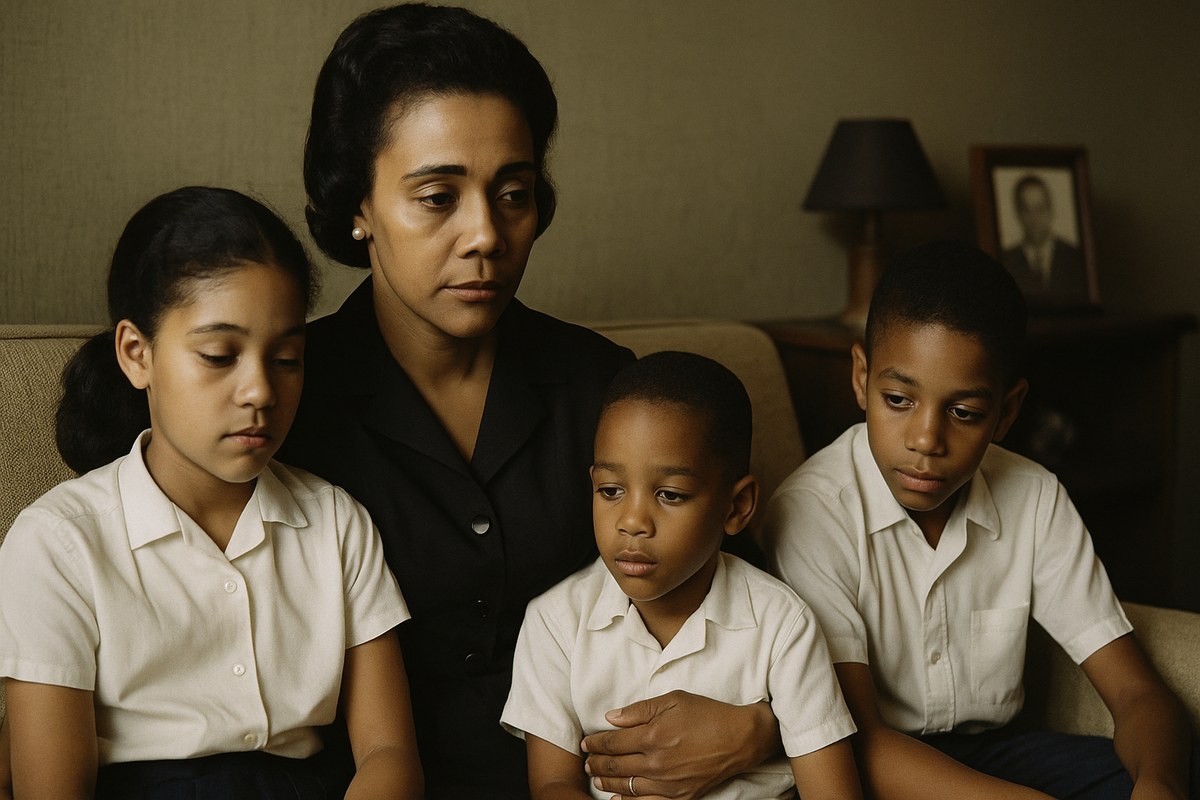
The magazine's largely white, middle-class readership—women who clipped recipes and debated wallpaper patterns—opened their mailboxes to find Myrlie Evers staring back at them. Not smiling. Not soft-focused. Just present, flanked by her three children, in a stark black-and-white photograph that refused to be decorative.
The essay she'd written, "What Do You Know About Violence?", didn't ask permission to exist alongside the homemaking advice. It demanded an answer.
Archive Details
Historical Figure: Myrlie Evers (widow of civil rights leader Medgar Evers)
Issue Date: July 1968
Essay Title: "What Do You Know About Violence?"
Context: Published three months after Dr. Martin Luther King Jr.'s assassination
Archive Source: Ladies' Home Journal, mainstream women's magazine circulation
The Summer America Came Undone
Nineteen sixty-eight didn't whisper. It screamed.
By the time this issue went to press, Dr. Martin Luther King Jr. had been murdered on a Memphis balcony. Senator Robert F. Kennedy had been shot in a Los Angeles hotel kitchen. Cities from Newark to Detroit still bore the scorch marks of uprisings that white America called "riots" and Black America called "predictable." The Vietnam War churned on, and college campuses were exploding in protest.
Into this cauldron walked Myrlie Evers—five years past the night she'd cradled her husband Medgar's bleeding body in their driveway after a white supremacist's bullet found him. Five years past becoming the kind of widow America preferred to forget.
But she wasn't interested in being forgotten.
Her children had returned from summer camp in New England with questions that wouldn't wait for a better time. They'd seen the news footage. They'd heard the word "riots" used like a curse. And they'd asked her directly: "Why don't Negroes rise up and rebel?"
The essay that followed was her answer—not just to her children, but to a nation willfully ignorant of its own violence.
The Magazine That Dared to Be More
Ladies' Home Journal in 1968 occupied a peculiar space in American culture. On its surface, it was exactly what its covers promised: elegant women in pearls, recipes tested in spotless kitchens, marriage advice dispensed with maternal confidence. It was aspirational domesticity, packaged monthly for $1.
But editor John Mack Carter understood something crucial: the women reading his magazine weren't living in a vacuum sealed against history. They were raising children who watched cities burn on television. They were married to men who came home from work talking about "those people" with fear in their voices. They were navigating a world where the old certainties—about race, about war, about their own roles—were collapsing in real time.
So Carter made a choice. He gave Myrlie Evers the platform.
The result was a magazine issue that functioned as cultural whiplash. A reader could move from an article on bedroom décor to Evers' searing analysis of racial violence, then flip to a feature on children's summer activities. This wasn't editorial confusion—it was intentional disruption. It said: Your life contains all of this. Your kitchen and your conscience. Your family and your country's failures.
The stark photograph accompanying the essay reinforced this. No soft lighting. No attempt to make grief palatable. Just Myrlie Evers with her children—Darrell, Reena, and James—looking directly at the camera. The caption identified her as "widow of Medgar Evers, NAACP field secretary in Mississippi, murdered in 1963."
Not "tragically killed." Not "passed away." Murdered.
What the Essay Revealed
Evers built her argument from bedrock: violence in America didn't begin with Watts or Detroit. It began with slave ships and auction blocks, with lynching trees and Jim Crow laws, with the daily accumulated brutality of being Black in a nation that claimed to believe in freedom.
Her children wanted to know why Black Americans didn't fight back. Her answer was that they had been fighting back—for centuries—and that white America's sudden panic over "riots" was obscene given the violence it had always inflicted and tolerated.
She wrote about Medgar's commitment to nonviolence, even as he kept a rifle by their bedside. Not because he wanted to be violent, but because he understood that a Black man defending his family in Mississippi had already exhausted every other option. She wrote about the 1965 Watts uprising, about how the National Advisory Commission on Civil Disorders had found that the "typical rioter" wasn't some criminal stereotype but a young, employed adult who'd simply run out of patience with empty promises.
She wrote about holding her husband as he died.
And then she turned the mirror outward. White Americans, she argued, had convinced themselves they were the victims of violence—afraid of Black anger, terrified of change. But they'd built the entire system that made that anger inevitable. They'd written the laws, enforced the segregation, nodded along with the murders, and now clutched their pearls when the bill came due.
Her closing plea was both prophecy and warning: unless America confronted racial injustice with honesty instead of fear, violence would continue. Not because Black Americans wanted it, but because oppression always produces resistance.
The Essay's Core Themes
Children's Questions
Mrs. Evers frames the essay around the candid, difficult questions her children asked about riots and uprisings after returning from camp.
Medgar's View
Though committed to nonviolence, Medgar Evers kept a rifle at the bedside, prepared to defend his family in a state defined by white supremacist terror.
The Watts Riots
She cites the 1965 Los Angeles unrest as a moment that showed how deeply systemic racism shaped urban America.
The "Typical Rioter" Myth
She references the National Advisory Commission on Civil Disorders, which found rioters were often young, working adults—not "criminals" or "thugs."
Cycles of Oppression
Evers linked contemporary riots directly to slavery, Jim Crow, and ongoing white violence—violence that predated and provoked Black resistance.
Personal Loss
She vividly recalls the night Medgar was killed and her grief in holding him in her arms—transforming personal mourning into national testimony.
White Fear vs. Black Reality
She critiques white Americans' fear of Black uprisings while ignoring centuries of oppression inflicted on Black communities.
Moral Appeal
She closes with a plea that unless America faces racial injustice honestly, violence will continue—not from desire, but from desperation.
Why This Issue Matters Now
Historical Timing
Published just three months after King's assassination, this issue captures the raw, unmediated national conversation about race and violence. There's no retrospective softening here, no historical distance to dull the edges. This is 1968 speaking directly.
Editorial Courage
Few magazines with Ladies' Home Journal's circulation and demographic reach would have published an essay this unflinching. The decision to give Myrlie Evers that space—and to let her words stand without apology or editorial hedging—marked a watershed in women's publishing.
Cultural Artifact
The jarring juxtaposition of content makes this issue uniquely powerful. The recipes and fashion spreads aren't flaws in the historical record—they're part of the point. They show exactly what American women were being asked to hold simultaneously: the kitchen timer and the national crisis.
Collector Demand
Issues that document civil rights history through primary voices—especially voices of women, especially in unexpected venues—command serious attention from museums, university collections, and private collectors preserving cultural heritage.
Hold History in Your Hands
If you want to read Myrlie Evers' words in their original context—surrounded by the advertisements and features and everyday domestic content that made her essay so radical—you can.
These aren't reprints or digital facsimiles. They're the actual magazines that arrived in mailboxes, that sat on coffee tables, that sparked conversations in living rooms across America. Holding one means holding the exact pages where history refused to stay quiet—where a widow transformed grief into testimony, and a women's magazine became a witness to its time.
Browse Ladies' Home Journal Magazine Collection