
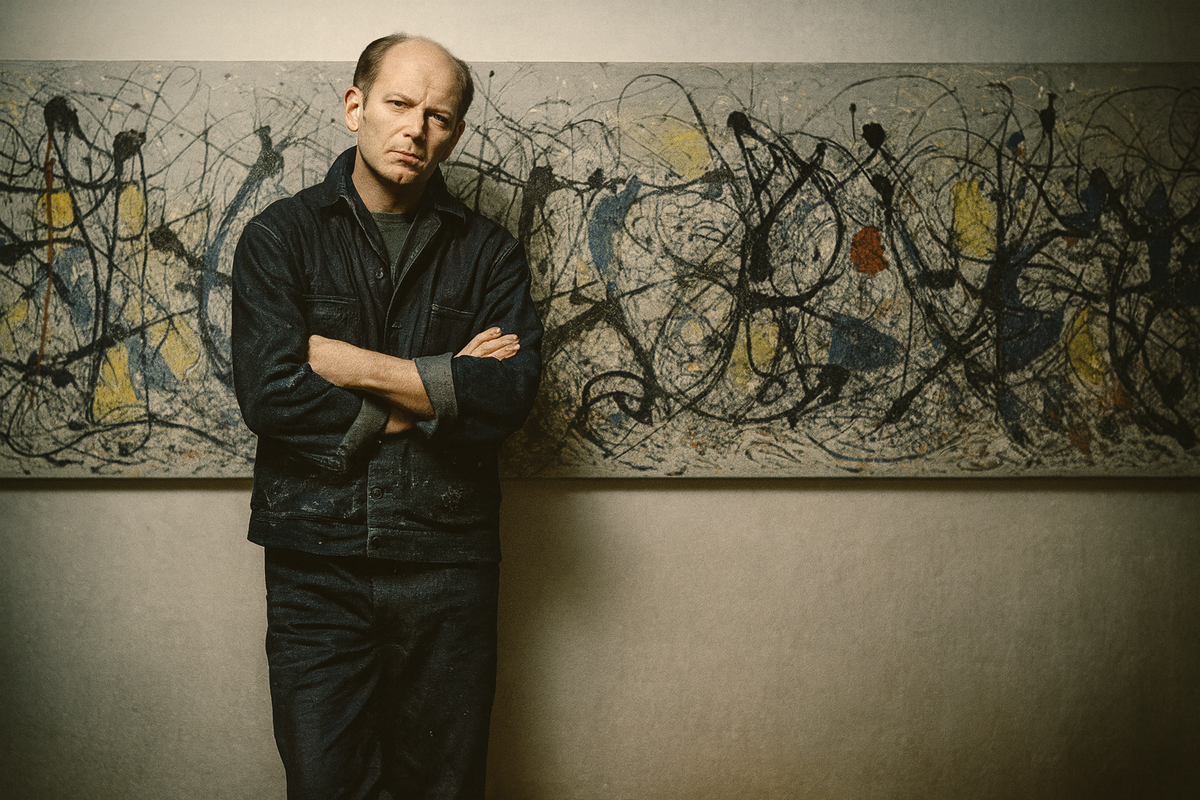
Jackson Pollock, Life Magazine, and the Day America Stopped Asking Europe's Permission
How a single magazine feature in 1949 transformed an obscure painter into a cultural phenomenon—and declared New York the new center of the art world
On August 8, 1949, a question landed on kitchen tables across America.
Not whispered in gallery corners or debated in faculty lounges, but printed in Life Magazine—the publication that had shown the nation Pearl Harbor, D-Day, and victory. Now, spread across its pages in stark black-and-white photography, came a different kind of confrontation: "Jackson Pollock: Is he the greatest living painter in the United States?"
For millions of readers, this wasn't an art review. It was a test.
The canvases looked like accidents. The painter worked on the floor, not at an easel. He used house paint, not oils. He didn't name his work; he numbered it like invoices. And yet here was Life—the arbiter of American normalcy—demanding that its audience reckon with this barn-studio maverick from Long Island as the face of a new artistic order.
What happened in those pages changed more than Pollock's career. It marked the moment American culture stopped deferring to Europe and started exporting its own vision of what art could be.
Archive Details
Historical Figure: Jackson Pollock (1912–1956)
Publication: Life Magazine
Issue Date: August 8, 1949
Feature Title: "Jackson Pollock: Is he the greatest living painter in the United States?"
Archive Source: Original Life Magazine Collection
The Postwar Gambit: New York Against Paris
Four years after V-J Day, the United States had won the war but not yet the peace—at least not culturally. Paris still owned the twentieth century's imagination. Picasso, Matisse, and the École de Paris cast long shadows. American painters, no matter how skilled, worked in a borrowed light.
But by 1949, the equation was shifting. Europe lay in reconstruction. New York hummed with energy, money, and a generation of artists who had rejected Old World rules entirely. Abstract Expressionism—raw, psychological, physically aggressive—was their answer to centuries of European refinement.
Jackson Pollock became the movement's unlikely ambassador. His "drip paintings," created by pouring and flinging enamel across canvases laid flat in his barn studio, embodied something the moment demanded: freedom without precedent. Critics divided sharply. Some saw revelatory genius. Others saw a con.
Life Magazine, with its unmatched reach into American homes, turned that division into a national referendum.
How Life Told the Story: Spectacle as Argument
Life's editors understood something fundamental: photography could democratize the inaccessible. Where words about Abstract Expressionism might alienate, images could seduce, provoke, challenge.
The Pollock feature delivered both spectacle and evidence. Photographs showed him crouched over massive canvases, cigarette dangling, paint arcing from a can in his hand. The compositions were dynamic, almost cinematic—art as performance, captured mid-gesture. Other shots presented the finished works: chaotic tangles of black, white, yellow, and blue stretching across canvases too large for conventional walls.
The captions did not soften the strangeness:
"Pollock drools enamel paint on canvas."
"Number Nine" stretches 18 feet long and sells for $1,800—or $100 a foot."
"Number Seventeen" was painted in several sessions so Pollock could 'get acquainted with the picture.'
These were not explanations. They were provocations. Life wasn't asking readers to admire Pollock. It was asking them to decide whether this was art at all.
For most Americans, this was their first encounter with modern abstraction. They would never visit a Manhattan gallery, never debate formalism over cocktails at the Cedar Tavern. But through Life, they became witnesses—and, implicitly, jurors.
The Artist in His Own Words: Pollock Unplugged
What made the feature devastating was its directness. Pollock's own statements, printed alongside the photographs, carried a blunt clarity that defied intellectual evasion:
"My painting does not come from the easel."
"When I am in my painting, I'm not aware of what I'm doing."
"The painting must retain a life of its own."
No manifesto. No theory. Just a man describing his process as if it were obvious—because to him, it was.
This refusal to justify or intellectualize was itself a kind of rebellion. European modernism had always come with philosophy, with movements and declarations. Pollock offered only action and result. The paintings either worked or they didn't. The reader either felt something or they didn't.
Life framed this as democratic access: here is the artist, here is the work, here is the question. No curator stands between you and judgment.
It was a gamble that paid off in cultural immortality.
Five Elements That Made History
The August 8, 1949 issue succeeded because it gave readers both controversy and fact. These are the details that mattered:
Pollock abandoned brushes and easels. He poured, dripped, and splattered paint onto canvases on the floor, often mixing in sticks, trowels, and sand for texture. Life showed this method in action, making the unfamiliar feel visceral rather than alien.
His pieces dominated space. Number Nine, 18 feet long, commanded an entire barn wall. At $1,800—or $100 per foot—these were statements, not decorations. The pricing detail alone told readers this was serious commerce, not bohemian indulgence.
Pollock numbered his paintings rather than titling them, removing narrative crutches. Viewers had to confront the work without preconception, without the safety of interpretation handed down from above.
Life didn't resolve the question its headline posed. Some critics hailed Pollock as the most important painter of his generation. Others dismissed him as a novelty. By amplifying the conflict, Life made the article urgent rather than declarative.
The images of Pollock—brooding, paint-splattered, cigarette in hand—created an archetype that would define the American artist for decades: uncompromising, physical, indifferent to approval. He looked like what postwar America wanted its culture heroes to be.
Together, these elements turned a magazine feature into one of the most influential pieces of art journalism ever published.
The Permanence of Print in an Ephemeral Age
What makes these issues endure is their materiality. They are not reporting; they are records.
Every photograph, every caption in the August 8, 1949 issue captures the texture of a specific historical moment—the skepticism, the curiosity, the anxiety about whether America could produce culture worthy of its new geopolitical dominance. In an era when digital images vanish in seconds, these printed pages offer weight, presence, the permanence of ink on paper.
That physicality is what collectors understand. These magazines are not just stories. They are witnesses.
Why Collectors Pursue This Issue
This was the inflection point. Before this issue, Pollock was a figure known to insiders. After, he was a cultural phenomenon.
The article didn't simply report on a shift in the art world—it accelerated that shift. By forcing a mainstream audience to engage with Abstract Expressionism, Life helped legitimize the movement.
The images of Pollock at work remain among the most recognized artist portraits in history. They defined how the public would visualize modern art's creation.
Issues tied to pivotal cultural debates—Pearl Harbor, the Moon Landing, and yes, this Pollock feature—consistently rank among the most sought-after by serious collectors.
Owning this issue means possessing a physical artifact of the moment America stopped importing its artistic identity and began exporting it. It is not memorabilia. It is evidence.
Explore the Archive
Thousands of original Life magazines—from the 1930s through the 1970s—are available for collectors, historians, and enthusiasts who want to trace decades of art, politics, science, and cultural transformation as they unfolded in real time.
Browse Life Magazine CollectionThe Question That Endures
More than seventy years later, the August 8, 1949 issue of Life Magazine remains a landmark. By asking if Jackson Pollock was the greatest living American painter, Life didn't merely document a debate—it ignited one that would reshape the cultural landscape.
Its photographs, its framing, and its presentation of Pollock's radical process remain touchstones in the history of art journalism. For collectors, holding this issue means holding the precise moment America claimed its place at the center of modern art.
The question Life posed has never fully been answered. Was Pollock a genius or a provocation? An innovator or an accident?
Perhaps the answer doesn't matter. What matters is that this magazine ensured his work—and the controversy it sparked—would never be forgotten.