
The Blueprint for Being a Wife
Inside the 1968 Bridal Shower That Defined a Generation
Open the May 1968 issue of Ladies' Home Journal, and you'll find something more dangerous than any manifesto: a shopping list.
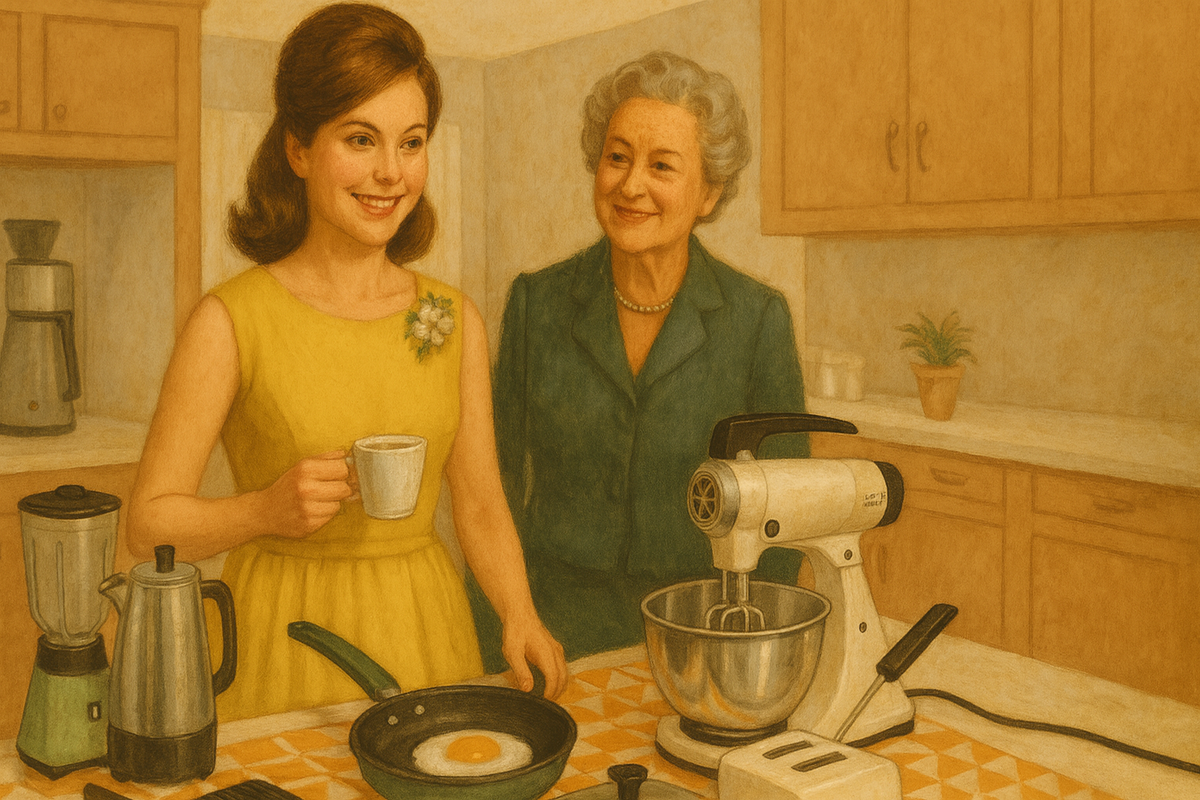
Sixteen appliances. Sixteen brand names. Sixteen carefully photographed objects arranged like altarpieces on patterned cloth. This wasn't just a bridal shower guide—it was a contract. "Bridal Shower Gifts for the New Cook" told young American women exactly what marriage required: a KitchenAid stand mixer, a Presto electric heater, a Hamilton Beach knife that pivoted for precision slicing, and the certainty that domestic perfection could be purchased, plugged in, and served on Teflon.
The timing makes it breathtaking. May 1968. The same spring that students occupied Columbia University. The same month Robert Kennedy was campaigning and Martin Luther King Jr.'s assassination was still raw in the national memory. While the country burned and rebuilt and questioned everything, Ladies' Home Journal was selling readers on avocado green blenders and the promise that a well-equipped kitchen was the foundation of a successful marriage.
This issue isn't just collectible. It's a historical pressure point—the moment when postwar domesticity collided with second-wave feminism, and the magazine held its ground.
Archive Details
Publication: Ladies' Home Journal
Issue Date: May 1968
Feature: "Bridal Shower Gifts for the New Cook"
Historical Context: Published during the height of second-wave feminism and cultural upheaval in America
The Electric Gospel of Modern Marriage
By 1968, kitchen appliances had crossed from luxury into obligation. The postwar economic boom had already wired millions of American homes with mixers, blenders, and percolators, but Ladies' Home Journal made clear these were no longer conveniences. They were qualifications.
The magazine's bridal shower spread reads like a checklist for admission into married life. Each item carried an implicit promise: with the right tools, you can be the right wife. The Ronson ice crusher wasn't just for drinks—it was "for gala occasions," positioning the bride as hostess, entertainer, architect of social life. The electric casserole freed women from "pot-watching," as if constant vigilance over a stovetop were the natural state of womanhood. The Teflon-lined skillet promised "easy cooking and time-saving," because a bride's time, the magazine suggested, was a resource to be managed, optimized, and ultimately spent in service of the household.
This wasn't subtle. The message encoded in every product description was that marriage in 1968 required infrastructure. A woman entered matrimony not just with love or commitment, but with an eight-speed blender and a Black Angus broiler that doubled as a rotisserie and timer-controlled oven.
The Sixteen Commandments
The spread cataloged its gospel with precision:
- Presto electric heater for soup, coffee, or tea
- Black Angus broiler, rotisserie, and timer-controlled oven
- Ronson ice crusher for gala occasions
- KitchenAid coffee maker promising fresher brews
- Eight-speed blenders in avocado green and other period finishes
- Teflon-lined skillet for easy cooking and time-saving
- KitchenAid stand mixer with dough hooks and ice cream freezer attachments
- Combination grill and waffle iron for versatile entertaining
- Teflon electric skillet designed for buffet-style cooking
- Automatic electric platter to keep hors d'oeuvres warm
- Electric casseroles that freed women from pot-watching
- Electric can opener for convenience
- Teflon tabletop grill for stylish serving
- Hamilton Beach electric knife with pivoting action for precision slicing
- Sunbeam toaster designed for slimness and efficiency
- 12-speed portable mixer by Iona, marketed as versatile and modern
Each item was branded, priced by implication, and photographed with the reverence typically reserved for fine jewelry. The layout transformed consumer goods into aspirational objects—not just what you needed, but who you were expected to become.
The emphasis on brand names reveals how deeply consumerism had infiltrated women's domestic identity. Owning a KitchenAid mixer wasn't just about baking—it signaled modernity, competence, readiness. The chrome finishes and avocado colorways weren't incidental. They were the design language of progress, the aesthetic proof that a household was keeping pace with the times.
The Magazine That Shaped Millions
Ladies' Home Journal wasn't simply reporting on American domestic life in 1968—it was constructing it. With a circulation reaching millions of households monthly, the magazine functioned as both mirror and blueprint. Its pages blended advice columns on marriage, serialized fiction, health and beauty features, and practical guides like this bridal spread, each reinforcing a singular vision: the competent, attractive, efficient American wife.
The advertisements surrounding the bridal shower feature deepened the message. Femicin menstrual pain relief ads reminded women of their physical burdens. Antiperspirant ads policed their bodies. Ritz cleaning cloth ads positioned household maintenance as their domain. The magazine didn't just sell products—it sold a complete identity, one in which women balanced beauty, health, household perfection, and the emotional labor of entertaining, all while making it look effortless.
For readers in 1968, this wasn't entertainment. It was instruction.
The Feminist Fault Line
Here's what makes this issue so historically charged: it arrived at the exact moment American women were beginning to reject the script it was selling.
Betty Friedan had published The Feminine Mystique five years earlier, naming the "problem that has no name"—the suffocating dissatisfaction of educated women trapped in domestic roles. By 1968, second-wave feminism was gaining momentum. Women were entering the workforce in growing numbers. Activists were questioning not just workplace discrimination but the entire structure of marriage, housework, and the expectation that a woman's identity should center on her kitchen.
And yet, in the pages of Ladies' Home Journal, the traditional bargain held firm. The bridal shower spread didn't acknowledge the feminist critique—it simply presented an alternative: modernity through consumption. You could be a liberated, efficient, stylish wife if you owned the right appliances. The magazine attempted to reconcile tradition with progress by rebranding domesticity as consumer choice.
This tension makes the issue invaluable. It captures a culture in transition, a moment when old norms were cracking but hadn't yet shattered. The magazine's refusal to bend reflects just how entrenched those norms were—and how much resistance the feminist movement would face in dismantling them.
Why Collectors Want This Issue
As Material Culture
The appliances listed—KitchenAid mixers, Sunbeam toasters, Teflon skillets—are now collector's items themselves, sought after by mid-century design enthusiasts. The avocado greens, chrome finishes, and Teflon revolution define an aesthetic era.
As Gender Studies Artifact
This issue is required reading for anyone studying women's history, consumer culture, or the American family. It documents how magazines reinforced traditional gender roles even as those roles were being challenged nationwide.
As Bridal History
The ritualized preparation of a bride through shower gifts, the social expectation that women would arrive at marriage fully equipped, the brands deemed acceptable—all of it is preserved here in original form.
As Design Document
The typography, photography, and layout reflect late 1960s editorial design at its peak. The way products were arranged, lit, and described offers insight into how consumer desire was manufactured.
Owning this issue means holding an original artifact from one of the most consequential years in American history. It's not just nostalgic—it's forensic evidence of how a culture tried to manage change by repackaging tradition.
Explore More of Women's History in Print
If this glimpse into 1968 bridal culture and American domesticity resonates, the archive runs deep.
Browse Ladies' Home Journal Magazine CollectionThese vintage issues contain decades of women's lives—fashion, literature, health advice, cultural commentary—preserved exactly as millions of readers encountered them. They're not reproductions or summaries. They're the primary sources, the original blueprints for how American families, homes, and gender roles evolved throughout the 20th century.
Whether you're a collector building a material culture archive, a design enthusiast drawn to mid-century aesthetics, or a researcher tracing the feminist movement's cultural opposition, these magazines are irreplaceable.
The Artifact Endures
The May 1968 Ladies' Home Journal remains one of the sharpest windows into American life at the end of the 1960s. Its "Bridal Shower Gifts for the New Cook" spread captures a moment of profound contradiction—a culture simultaneously embracing and resisting change, selling liberation through the very appliances that symbolized constraint.
Holding this issue today, you're not looking at a relic. You're holding evidence of a negotiation that's still happening: what marriage demands, what women owe, what modernity costs. That's what makes it powerful, collectible, and urgently relevant—even 56 years later.