
Japan Slams the Open Door
The Life Magazine Issue That Warned America War Was Coming
On January 2, 1939, American families opened their mailboxes to find a magazine that would change how they saw the world.
The cover of Life showed Elinor McIntyre modeling a fashionable wimple—light, domestic, safe. But inside, spread across nearly a dozen pages, was something far more unsettling: a visual chronicle of American power in Asia collapsing in real time. The feature was titled "Japan Slams the Open Door and the U.S. Begins to Fight," and it did something few publications had dared to do so bluntly—it told Americans that war was no longer a distant possibility. It was already here.
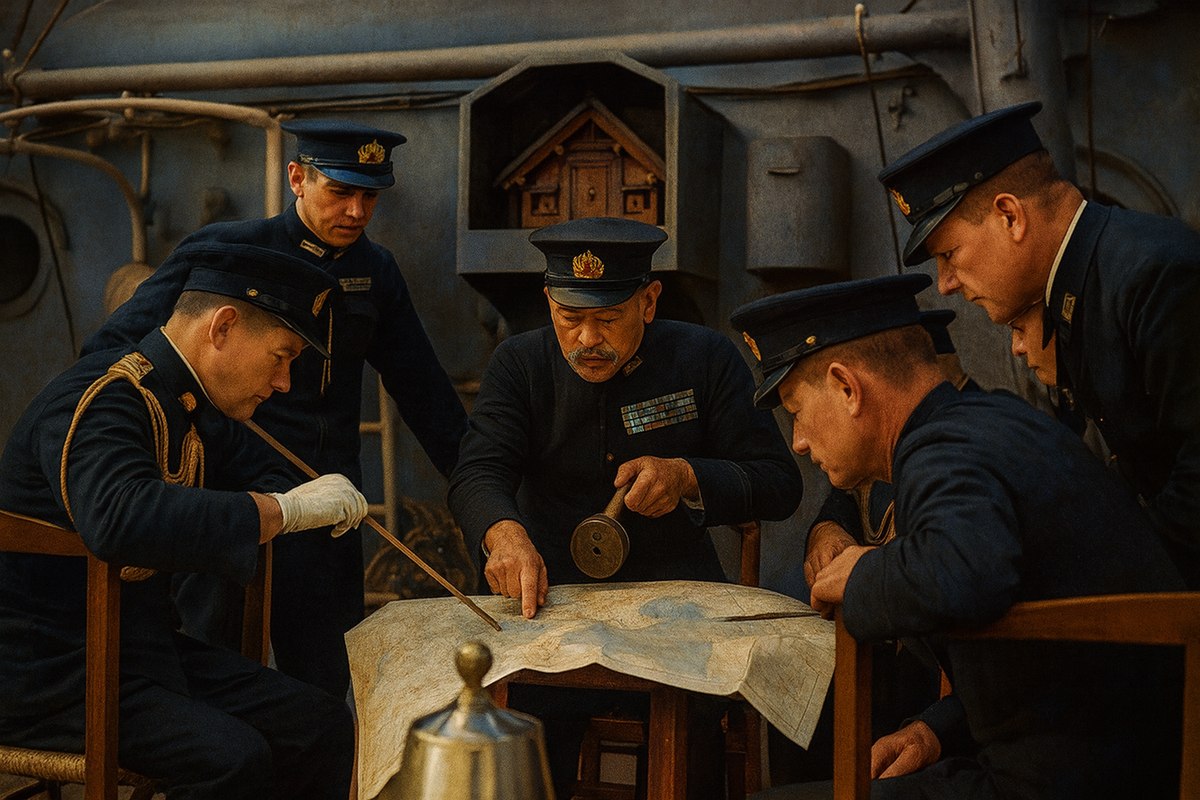
Less than three years before Pearl Harbor, Life used the full force of photojournalism to document the death of a policy that had shaped U.S. foreign relations for forty years. Readers saw Japanese generals standing over maps of conquered China. They saw the wreckage of the USS Panay, an American gunboat bombed by Japanese aircraft. They saw Texaco stations operating under occupation in Shanghai, American oil companies doing business in a city now controlled by Tokyo.
This was not diplomacy. This was a warning shot—captured on film, printed on glossy paper, and delivered to living rooms across the country.
Archive Details
Publication: Life Magazine
Issue Date: January 2, 1939
Feature Title: "Japan Slams the Open Door and the U.S. Begins to Fight"
Cover Subject: Elinor McIntyre (Fashion Feature)
Historical Context: Published 1,079 days before Pearl Harbor
The Policy Japan Destroyed
The Open Door Policy, articulated by Secretary of State John Hay in 1899, was built on a simple idea: all nations would have equal access to trade in China, and China's sovereignty would be respected. It was never a treaty. It was never enforceable. But for decades, it functioned as the diplomatic fiction that kept Western powers from carving China into colonial fiefdoms.
By late 1938, that fiction was dead.
Japan's armies had seized Nanking, Shanghai, and Hankow. Japanese Foreign Minister Hachirō Arita stood before the world and declared that "the ideas and principles of the past" no longer applied. The Open Door was closed. Western powers—including the United States—would no longer enjoy guaranteed access to Chinese markets or waters.
Life understood what this meant. It wasn't just about trade routes or diplomatic protocols. It was about the collapse of an American-led order in Asia, one that had been built painstakingly over a century—from Caleb Cushing's first treaty with China in 1844, to Commodore Matthew Perry forcing open Japan's ports in 1853, to the missionaries, banks, and oil companies that followed.
Now, the very nation America had opened at gunpoint was slamming the door on everyone else.
The Power of the Visual Record
What made the January 2, 1939 issue so devastating was not just what it reported—it was how it reported.
Life was the premier photojournalism magazine of its era, and its editors knew that images carried authority no editorial could match. This feature was a masterclass in visual storytelling. It moved fluidly between historical engravings and contemporary war photography, between 19th-century diplomacy and 20th-century bloodshed.
Readers saw Commodore Perry's "Black Ships" arriving in Tokyo Bay in 1853. They saw American statesmen like John Hay, whose policy had just been declared obsolete. They saw General Shunroku Hata and Vice Admiral Koshiro Oikawa—Japanese military leaders now controlling Central China and the Yangtze River, waters once patrolled by Western gunboats.
And they saw the USS Panay, half-submerged in the Yangtze after Japanese planes attacked it in December 1937. Two Americans were killed. The Japanese government apologized. But the message was clear: U.S. forces were no longer safe in China. Neutrality was no longer an option.
For families reading Life in their living rooms, these were not abstract geopolitical arguments. They were photographs—documentary evidence that the world was splitting apart, and America's place in it was no longer guaranteed.
The Anatomy of a Warning
The feature worked because it layered history and immediacy into a single narrative. It wasn't just reporting what Japan had done—it was showing Americans how much they stood to lose.
A century of influence was cataloged in images: treaty signings, missionary schools, Western investments in Chinese infrastructure. These weren't colonial conquests in the European mold, but they represented deep American ties to China—commercial, religious, educational.
Then came the military reality. Japanese generals studied maps. Japanese fleets held the rivers. American businesses—Texaco, Socony—operated under occupation, their signs still visible in Shanghai but their autonomy gone.
The irony was unavoidable. Japan, forced open by American gunboats in 1853, was now the power shutting others out. The Open Door had been kicked off its hinges by the very nation that once had no choice but to walk through it.
And beneath it all was the human cost. While the article focused on policy and power, the photographs hinted at what lay beyond the frame: Chinese cities in ruins, refugees fleeing Japanese advances, the machinery of war grinding forward.
Life did not need to say the words "inevitable conflict." The images said it louder.
What the Feature Revealed
Why This Issue Matters to Collectors
Historical Precision
Published less than three years before Pearl Harbor, it captures U.S.–Japanese relations at the breaking point. This is not retrospective analysis. This is contemporary reporting from the edge of war.
Photojournalistic Excellence
The feature bridges a century of history—from Perry's arrival in Japan to modern Japanese warlords—using archival images and on-the-ground war photography. It is visual storytelling at its finest.
Cultural Juxtaposition
The lighthearted cover on fashion trends paired with a hard-hitting geopolitical exposé is quintessential Life—a reminder that even in 1939, Americans were living in two worlds at once.
Rarity and Significance
Prewar issues that foreshadow World War II are among the most sought-after by collectors, historians, and families preserving their own history. This issue captures the psychological moment when a nation realized it could no longer avoid taking sides.
Owning this issue means holding a piece of journalism that was, in every sense, a warning. Americans in 1939 turned these pages and saw their future. We turn them today and see how clearly that future was already visible.
The Permanence of Print
In an era when news flashes across screens and vanishes, these printed pages remind us that history was once consumed slowly, studied carefully, and preserved deliberately. Life magazines were not disposable. They were saved, stacked, passed down.
For collectors, that permanence is what makes them irreplaceable. These are not reprints or digitized archives. They are original documents—ink on paper, printed in 1939, untouched by revision or reinterpretation. They are witnesses to history.
Explore the Collection
If you're interested in this issue—or thousands of others spanning decades of world history—we invite you to browse our full collection of original Life magazines.
Browse Life Magazine CollectionWhether you're a seasoned collector, a student of history, or someone honoring family who lived through the era, these magazines offer something unique: the ability to experience history as it was first reported, before hindsight rewrote the story.
Holding History Itself
The January 2, 1939 issue of Life stands as one of the most significant prewar publications of the 20th century. It brought home to Americans the reality that their interests in Asia were under direct attack—and that neutrality was becoming impossible.
Through photography and narrative, Life traced both the century-long arc of U.S.–China relations and the dangerous present of 1939. For modern readers and collectors, it remains a powerful reminder of how quickly policies collapse, how nations rise to challenge the established order, and how photojournalism can make distant conflicts immediate.
To hold this issue is to hold the last moment before America understood it was already at war.