
The Morning Women Stopped Apologizing
Vogue, September 1972, and the Quiet Revolution in Fashion
She crossed Lexington Avenue in the rain with her sleeves rolled up.
No umbrella perfectly angled for the photographer. No stilettos tip-tapping on wet pavement in some fantasy of feminine fragility. Just a woman in a brown poplin rain suit, moving through New York like she owned the sidewalk. The caption in Vogue's September 1, 1972 issue didn't poeticize it. It simply stated: "Real rainwear."
That bluntness—that refusal to apologize for practicality—was revolutionary.
When readers opened this issue fifty-three years ago, they weren't just flipping through autumn fashion. They were witnessing the visual codification of a cultural rupture. The trench coat as boardroom armor. The pantsuit as professional legitimacy. Knitwear layered not for decorative effect, but because a woman might actually move through her day. Vogue wasn't reporting on fashion in September 1972. It was documenting the moment American women stopped dressing for the male gaze and started dressing for their own ambitions.
Archive Details
Publication: Vogue Magazine
Issue Date: September 1, 1972
Editor-in-Chief: Grace Mirabella
Historical Context: Title IX passed June 1972; Ms. magazine launched as standalone publication; ERA advancing toward ratification
Featured Designers: Anne Klein, Pierre Cardin, Nina Ricci, Georges Rech, Ben Kahn
The World Outside the Magazine
Context matters. The Equal Rights Amendment was racing toward ratification. Title IX had just passed in June, guaranteeing women equal access in education. Ms. magazine launched its first standalone issue that summer. Gloria Steinem was on television. The Vietnam War still raged, but the protests had shifted the national conversation about authority, gender, and who got to hold power.
Fashion, that supposedly frivolous art form, registered these seismic shifts faster than most institutions. By 1972, the pantsuit wasn't a radical statement—it was Tuesday morning. The question Vogue posed wasn't whether women would wear trousers to work, but how they'd wear them with enough elegance to render the whole debate obsolete.
The answer: monochrome. Texture. Confidence.
What Vogue Actually Showed
The editorial spreads read like a manifesto disguised as a lookbook.
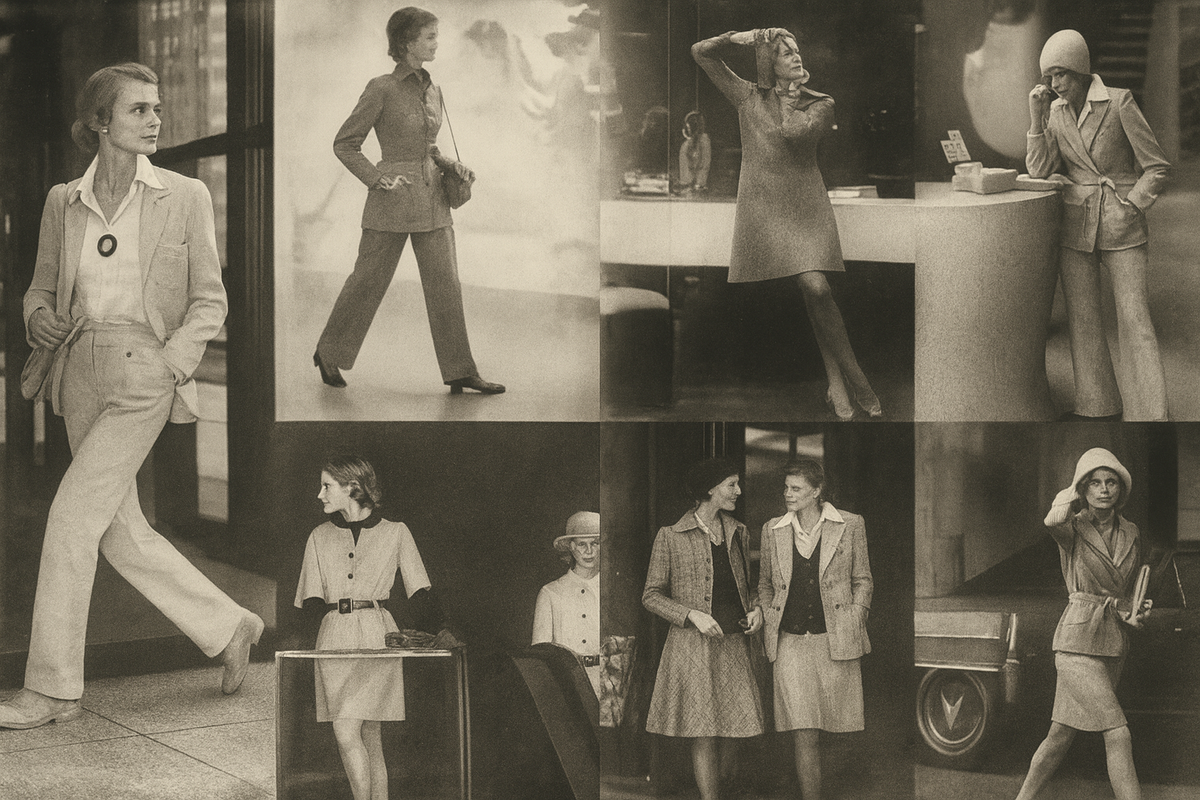
"Easy, racy, all of a tone—the essence of fashion for day." That headline alone contained multitudes. "Easy" rejected the corseted past. "Racy" acknowledged sexuality without submission to it. "All of a tone"—the monochrome palette of camel, beige, chocolate brown—signaled minimalist sophistication, a knowing restraint that whispered power rather than shouting it.
The photography abandoned fantasy for documentation. Models didn't pose; they moved. One woman shopped in a cloche hat, her sleeves casually rolled to reveal knitwear beneath—the headline read "Rolled-up sleeves…and something knitty underneath." That rolled sleeve wasn't styling. It was semiotics. It meant: I work. I'm busy. I'm capable.
Another spread featured Anne Klein's blouson jacket suits—soft, unstructured jackets paired with skirts in a deliberate rejection of the rigid tailoring that had masculinized early pantsuit adopters. Klein understood something critical: women didn't need to dress like men to claim professional space. They needed clothes that moved like they did.
The poplin rain suit appeared repeatedly. Not fashion rainwear—real rainwear, as Vogue insisted. Trench coats cut for actual weather. Umbrellas that functioned. Gloves. Scarves. Handbags sized for documents, not decoration. Every accessory served double duty: style and utility, beauty and function.
The palette told its own story. Earthy tones replaced the psychedelic fever dream of the late '60s. Camel, tobacco, cream, charcoal—colors that photographed as seriously as they felt. Textures mattered: suede, angora, ribbed knits, flannel, poplin. Clothes you could feel through the page.
The Editorial Voice as Cultural Force
Vogue's power in 1972 lay not in dictating trends but in legitimizing them. When the magazine ran spreads on monochrome pantsuits and blouson jackets, it wasn't suggesting women should wear these things. It was declaring they already were—and doing so with authority, elegance, and zero apology.
The editorial voice—playful yet commanding—never preached. It observed. It celebrated. Headlines like "the ease of a suit with a blouson jacket" made professional dressing sound not just acceptable but enviable. This was fashion as soft power: Vogue positioned itself as ally to women's expanding ambitions without ever mentioning feminism directly.
The designers featured—Anne Klein, Pierre Cardin, Nina Ricci, Georges Rech, Ben Kahn—were captured at inflection points in their careers, creating clothes that would define the decade. These weren't advertisements. They were historical records of who was shaping the visual language of female power.
Why This Issue Endures
Original copies of Vogue from September 1972 function as primary source documents. Fashion historians mine them for evidence of design evolution. Cultural scholars analyze them for gender politics encoded in hemlines and shoulder seams. Collectors prize them because they're beautiful, yes—but also because they're proof.
Proof that style is never frivolous. Proof that a magazine spread can be as historically significant as legislation. Proof that the quiet revolution of women rolling up their sleeves and crossing rain-slicked streets in practical coats was, in its way, as transformative as any protest march.
The Collector's Case
New York Collections Coverage
Featuring designers like Anne Klein, Pierre Cardin, Nina Ricci, Georges Rech, and Ben Kahn at pivotal moments in their careers.
Iconic Photography
Editorial spreads that show real fashion in urban life—rainwear, knits, and blouson suits—capture a unique 1970s aesthetic.
Cultural Significance
This issue reflects women's changing roles in society, aligning fashion with empowerment and practicality during a transformative era.
Material Authenticity
Every mention of poplin, ribbed knits, and angora layers documents the tactile reality of 1970s fashion in ways digital archives cannot replicate.
Primary Source Value
These aren't reproductions or summaries—they're original artifacts from the moment American culture rewrote the rules.
Increasing Rarity
As original issues from the early 1970s become harder to find in good condition, their collectible value continues to rise.
Search terms like "Vogue magazine September 1972" or "collectible Vogue magazines 1970s" don't just indicate fashion interest. They signal a hunger for cultural context, for the original documents that explain how we got from there to here. This issue delivers that context with every spread, every caption, every unapologetic assertion that practical could be powerful.
Experience the Archive
If you want to understand the 1970s—not through retrospective analysis but through the original documents that shaped the decade—explore our full collection of original Vogue magazines.
Each issue is a primary source. Each one captures not just fashion but the cultural assumptions, the visual language, the unstated rules of its moment. From the 1930s through the 1990s, every decade of Vogue archives the evolution of style as social history.
Browse Vogue Magazine CollectionThe Legacy in Your Hands
The September 1, 1972 Vogue stands as evidence that fashion magazines can be historical records as significant as any newspaper archive. Its coverage of the New York Collections—those trench coats, blouson jackets, monochrome pantsuits, and rolled-up sleeves—documented American women claiming new territory in culture, work, and self-conception.
The issue's photography rejected fantasy for reality. Its editorial voice celebrated competence as chic. Its designers created uniforms for ambition.
Today, this magazine remains what it was in 1972: proof that style is never separate from the cultural forces that shape it. For anyone who understands that fashion history is social history, this issue offers something rare—the original artifact, preserved, undiluted, exactly as women encountered it the morning they stopped apologizing for taking up space in the world.