
When The New Yorker Rode the Rails Through Enemy Territory
How a Halloween 1942 issue gave American readers their first glimpse inside wartime Japan—not through propaganda, but through failing trains and mistranslated advertising
On Halloween 1942, while American Marines were dying in the jungles of Guadalcanal, New Yorker readers opened their mailboxes to find something unsettling: a firsthand account of life inside the enemy's capital, written not as propaganda but as anthropology.
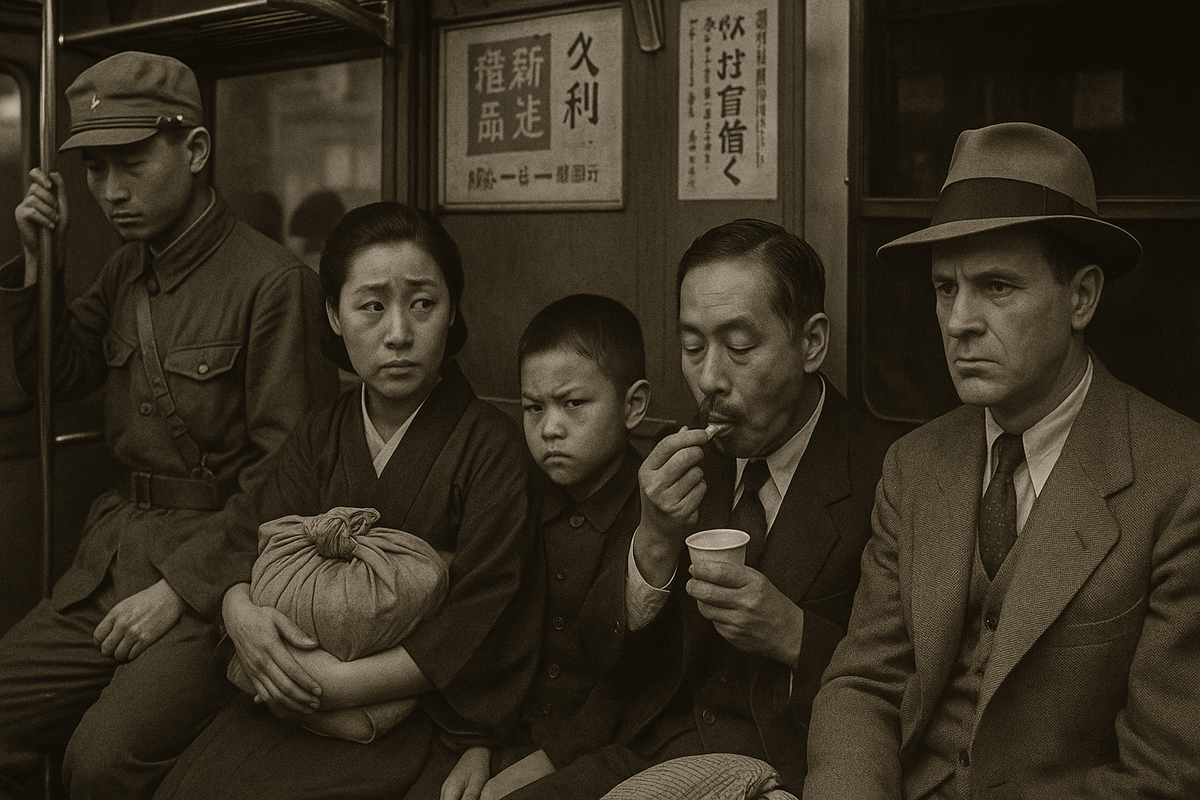
"The Improbable Empire: The Sendai-Tokio Express" was cultural reconnaissance disguised as travel writing—a portrait of wartime Japan rendered not through government briefings or newsreel hyperbole, but through the cramped compartments of its failing railway system. It arrived at a moment when Americans knew Japan primarily as a military abstraction. Here, suddenly, was the empire's mundane chaos: trains that never ran on time, bizarre advertising slogans mistranslated from English, passengers hauling bundles of refuse alongside their lunch.
The piece did something radical for 1942: it made the enemy human without making them sympathetic. And in doing so, it gave American readers their first sustained look at the fragility lurking beneath Japan's military facade.
Archive Intelligence
Publication: The New Yorker
Issue Date: October 31, 1942
Featured Article: "The Improbable Empire: The Sendai-Tokio Express"
Historical Context: Published during the Guadalcanal Campaign, ten months after Pearl Harbor
Cover Art: Halloween witch in mid-flight (iconic wartime seasonal illustration)
The War That Changed Everything
Ten months before this issue reached newsstands, Japanese aircraft had transformed Pearl Harbor into a graveyard. By October 1942, the empire controlled territory stretching from Burma to the Philippines—a conquest unmatched in speed and scope since the Mongol invasions.
But the arithmetic of war was already turning. Midway had cost Japan four irreplaceable aircraft carriers in June. As this New Yorker hit the stands, American forces were locked in the first major ground offensive against Japanese expansion: Guadalcanal, where the jungle consumed men at a rate that made headlines abstract and casualties incomprehensible. Simultaneously, Soviet forces were bleeding at Stalingrad while the British prepared to break Rommel at El Alamein.
Against this backdrop of industrial-scale violence, The New Yorker made an editorial choice that defined its wartime identity: rather than recycle War Department dispatches, it would show readers what the enemy looked like when he wasn't shooting.
What The New Yorker Saw (And What It Meant)
"The Sendai-Tokio Express" stripped away the mythology. Japan's vaunted organizational efficiency? A fiction maintained by Western observers who'd never waited on a Japanese platform. The article documented a transportation system in perpetual crisis—derailments, delays, overcrowding so severe that the notion of a schedule became a dark joke.
The advertising slogans scattered throughout train stations revealed something deeper: a society attempting to graft Western consumer culture onto a militarized empire. "Never say magnificent until you have seen the shrines at Nikko" wasn't just awkward English—it was the vestige of a tourist economy that had evaporated overnight, leaving only the ghost of commercial normalcy.
Passengers carried refuse alongside food. Soldiers performed ritual bows mid-commute. Children glared at strangers with eyes trained by propaganda to see enemies everywhere. And through it all, the trains lurched forward through a landscape the article described as wrapped in "an atmosphere of negation"—a national psychology shaped by war, natural disaster, and authoritarian compression.
The genius of the piece lay in its refusal to editorialize. It simply observed. The contradictions spoke for themselves: an empire powerful enough to threaten American security, yet incapable of running trains on schedule. A culture obsessed with ritual precision, surrounded by literal garbage. The title—"The Improbable Empire"—captured the paradox perfectly.
For readers conditioned to view Japan through the lens of Yellow Peril stereotypes or military threat assessments, this was cognitive whiplash. The enemy was neither subhuman nor superhuman. He was deeply, recognizably human—and that made the empire's fragility visible in ways no battle report could achieve.
The Magazine That Refused to Panic
The October 31, 1942 cover announced its editorial philosophy before readers turned a single page: a witch in mid-flight across a Halloween sky, bats circling, the whole scene rendered with the magazine's signature combination of whimsy and technical precision.
In the middle of history's bloodiest war, The New Yorker published a Halloween cover. Not a propaganda poster. Not a war bond advertisement. A witch on a broomstick.
This was editorial defiance of the highest order—an assertion that culture, humor, and seasonal tradition would survive fascism, no matter how long the casualty lists grew. Inside, the magazine maintained that balance ruthlessly: war commentary alongside poetry, battle analysis next to cartoons, serious reportage wrapped in the magazine's characteristic urbanity.
The New Yorker had built its reputation on this fusion since its 1925 founding—a publication that treated its readers as intelligent adults capable of holding multiple ideas simultaneously. By 1942, that editorial vision had become a form of psychological resistance. When the government wanted citizens terrified or enraged, The New Yorker offered them complexity. When propaganda demanded simplification, it provided nuance.
"The Sendai-Tokio Express" embodied this approach. It was journalism, cultural criticism, and literature simultaneously—a genre-defying piece that educated readers while entertaining them, that critiqued an enemy empire while acknowledging its humanity.
This is why the magazine became required reading for the generation that fought World War II: it refused to insult their intelligence, even when terror would have been easier to sell.
Inside "The Improbable Empire"
Cultural Mistranslation
Bizarre advertising slogans like "Never say magnificent until you have seen Nikko" revealed a society awkwardly grafting Western consumer culture onto wartime empire—the ghost of tourism haunting military reality.
Railway Chaos
Constant delays, derailments, and overcrowding exposed the fiction of Japanese organizational efficiency. The article documented a transportation system in perpetual crisis beneath the veneer of military precision.
Atmosphere of Negation
The piece captured a national psychology shaped by war, disaster, and authoritarian control—a pervasive gloom that contradicted propaganda images of martial triumph and unity.
Human Contradictions
Small moments—soldiers bowing ritually, children glaring with patriotic fervor, passengers eating ice cream amid chaos—revealed an enemy that was neither superhuman nor subhuman, but deeply, vulnerably human.
The Bigger Picture
The New Yorker's wartime issues endure for the same reason Life Magazine's combat photography remains essential: they didn't just record history, they interpreted it in real time. They gave readers frameworks for understanding events too large and terrible to comprehend through headlines alone.
In 1942, Americans were terrified, exhausted, and hungry for information that treated them as adults rather than children requiring propaganda. The New Yorker delivered that—not by minimizing the war's horror, but by refusing to reduce the enemy to caricature or the conflict to simple morality tales.
That editorial courage is why these issues remain valuable eight decades later. They capture not just what happened, but how it felt to live through it without knowing how it would end.
Why This Issue Matters to Collectors
Historical Rarity
Published during the narrow window when Japan seemed invincible but Midway had revealed the first cracks, this issue captures a unique psychological moment—American confidence beginning to return, but uncertainty still dominant.
Cover Art Value
Wartime Halloween covers from the 1940s represent some of the magazine's most sought-after illustrations. The witch-in-flight design has become iconic precisely because it demonstrates The New Yorker's refusal to let war consume all cultural space.
Primary Source Credibility
"The Improbable Empire" functions as an anthropological document. For scholars studying American perceptions of Japan, wartime journalism, or cultural propaganda, this article is irreplaceable. It's not filtered through decades of academic interpretation—it's the raw contemporary observation.
Literary Genealogy
This issue sits in the lineage that would eventually produce John Hersey's "Hiroshima" (1946) and the magazine's defining tradition of immersive war reportage. Collectors tracking The New Yorker's evolution as a journalistic institution need this piece.
These aren't magazines you read and recycle. They're artifacts—primary evidence of how a generation understood the world while it was still burning.
Finding Your Own Piece of 1942
Original New Yorker magazines from the 1940s remain accessible to collectors willing to seek them out. Our collection spans the magazine's complete cultural evolution—from the Jazz Age through the war years and beyond—allowing you to trace how American literary culture responded to its most consequential century.
Whether you're building a research archive, honoring family members who lived through these years, or simply drawn to the intersection of history and literature, these magazines offer something digital archives cannot: the material presence of the past.
Browse The New Yorker Magazines CollectionA Final Note
The October 31, 1942 New Yorker stands as proof that great journalism doesn't age—it accrues meaning. "The Improbable Empire: The Sendai-Tokio Express" gave 1942 readers a window into enemy territory. Today, it gives us a window into how Americans made sense of an enemy they feared but barely understood.
Hold this issue in your hands and you're holding more than paper and ink. You're holding the moment when cultural journalism demonstrated it could accomplish what government propaganda never could: make the enemy visible as human beings, which somehow made victory seem both more necessary and more achievable.
That's the power of primary sources. The past doesn't speak through textbooks. It speaks through the magazines people actually read while history was still happening.