
When America Questioned Whether Black Colleges Should Exist—And Ebony Magazine Answered
The July 1961 feature that defended HBCUs at their most vulnerable moment
The summer of 1961 asked a question that should have been unthinkable: Were Black colleges obsolete?
Desegregation was spreading. White universities were cracking open their doors. And across editorial boards, foundation offices, and even some Black communities, a dangerous whisper gained traction: Maybe historically Black colleges had served their purpose. Maybe it was time to let them fade.
The July 1961 issue of Ebony Magazine refused that premise entirely.
Its feature, "The Future of Private Negro Colleges," wasn't a eulogy. It was a defiant brief for survival—a richly reported, unflinching examination of whether the institutions that had trained Thurgood Marshall, Martin Luther King Jr., and countless teachers, preachers, and organizers could withstand the very desegregation they had fought to achieve. For readers who opened that issue, the stakes were existential. These weren't abstractions. They were alma maters. Pipelines to the middle class. Sanctuaries in a hostile nation.
And Ebony understood what mainstream publications did not: the fight to integrate America and the fight to preserve Black institutions were not contradictory. They were inseparable.
The Crossroads of 1961
The timing was no accident. When this issue reached newsstands, Freedom Riders were being beaten in Montgomery. Student sit-ins had metastasized from Greensboro across the South. The Civil Rights Movement had entered its most volatile, visible phase—and Washington was watching.
But while the nation fixated on lunch counters and bus terminals, Ebony turned its lens to a quieter battlefield: the campus. Since the Civil War, schools like Howard, Hampton, Spelman, and Tuskegee had functioned as the intellectual engine of Black America. They weren't just colleges. They were survival mechanisms—institutions that existed because white schools had barred the door.
Now, court-ordered desegregation was forcing an uncomfortable reckoning. If white universities had to admit Black students, did Negro colleges still matter? Or had history rendered them redundant?
The article didn't flinch from the question. It answered with data, interviews, and something rarer: moral clarity.
Historical Context
Publication: Ebony Magazine, July 1961
Feature Title: "The Future of Private Negro Colleges"
Key Figures: Dr. Benjamin Mays (Morehouse), Dr. Frederick D. Patterson (Tuskegee), Dr. Samuel Proctor, Dr. James Nabrit (Howard), Dr. Jerome Holland (Hampton Institute)
Historical Moment: Published during the Freedom Rides, amid intense national debate over desegregation and the future of historically Black institutions
Ebony as Archive and Advocate
By 1961, Ebony had become the most influential Black publication in America—part Life, part Look, but entirely its own. It blended hard reporting with aspirational imagery, civil rights coverage with celebrity profiles, creating a visual and editorial grammar that refused to separate Black struggle from Black joy.
The Negro colleges feature embodied that philosophy. Its pages were dense with evidence:
Interviews with giants—Dr. Benjamin Mays of Morehouse, Dr. Frederick D. Patterson of Tuskegee, Dr. Samuel Proctor, Dr. James Nabrit of Howard. These weren't token voices. They were the architects of Black educational infrastructure, speaking on the record about funding crises, integration pressures, and institutional survival.
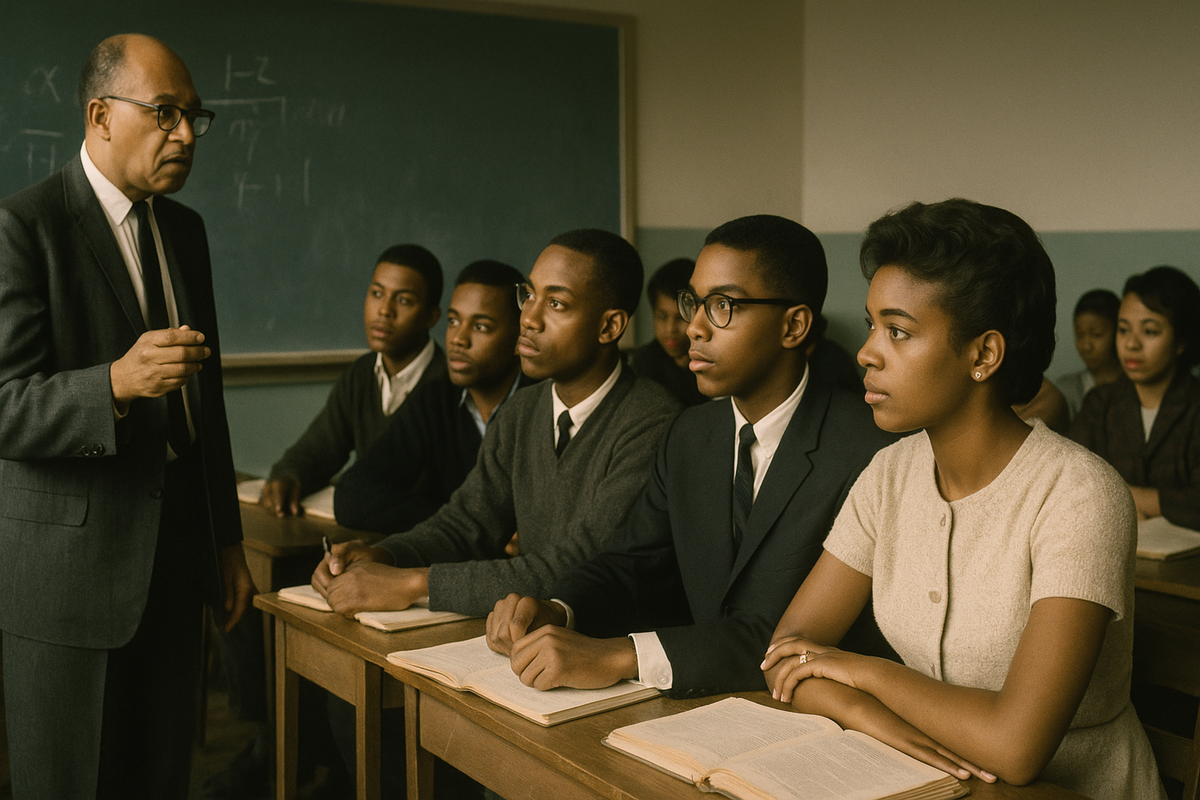
Documentary photography that mainstream outlets ignored—integrated classrooms at Lincoln University and Howard, Dr. Jerome Holland's presidential inauguration at Hampton Institute, ROTC cadets in formation, Homecoming crowds, philanthropic ceremonies. Every image reinforced a single argument: these campuses were alive, evolving, indispensable.
Hard financial realities—rising tuition, shrinking endowments, the fragile dependence on Rockefeller Foundation grants and alumni donations. The article didn't romanticize. It showed the ledger.
What emerged was not sentiment. It was testimony.
The Cover's Quiet Provocation
The issue's cover featured Billy Eckstine—smooth, glamorous, surrounded by his family in a tableau of Black middle-class achievement. No protest signs. No courtroom drama. Just success.
That juxtaposition was deliberate. While the interior feature grappled with institutional survival, the cover radiated arrival. This was Ebony's genius: the refusal to choose between dignity and defiance. The magazine understood that Black Americans didn't need to be only struggling or only succeeding. They were both, simultaneously, and the culture deserved documentation in full.
The Eckstine cover was aspiration. The HBCU feature was infrastructure. Together, they formed a complete editorial argument about what Black life required to thrive.
The Case for Survival
The article structured its defense across five interlocking arguments:
The Leadership Pipeline Was Irreplaceable
Without Negro colleges, there would be no Martin Luther King Jr., no Thurgood Marshall, no Walter White leading the NAACP. These institutions didn't just educate. They forged the minds dismantling Jim Crow.
The Financial Crisis Was Real
Tuition was rising. Donations were inconsistent. Many schools were one bad year from closure. The article didn't sugarcoat: survival required consolidation, better fundraising, and honest conversations about which institutions could sustain quality.
Integration Cuts Both Ways
Schools in border states were already enrolling white students. The question wasn't whether HBCUs would integrate—it was whether they could do so without losing their mission. Could a historically Black college remain Black in purpose while opening its doors?
Quality Over Quantity
Dr. Frederick D. Patterson warned that too many underfunded schools risked becoming diploma mills. Better to strengthen a smaller number of excellent institutions than spread resources too thin. It was a hard truth, spoken plainly.
Moral Necessity Transcends Law – Dr. Benjamin Mays, photographed receiving foundation grants, made the sharpest point: Negro colleges weren't a convenience. They were a necessity. For generations, they had been the only path to education for Black Americans. Desegregation didn't erase that history—or the ongoing need for institutions where Black students weren't tolerated, but centered.
The article didn't predict the future. It demanded one.
The Unfinished Argument
The questions Ebony raised in 1961 never closed. HBCUs still fight for equitable funding. They still produce disproportionate numbers of Black professionals while operating on fractions of the endowments enjoyed by predominantly white institutions. They still face skeptics who question whether they're necessary in a "post-racial" America.
The July 1961 feature stands as proof that these institutions have always operated under existential threat—and that their survival has never been inevitable. It has been fought for, funded by sacrifice, and defended in print by voices who understood what was at stake.
When Ebony asked whether Negro colleges had a future, it wasn't posing a hypothetical. It was drawing a line.
Why Collectors Prize This Issue
Primary Source Documentation
Not commentary about the Civil Rights era, but from it. Published the same summer as the Freedom Rides, it captures the educational front of the movement in real time.
Visual Archive
The photographs of 1961 campus life—ceremonies, classrooms, student culture—document a world that was simultaneously under siege and flourishing.
Leadership Directory
Mays, Proctor, Nabrit, Patterson, Holland. The article reads like a directory of Black educational leadership at a hinge moment in history.
Enduring Relevance
The funding inequities, the questions about relevance, the pressure to justify existence—every tension the article identified remains unresolved. HBCUs still face them today.
For Collectors and Historians
If you study the Civil Rights Movement, HBCU history, or the cultural architecture of mid-century Black America, this issue is essential reading. It captures the moment when the survival of Black colleges was openly debated—and passionately defended by the leaders who built them.
Browse Ebony Magazines CollectionWhether you're an alum honoring institutional legacy, a historian sourcing primary documents, or a collector of magazines that shaped American culture, the July 1961 Ebony offers something rare: a window into an argument that never ended.