
Justice on Trial: The Nuremberg Legacy and The New Yorker's "Letter from Nuremberg"
How a 1947 dispatch from history's most consequential courtroom redefined accountability and shaped the postwar conscience
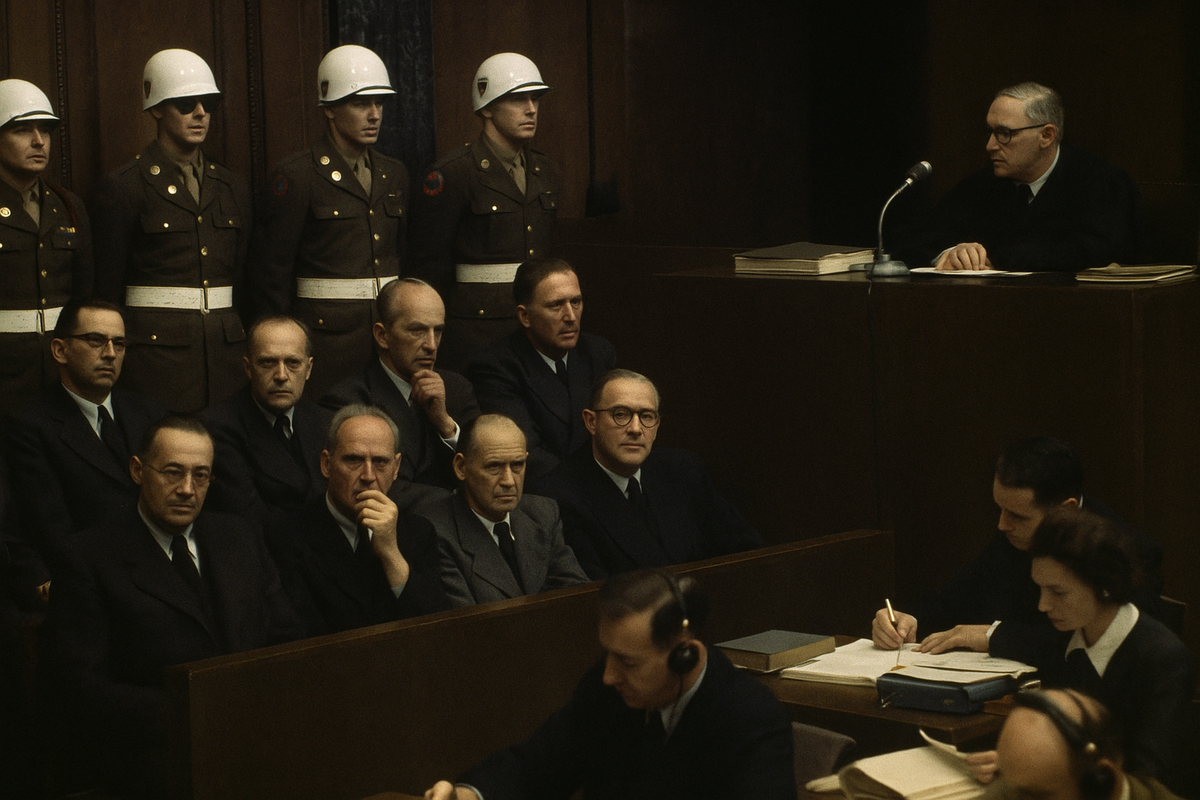
On December 27, 1947, readers opened The New Yorker expecting wit, sophistication, and the magazine's signature cultural elegance. What they found instead was a dispatch from the epicenter of modern justice: the Nuremberg courtroom, where the machinery of Nazi Germany—not just its generals, but its accountants, industrialists, and executives—faced judgment for enabling the most catastrophic war in human history.
The article, "Letter from Nuremberg," wasn't just reportage. It was a reckoning.
For Americans in 1947, the war had ended only two years earlier. Millions were rebuilding lives shattered by loss and displacement. The first Nuremberg trial had already convicted Hermann Göring, Rudolf Hess, and Joachim von Ribbentrop—the visible architects of fascism. But this issue documented something more unsettling: the prosecution of men in business suits. Engineers. Financiers. The quiet bureaucrats whose spreadsheets and contracts had fueled genocide.
This was justice confronting a darker truth: evil doesn't always wear a uniform.
The Trials That Redefined Accountability
By late 1947, the Nuremberg proceedings had entered their second phase—targeting not battlefield commanders but the economic engine of the Third Reich. Among those on trial: executives from I.G. Farben, the chemical conglomerate that had supplied synthetic fuel, rubber, and the industrial backbone of Nazi aggression. Farben's factories had exploited slave labor at Auschwitz. Its profits were baptized in atrocity.
The New Yorker understood the stakes. This wasn't merely about punishing individuals. It was about establishing a precedent: that corporate power, when weaponized for war, could be prosecuted under international law.
For American readers, many of whom had sent sons and brothers to fight fascism, the trials raised a question that still echoes today: Where does complicity begin? At the Führer's desk? Or in the boardroom where contracts are signed?
Issue Details
Publication: The New Yorker
Issue Date: December 27, 1947
Featured Article: "Letter from Nuremberg"
Historical Context: Subsequent Nuremberg Trials (Industrialist Prosecutions)
Archive Source: Original Magazines Collection
The New Yorker's Lens: Nuance Over Noise
Unlike newspapers chasing verdicts and headlines, The New Yorker specialized in capturing what couldn't fit in a wire report—tone, irony, moral complexity. "Letter from Nuremberg" rendered the trials in sharp, literary detail:
Inside the Courtroom: Documenting the Machinery of Evil
The piece distilled the trials into moments that crackled with moral tension:
The I.G. Farben executives sat impassively as prosecutors outlined their role in Germany's rearmament, their use of concentration camp labor, their chemical innovations that made modern warfare possible. These were not minor players—they were architects of industrial-scale destruction.
The courtroom atmosphere lacked the drama of earlier proceedings. No grandstanding speeches. No theatrical defiance. Just the slow, methodical presentation of documents, memos, and contracts. Evil as paperwork.
The burden of proof demanded that prosecutors trace a line from a signature on a contract to a death in a camp. The article captured the painstaking labor of building a case that would survive history's scrutiny.
The moral experiment itself—could law and reason triumph over the logic of exploitation? Could the postwar world create a system where bankers and businessmen understood that profit extracted from atrocity carried consequences?
Through The New Yorker's lens, Nuremberg became a mirror held up to civilization itself.
The Magazine as Cultural Witness
The cover of this issue—a snow-blanketed house glowing warmly against the winter dark—seemed at first glance to be pure seasonal charm. But in the context of the Nuremberg article, it carried deeper resonance: light amid darkness, shelter against the cold, the fragile warmth of moral order in a world still reeling from chaos.
This was The New Yorker at the height of its postwar authority. Fiction, poetry, and cartoons shared pages with dispatches from the frontlines of justice. The magazine didn't just report on culture—it shaped how Americans understood their moment in history.
Why Vintage New Yorker Magazines Endure
These weren't disposable periodicals. They were—and remain—cultural artifacts that fused reportage with reflection, journalism with literary craft. The "Letter from Nuremberg" still reads as urgently relevant because the questions it raised never fully resolved: How do we hold power accountable? What responsibility do corporations bear for the regimes they enable?
The New Yorker documented these questions with a clarity that transcends its era.
Why Collectors Treasure This Issue
To hold this issue is to hold a piece of the postwar conscience—a time when civilization asked itself whether law could tame the darkest impulses of modernity.
Explore the Archive
If this issue captivates you, thousands more await—spanning the Roaring Twenties through the Cold War. The New Yorker chronicled America's cultural and political evolution with unmatched wit and depth.
Browse New Yorker Magazine CollectionThese aren't just back issues. They're living documents of the 20th century.
A Time Capsule of Conscience
The December 27, 1947 issue stands among The New Yorker's most consequential postwar publications. It brought American readers face-to-face with a radical idea: that justice must extend beyond uniformed leaders to the economic structures that sustain tyranny.
To own this issue is to own a moment when the world asked whether law could match the scale of modern atrocity. It is to encounter the blend of literary craft and moral urgency that made The New Yorker indispensable—and makes these vintage issues enduringly collectible.
For anyone who values history, justice, and the power of words to shape conscience, this magazine isn't merely old. It's essential.