
When Cannabis Was Culture: Inside High Times' 1976 Portrait of Moroccan Kif
How Paul Bowles and a photo essay from the Rif Mountains redefined cannabis journalism—and gave American readers proof that the plant had history, ritual, and dignity
When Americans cracked open the September 1976 issue of High Times, they weren't just reading about getting high. They were holding evidence that somewhere in the world, cannabis wasn't criminal—it was ceremonial.
Paul Bowles' feature "Kif Making in Morocco" did something no American publication had dared: it documented cannabis as craft. Not rebellion. Not vice. Craft. For readers living under Nixon's War on Drugs, watching friends arrested for possession, the message landed like a manifesto: this plant had a history that predated prohibition by centuries.
Bowles—the expatriate novelist who'd made Tangier his home—guided readers through the Rif Mountains with the precision of an anthropologist and the intimacy of a neighbor. His words didn't romanticize. They recorded. And what they recorded was a tradition so meticulous, so bound to daily life, that it made American pot culture look like amateur hour.
Archive Details
Publication: High Times Magazine
Issue: September 1976
Feature: "Kif Making in Morocco" by Paul Bowles
Photography: Pato
Historical Context: Published two years after High Times launched, during the height of America's War on Drugs
The Ritual: Precision Over Pleasure
The Moroccans Bowles profiled didn't smoke cannabis. They smoked kif—and the distinction mattered.
Only the resinous female bracts made the cut. Leaves were discarded. Stems were worthless. The selected material was then blended with black tobacco in ratios that sparked endless debate: three parts tobacco to one part cannabis for some, a 50/50 split for purists.
But here's where the ritual turned radical: fresh kif was considered garbage. Oily, harsh, headache-inducing. The finest kif had aged six to seven years before anyone would smoke it. Like Bordeaux. Like scotch. Like anything worth waiting for.
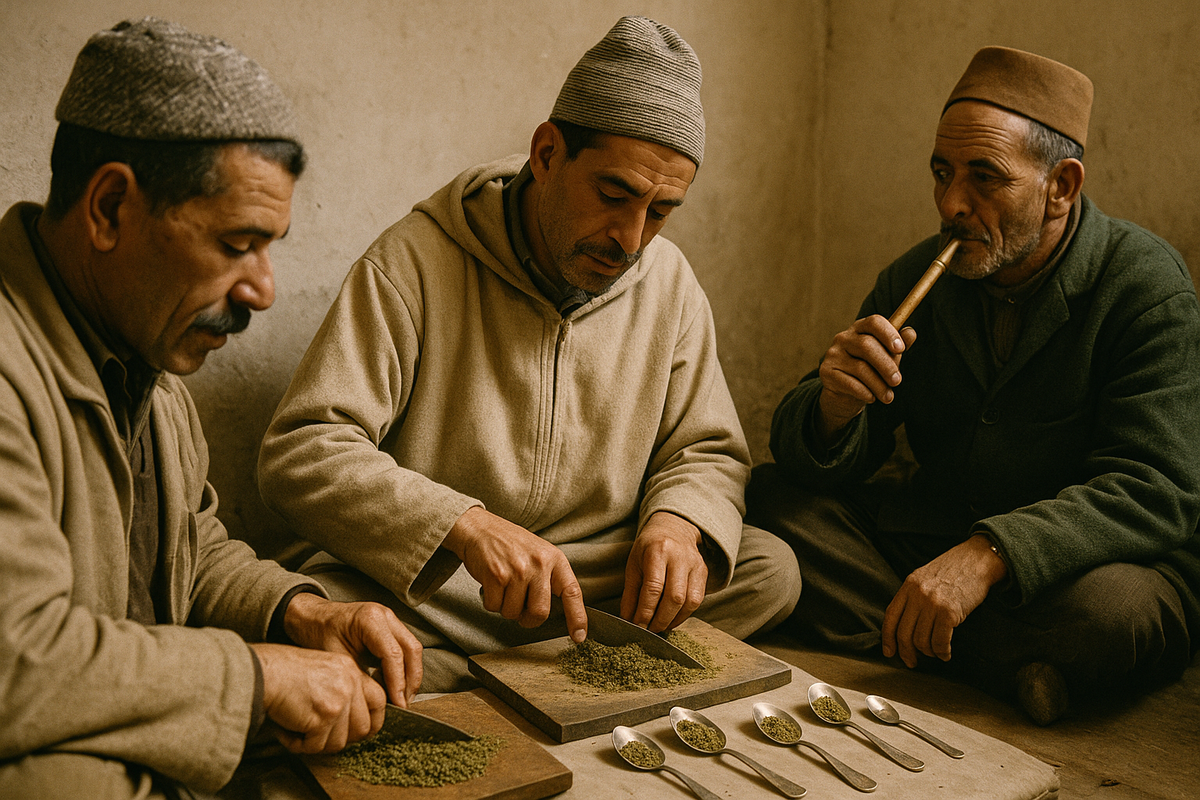
The preparation itself demanded skill. Stripping bracts, separating debris, cutting 400 grams of raw material—an expert needed a full hour. The tools were simple: hardwood boards, flexible knives, whetstones. The technique was not. Cut too fine and the kif burned too fast. Too coarse and it smoldered unevenly. Consistency wasn't preference. It was physics.
Pato's photographs captured hands moving in practiced rhythm, blades flashing over wooden boards, four spoons displaying kif at different stages of preparation. These weren't images of intoxication. They were portraits of labor.
The Politics of Refusal
One line appears repeatedly throughout Bowles' piece, almost like a refrain: "There is no way of buying ready-mixed kif. Anything already prepared is by definition zbil, garbage."
This wasn't snobbery. It was resistance.
The Moroccan government produced pre-mixed kif for the tourist trade—packaged, convenient, soulless. Locals called it "French kif" and wouldn't touch it. To buy government kif was to betray the ritual. To prepare your own was to claim autonomy over a practice older than borders.
For High Times readers in 1976, this resonated beyond Morocco. They were living through NORML rallies, Cheech & Chong films, and federal raids on their friends. The idea that cannabis could be defended not just as personal freedom but as cultural heritage reframed the entire argument.
Why High Times Mattered in 1976
High Times launched in 1974, two years into a cultural stalemate. Cannabis use was everywhere—dorms, concerts, living rooms—but so were arrests. Mainstream media treated pot smokers as either criminals or punchlines. No one was documenting the culture seriously.
High Times did. With psychedelic layouts, investigative rigor, and zero apologies.
The September 1976 issue crystallized the magazine's mission. While other publications debated legalization in abstract terms, High Times showed readers that cannabis already had legitimacy—in Morocco, in India, in cultures that never needed permission from Washington.
Paul Bowles wasn't just a writer. He was proof that cannabis culture could claim literary credibility. His byline elevated the piece beyond stoner journalism into something closer to ethnography.
Key Elements of Moroccan Kif Culture
The Artifact Today
Fifty years later, this issue commands attention from collectors for reasons that transcend nostalgia.
Historical positioning: Published when High Times was still defining itself, the magazine hadn't yet become the institution it would later represent. This was the magazine as insurgent, not legacy brand.
Literary pedigree: Bowles' involvement remains unusual. Few writers of his stature contributed to cannabis publications in the 1970s.
Photographic documentation: Pato's color essay remains one of the most comprehensive visual records of traditional kif preparation published in American media.
Rarity: Like all vintage High Times issues, survival rates are low. These were read, passed around, hidden from parents, confiscated by authorities. Clean copies are uncommon.
Cultural evidence: For historians studying how American drug culture understood itself during prohibition, this issue is primary source material. It shows the moment when cannabis users began claiming global lineage for their practices.
To own this issue is to own a fragment of the conversation that eventually led to legalization.
Why Collectors Pursue These Issues
Explore the Archive
Trace the full arc of cannabis journalism—from underground defiance to mainstream acceptance. The High Times collection offers decades of primary sources documenting how the conversation shifted, how the culture evolved, and how prohibition was challenged in real time.
Browse High Times Magazine CollectionWhether you're a historian researching American counterculture, a collector building an archive, or someone fascinated by how cannabis moved from criminal to commonplace, these issues offer something libraries can't: the actual magazines that people read, hid, and passed around when cannabis was still dangerous to defend.
Final Word
The September 1976 issue of High Times did more than document Moroccan kif. It made an argument.
Cannabis had history. It had tradition. It had been part of human culture long before it became part of American law enforcement.
Paul Bowles didn't need to say this explicitly. The photographs said it. The meticulous descriptions of preparation said it. The refusal of Moroccans to buy government-approved kif said it.
For readers in 1976, living under prohibition, this wasn't just journalism. It was evidence that the War on Drugs was a war on culture itself.
And that evidence, preserved in magazine form, is still making its case today.