
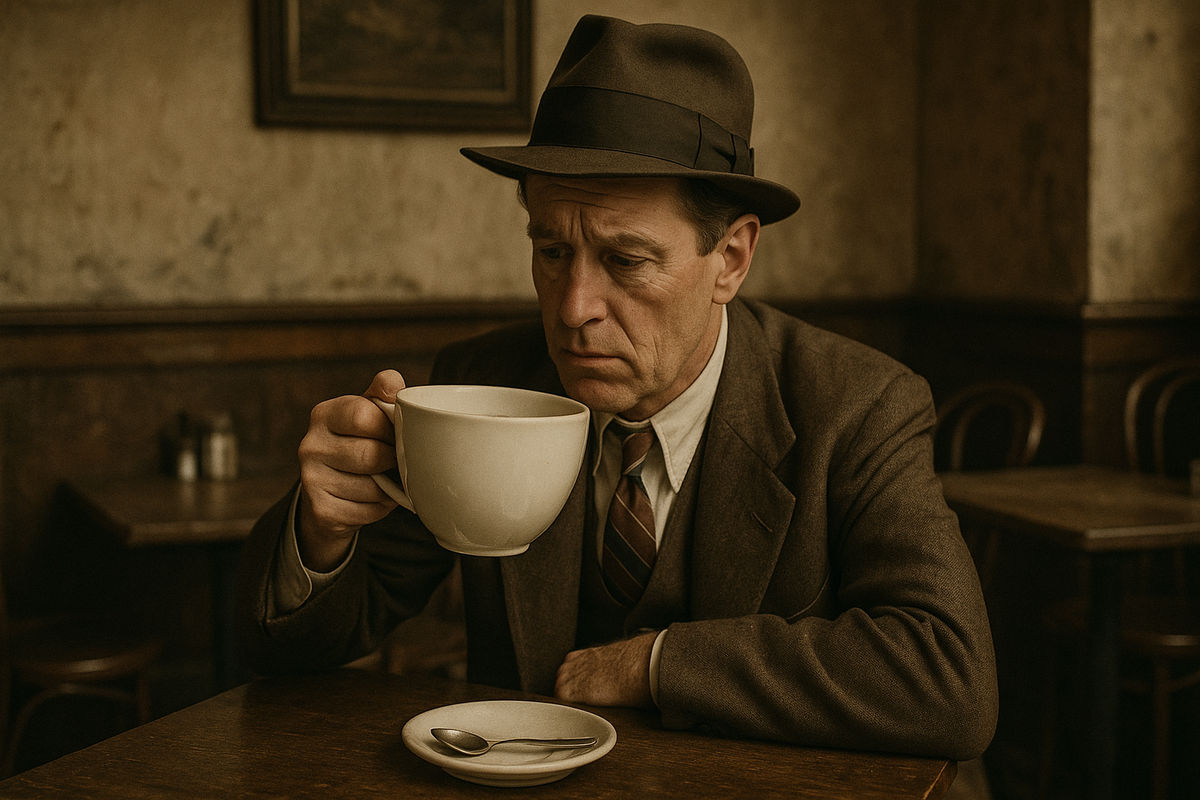
The Last Laugh Before the Crash
When The New Yorker Satirized America's Coffee Addiction on the Eve of Economic Collapse
On September 28, 1929, New Yorkers could still buy a magazine that mocked their nervous habits without a trace of irony. Five weeks later, the stock market would collapse, and the joke would land differently.
Tucked inside that issue was "Large Coffee"—a satirical diary that turned caffeine consumption into a commentary on American excess. The piece wasn't prophecy, but it captured something essential about the final weeks of the Jazz Age: a culture running on overstimulation, convinced that speed and efficiency could be maintained indefinitely. The timing makes it impossible to read now without feeling the weight of what came next.
Archive Details
Publication: The New Yorker
Issue Date: September 28, 1929
Featured Article: "Large Coffee" (satirical diary)
Historical Context: Published five weeks before the Wall Street Crash of October 1929
Cultural Significance: Final artifact of Jazz Age confidence before the Great Depression
Coffee as Cultural Barometer
By 1929, coffee had evolved beyond refreshment into an infrastructure of urban life. Luncheonettes, office breaks, and café counters formed the scaffolding of professional New York. Grabbing a "large coffee" wasn't just habit—it was tempo, the rhythm by which the city moved.
The New Yorker, barely four years old, had already mastered the art of turning mundane rituals into cultural diagnosis. "Large Coffee" exemplified this talent. Structured as diary entries—Friday, May 31; Sunday, June 2—the piece tracked a narrator's comic failures at caffeine moderation. Health resolutions collapse. The "big cups" win. Brain fog demands clearing, productivity demands fuel, and the habit becomes inescapable.
The humor worked on three levels. First, it normalized excess as baseline behavior—stimulants weren't indulgence but necessity. Second, it skewered efficiency culture, the relentless urban drive to stay alert and competitive. Third, it embraced self-aware irony: the narrator knows the habit is absurd but surrenders anyway. Readers were invited to recognize themselves and laugh.
The Magazine That Captured the Mood
The September 28 cover telegraphed The New Yorker's sensibility before a reader cracked the spine: a caricature of a smug gentleman in checkered trousers, top hat, and tails, small dog at his side. High society pretension, rendered ridiculous. Inside, "Large Coffee" performed the same operation on ordinary life.
What distinguished The New Yorker—then and now—was its refusal to separate entertainment from critique. Journalism, fiction, poetry, cartoons, and satire coexisted in a tone that managed to be both sophisticated and accessible. "Large Coffee" wasn't about caffeine. It was about an entire culture of speed, consumption, and looming instability that no one yet understood was terminal.
The piece reads now as unintentional eulogy. Each diary entry—confessing inability to restrain consumption, joking about brain fog and overwork, treating daily ritual as theater of the absurd—captures a society that had mistaken momentum for permanence. The New Yorker didn't predict the crash, but it documented the texture of life just before it.
Consumption as Confession
Each diary entry reads like a comic exposure of the narrator's inability to restrain himself—modern excess disguised as everyday routine.
Efficiency Culture Satirized
The relentless drive to be alert, sharp, and productive becomes the real subject—coffee is simply the delivery mechanism.
Self-Aware Irony
The narrator recognizes the absurdity but indulges anyway—a sophisticated humor that invites readers to laugh at their own habits.
Urban Ritual as Theater
Something as ordinary as a coffee cup becomes a stage for examining modernity's exaggerations and anxieties.
Time Capsules in Print
The value of publications like this extends beyond nostalgia. They preserve not just what people did, but how they thought, what made them nervous, what they found funny. "Large Coffee" appears to be a throwaway piece about caffeine. What it actually documents is modernity's relationship with stimulation, productivity, and excess—concerns that remain recognizable nearly a century later.
For anyone studying American culture, these issues are irreplaceable. They capture the intersection of art, literature, and social commentary at a level no other medium achieved. The New Yorker wasn't just reporting on the Jazz Age; it was creating the language to understand it.
Why This Issue Matters to Collectors
Historical Proximity
Published one month before the Wall Street crash, this issue preserves the final lighthearted weeks of the Jazz Age. It's cultural evidence from the other side of a dividing line.
Signature Wit
"Large Coffee" demonstrates the magazine's ability to transform the everyday into lasting commentary. These weren't just jokes; they were anthropology disguised as humor.
Visual Legacy
The cover art and interior illustrations represent the visual language that made early New Yorker issues recognizable and collectible. The style was already iconic.
Archival Scarcity
Early issues from the 1920s, particularly those published near watershed historical moments, command serious attention from literary scholars, cultural historians, and collectors of vintage periodicals.
The September 28, 1929 New Yorker occupies a specific position in the archive: last artifact of an ending world. This single issue contains a peculiar form of historical knowledge—the sound of laughter just before the ceiling falls. "Large Coffee" satirized habits that felt permanent: the big cups, the efficiency obsession, the nervous energy of urban modernity. Within weeks, those habits would be recontextualized by economic catastrophe, but they wouldn't disappear. The anxieties remained. The coffee kept flowing.
For collectors of cultural history, that's what makes the September 28, 1929 New Yorker essential. It's not a relic of a foreign world. It's a mirror that still reflects.
Access the Archive
For collectors and historians fascinated by this period, original issues remain available—physical artifacts of a specific cultural moment, preserved in paper and ink.
Browse The New Yorker Magazine CollectionWhether your interest is scholarly, aesthetic, or simply the pleasure of holding a piece of history, these issues offer something digital archives cannot: the weight, texture, and immediacy of the object itself.