
The Mother Who Made Broadway Weep
Claudia McNeil, Ebony Magazine, and the Performance That Proved Black Motherhood Belonged on America's Stage
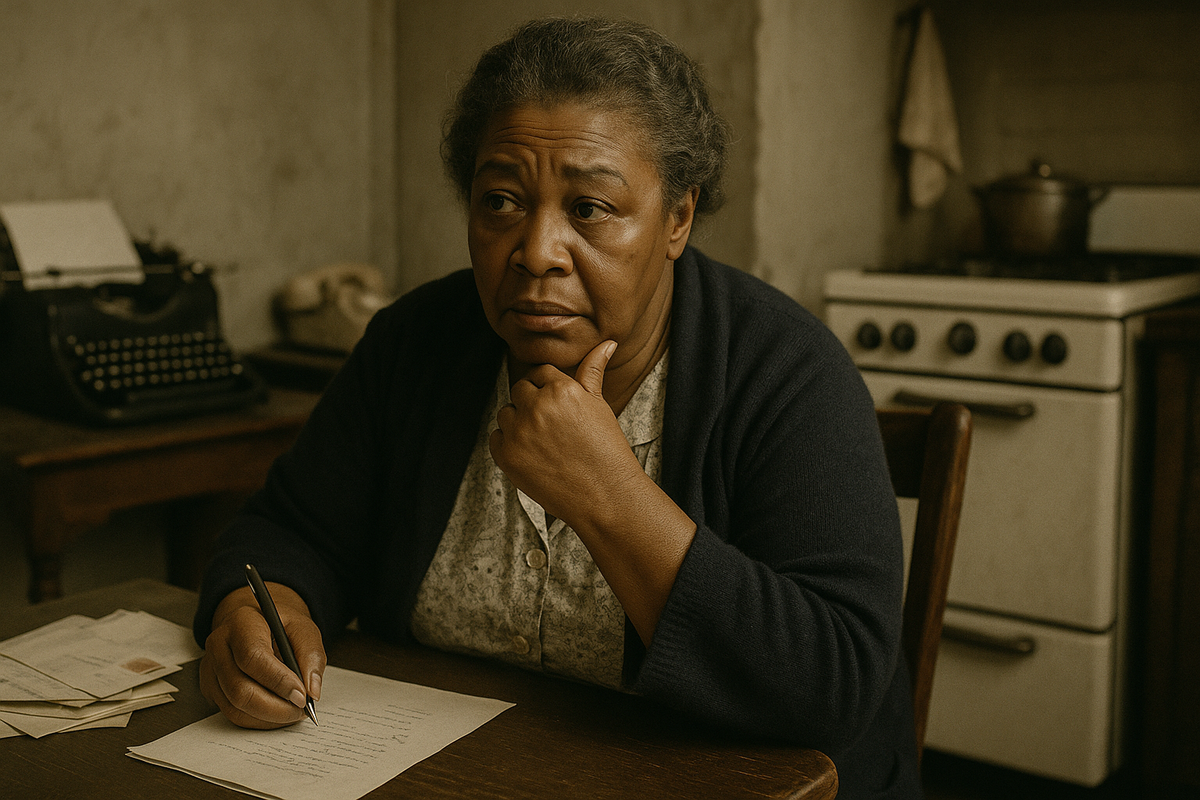
In May 1960, a Black woman stared out from the cover of Ebony Magazine with the kind of gaze that stops you mid-page. Not defiant. Not pleading. Just present—with the weight of every sacrifice, every skipped meal, every closed door behind her. Claudia McNeil had just done something no critic thought possible: she'd made Broadway cry.
Not polite theater tears. The kind that shake shoulders. The kind a Yale professor admitted to when he showed up at her dressing room and told her she reminded him of his own mother. The kind Sidney Poitier—her co-star, playing her son Walter Lee Younger—expressed by leaping from the stage in spontaneous applause after opening night.
A Raisin in the Sun had cracked open something in American theater. And Ebony understood what the mainstream press missed: this wasn't just a performance. It was a reckoning.
Archive Profile
Historical Figure: Claudia McNeil (1917–1993)
Publication: Ebony Magazine, May 1960
Feature Title: "Mother Role Brings Broadway Fame"
Theatrical Production: A Raisin in the Sun by Lorraine Hansberry (1959)
Director: Lloyd Richards
Archive Source: Original vintage edition
Why 1960 Mattered
Spring 1960 sits at a hinge point in American history. Sit-ins were spreading like fire across Southern lunch counters. Martin Luther King Jr. was ascending from minister to movement. The question of Black dignity wasn't abstract anymore—it was forcing itself into every institution, including the ones that had perfected the art of looking away.
Broadway was one of those institutions.
Then came Lorraine Hansberry's A Raisin in the Sun in 1959—the first Broadway production written by a Black woman, directed by a Black man (Lloyd Richards), centered entirely on a Black family's struggle against housing discrimination in Chicago. No softening. No white savior subplot. Just the Younger family, their cramped apartment, and a $10,000 insurance check that might buy them a way out.
At the center: Lena Younger, the matriarch. The one holding it together. The one whose hands knew the weight of other people's dirty laundry and whose faith somehow survived knowing God watched her scrub floors.
Claudia McNeil didn't just play Lena Younger. She was every Black mother who'd ever chosen her children's survival over her own dreams. Audiences knew it. Critics knew it. And Ebony knew how to tell that story in a way Time and Life never would.
What Ebony Saw That Others Didn't
Mainstream theater critics praised McNeil's "powerful performance." They called it "moving." Fine. Accurate. Completely inadequate.
Ebony went deeper. The May 1960 feature—titled "Mother Role Brings Broadway Fame"—wasn't celebrity fluff. It was photojournalism as cultural testimony.
The cover itself was a statement. While other magazines still caricatured Black women or relegated them to household product ads, Ebony gave McNeil the full treatment: dignified, direct, iconic. She appeared both as Lena Younger and as herself—a deliberate collapse of the boundary between role and reality.
Inside, the visual narrative did something radical: it showed McNeil on stage in moments of searing intensity—her face carrying generations of exhaustion and love—and then showed her at home in her modest Greenwich Village apartment, answering fan mail by hand, cooking alone, living simply despite Broadway fame.
The juxtaposition wasn't accidental. Ebony was telling its readers: This woman is extraordinary and she is one of us. She's a star who still knows the price of humility. She's reached the pinnacle and hasn't forgotten where she came from.
This was representation with purpose. Not just "look, we made it to Broadway," but "look how much it cost to get here—and look what we're carrying forward."
The Woman Behind Lena Younger
The Ebony profile laid bare the architecture of McNeil's life—every strut and beam that held up her Broadway triumph.
Poverty from the start. Born in Baltimore, raised in Harlem, she worked from childhood. "I never really experienced teenage childhood pleasures," she admitted. There was no time for girlhood when survival was the family business.
Cross-cultural grief. After her mother died, a Jewish family took her in. She absorbed their traditions, lived in their world. Years later, she converted to Catholicism in 1952. Faith became her through-line—the thing that carried her when theater didn't pay and directors didn't call back.
Years of professional failure. Arthur Miller's The Crucible closed quickly. Langston Hughes' Simply Heavenly lasted weeks. She was good—everyone said so—but good doesn't pay rent. She seriously considered quitting.
Then Lloyd Richards cast her as Lena Younger. She rehearsed obsessively, pouring her own heartbreak into the character. When the play opened in March 1959, something shifted in American culture. Black families saw themselves. White audiences saw something they'd been trained not to notice: the full humanity of people they'd been taught to overlook.
Critics didn't just praise the play. They wept over McNeil specifically. Actors came to her dressing room to thank her. Professors told her she reminded them of their mothers—not symbolically, but actually. She'd located something universal by refusing to sand down anything specific.
And yet she lived modestly. Fame didn't change her apartment or her habits. She still answered every piece of fan mail personally. She had no children but planned to adopt a 12-year-old German girl named Monika—because the desire to mother wasn't something Broadway could satisfy. It was deeper than applause.
Why Ebony Was the Right Chronicler
In 1960, mainstream media had a Black America problem: they didn't know how to cover achievement without condescension, or struggle without voyeurism.
Ebony had no such confusion. Founded in 1945 by John H. Johnson, it existed to document Black excellence, complexity, and everyday life with the same seriousness white Americans took for granted in their own magazines. It profiled scientists and singers, activists and entrepreneurs, homemakers and Hollywood stars—all with the underlying thesis that Black life was worth examining in full.
The McNeil feature exemplified this mission. Where a mainstream outlet might have written "Broadway Star Overcomes Hardship," Ebony wrote something closer to: "Here is a woman whose life contains the struggles and strengths of millions—and now, finally, the stage is worthy of her."
The photography reinforced this. Stage stills captured McNeil mid-performance, her expressions calibrated to heartbreak. Domestic shots showed her in her apartment, alone with her thoughts and her mail. The message: She's a great actress and she's still cooking her own meals. Talent didn't erase the texture of her daily life—and that texture mattered.
Ebony never insulted its readers by pretending McNeil's success was easy or that one Broadway role solved systemic racism. But it did something equally important: it showed that representation could be both symbolic and real, that one woman's triumph could honor the struggles of millions without being reduced to allegory.
The Lasting Image
What the May 1960 Ebony profile of Claudia McNeil proves is this: journalism can be an act of cultural preservation when it refuses to flatten complexity for the sake of a clean narrative.
McNeil's story wasn't simple. She converted religions, survived poverty, nearly quit theater, and then became the embodiment of Black motherhood on Broadway—all while remaining unmarried and childless offstage. Ebony let all of that exist simultaneously. No tidy arc. Just the truth of a life lived in full.
For African American readers in 1960, McNeil's success wasn't abstract. It was proof that their mothers, their grandmothers, their own sacrifices could command the nation's most prestigious stage. It was validation that the work of holding families together—often invisible, often thankless—was worthy of standing ovations.
For us now, it's a reminder that the best cultural documentation doesn't explain away contradictions. It honors them.
The Collector's Lens: Why This Issue Endures
Primary Source for Theater History
Published just one year after A Raisin in the Sun premiered, it captured McNeil at her peak—before Hollywood, before the inevitable complications of fame, when her performance was still raw and her story still unfolding.
Cultural Shift in Real Time
This issue sits at the intersection of the Civil Rights Movement and the American theater's long overdue reckoning with representation. You can see the seismic plates moving.
Irreplaceable Photography
These images of McNeil—on stage, at home, in reflection—are rare intimate records. They weren't shot for posterity; they were shot for Ebony's readers in 1960. That specificity makes them invaluable now.
Enduring Demand
Like issues featuring Martin Luther King Jr. or Nat King Cole, this edition has become a sought-after piece for collectors of Civil Rights-era journalism and African American cultural history. It's not just memorabilia—it's evidence.
Owning this issue today means holding a document that believed Black women's stories deserved the full treatment while it was still controversial to say so.
For Collectors and Historians
The May 1960 issue of Ebony featuring Claudia McNeil represents a pinnacle moment in American theater and civil rights journalism. It's a museum piece you can still hold in your hands.
Browse Ebony Magazine CollectionFrom the 1940s through the 1970s, Ebony preserved what mainstream media often ignored: the milestones, struggles, and everyday dignity of African American life. Each issue is more than a magazine—it's a primary source, a cultural record, a piece of history that refused to be erased.