
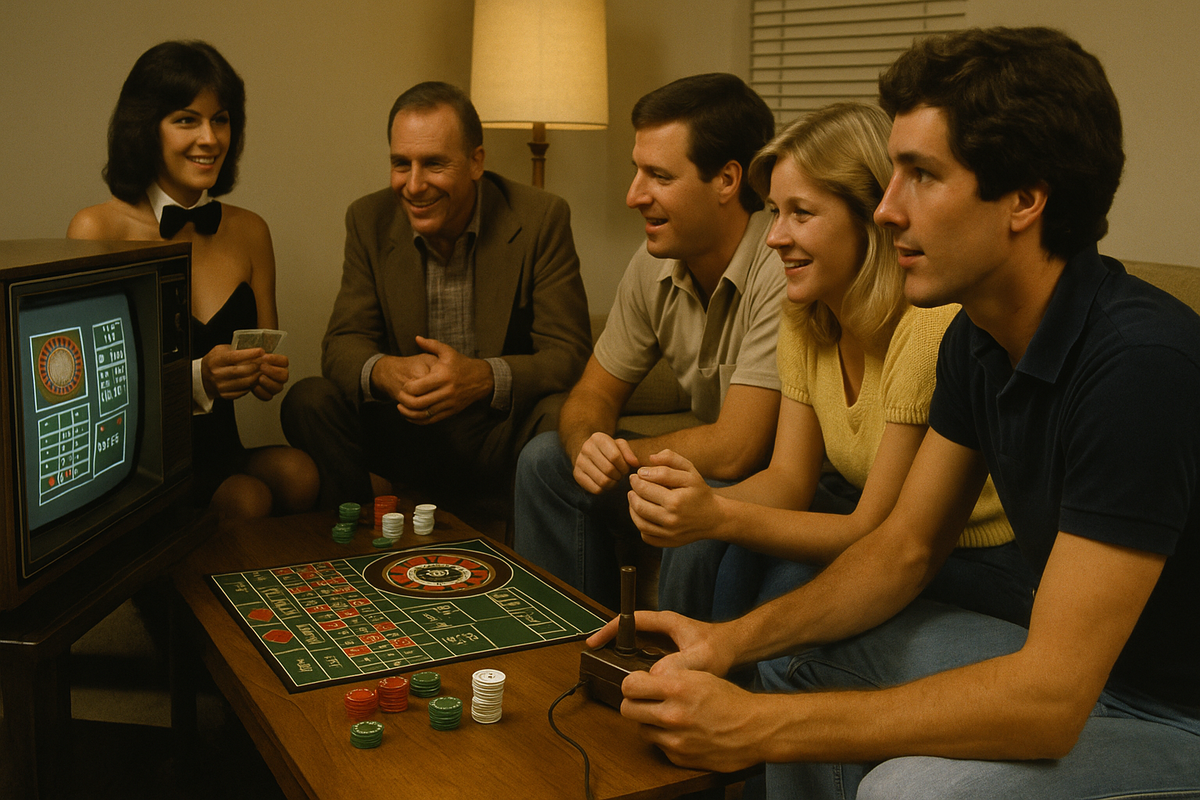
The Last Summer Before the Crash
When Electronic Games Magazine brought Vegas to your living room—and documented the golden age's final gamble
July 1983. The Atari 2600 still dominated American living rooms. Dragon's Lair was draining quarters in darkened arcades. And tucked inside that month's issue of Electronic Games Magazine was something nobody saw coming: a full-throated celebration of digital gambling, published mere months before the entire industry would collapse.
The cover promised "Las Vegas in Your Living Room—The Video Casino." Inside, founding editors Bill Kunkel, Arnie Katz, and Joyce Worley had assembled something remarkable: a serious journalistic survey of blackjack simulations, roulette wheels, horse racing bets, and slot machines—all translated into cartridge form for home consoles. Not as novelties. As legitimate software.
This wasn't just game coverage. It was cultural anthropology in real time.
Archive Document
Publication: Electronic Games Magazine
Issue: July 1983
Cover Story: "Video Casino" — Las Vegas in Your Living Room
Founding Editors: Bill Kunkel, Arnie Katz, Joyce Worley
Historical Context: Published months before the North American video game crash of 1983
The Moment the Industry Tried Everything
By mid-1983, the cracks were already showing. Oversaturation. Plummeting quality. E.T. cartridges gathering dust in warehouses. But before the crash came the desperation—and with it, genuine creativity. Publishers were scrambling to differentiate, to find the next big genre beyond space shooters and maze games.
Casino simulations were the answer nobody expected. They offered strategic depth without requiring twitch reflexes. They appealed to adults in an industry that was being dismissed as children's entertainment. And crucially, they brought the psychological thrill of risk into homes where actual gambling was either illegal, inaccessible, or financially dangerous.
Electronic Games understood what was happening. Founded in 1981 as the first magazine devoted entirely to video gaming, it had positioned itself as the industry's paper of record—the publication that treated games as cultural artifacts worth serious analysis. The July 1983 issue proved it.
What They Were Playing
The "Video Casino" feature cataloged an entire subgenre most gaming histories ignore:
Ken Uston's Blackjack & Poker
ColecoVision's attempt to simulate not just card mechanics but dealer personalities and bluffing psychology. Uston, a real-world blackjack legend banned from multiple casinos, lent his name and strategy expertise to the cartridge.
Intellivision Royal Dealer
Brought poker to living rooms with betting tables and payout structures that mimicked casino floors.
Horse Racing Simulations
Mattel's Horse Racing and Coleco's Fidelity Horse Racing let players handicap digital jockeys and watch their bets ride or die in pixelated furlongs.
Atari 2600 Slot Machines
Recreated spinning reels, jackpot bells, and the one-armed bandit's primal appeal—minus the financial ruin.
What unified these titles was their promise: authentic gambling simulation without authentic gambling stakes. In an era of economic uncertainty and growing national conversations about addiction, that distinction mattered.
Why This Issue Endures
The July 1983 "Video Casino" issue is collectible precisely because it captures contradiction. It was published during the golden age's final summer, when the industry still believed it could expand into any genre, appeal to any demographic, colonize any aspect of human leisure.
Within months, the North American video game market would crater. Publishers would shutter. Retailers would clearance entire aisles. The industry wouldn't recover until Nintendo arrived in 1985 with tighter quality control and a reset button on console culture.
But this issue—this specific artifact—preserves the moment before the fall. When Electronic Games could still run a cover story about digital roulette wheels with complete sincerity. When developers genuinely believed blackjack simulations represented the future. When gaming journalism was pioneering the idea that cartridges deserved the same critical attention as films or novels.
The cover art alone tells the story: a beach party scene where sunbathers and arcade enthusiasts mingle under that "Las Vegas in Your Living Room" banner. It's playful, optimistic, utterly unaware of the cliff edge just ahead. That naïveté is what makes it valuable.
The Collector's Case
Historical Timing
Published in the months preceding the 1983 crash, documenting genre experimentation that would vanish for years.
Thematic Uniqueness
Coverage of gambling software at the exact intersection of adult entertainment and family-friendly consoles.
Editorial Pedigree
Kunkel, Katz, and Worley were building the vocabulary of games criticism in real time. Their work here isn't just reportage; it's foundational journalism.
Visual Distinctiveness
That beach party cover is instantly recognizable to anyone who lived through the era or studies it now.
Today, as mobile casinos and online poker dominate, these 1983 cartridges look both quaint and prophetic. They prove video games were always about more than rescuing princesses—they were laboratories for translating human experience into code. Risk. Strategy. Chance. The house edge, now rendered in 8-bit.
Own the Artifact
The July 1983 issue of Electronic Games Magazine isn't just reading material. It's a primary source document from the moment Las Vegas entered the living room, when game developers believed they could simulate anything, and when the industry's brightest minds documented it all with the seriousness it deserved.
Every copy is a time capsule. This one just happens to smell like casino smoke and cartridge plastic.
Browse Electronic Games Magazines Collection