
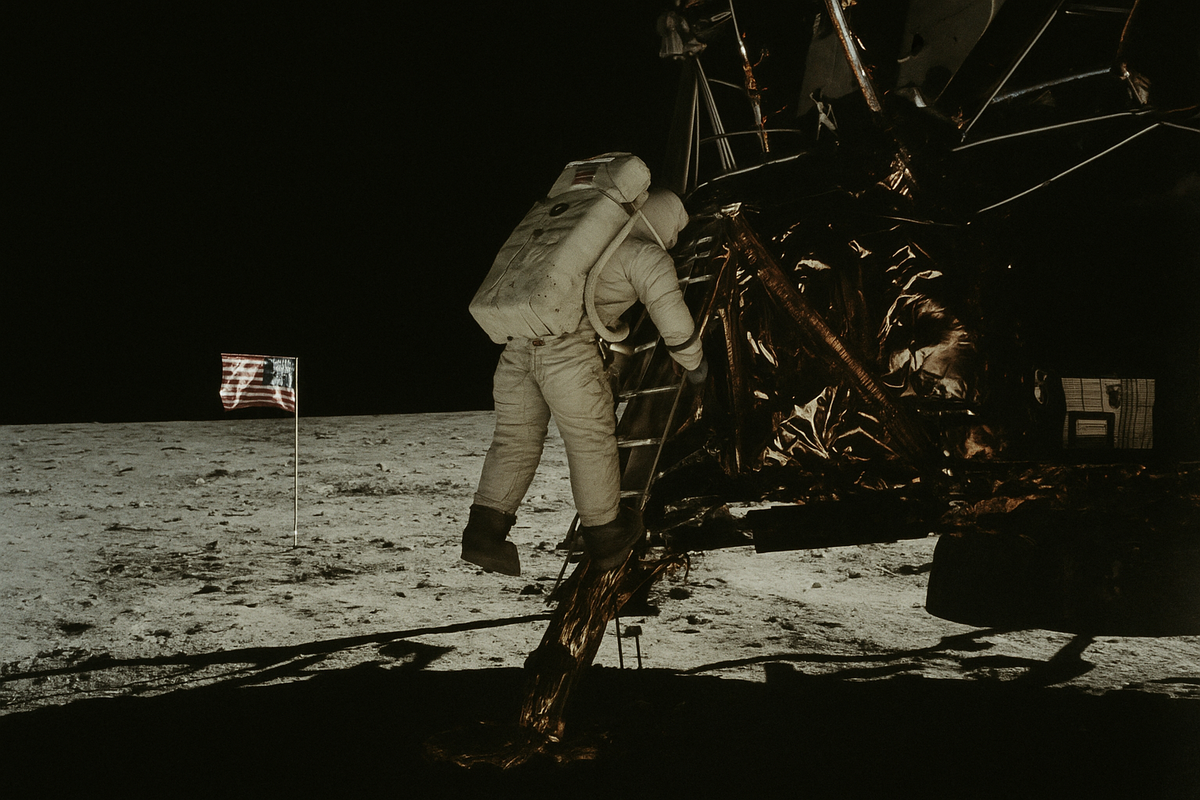
The Magazine That Landed With Apollo 11
Inside Time's July 25, 1969 issue—the publication that transformed humanity's greatest leap into permanent history
On July 25, 1969, Americans didn't just read the news. They held it—still warm with the afterglow of humanity's most audacious gamble.
The July 25, 1969 issue of Time Magazine arrived on newsstands and doorsteps five days after Neil Armstrong's boot pressed into lunar dust. For millions who had watched the grainy television broadcast—or missed it entirely—this was the moment the moon landing became real. Permanent. Official. Time didn't just report Apollo 11. It canonized it.
The cover was austere perfection: Armstrong descending the ladder, framed by the words "The Moon: 'A Giant Leap for Mankind.'" No clutter. No hedging. Just the photograph that would define a generation and the headline that belonged to history.
Archive Details
Publication: Time Magazine
Issue Date: July 25, 1969
Historical Event: Apollo 11 Moon Landing
Cover Subject: Neil Armstrong's lunar descent
Archive Source: Original 20th Century Magazine Collection
When the Space Race Had a Finish Line
The 1960s were a decade of Cold War mathematics. Every Soviet first—Sputnik in 1957, Gagarin orbiting Earth in 1961—was a humiliation tallied in American living rooms. When President John F. Kennedy stood before Congress in May 1961 and promised a lunar landing before decade's end, the odds were long and the stakes absolute.
Eight years. $25 billion. 400,000 engineers, technicians, and dreamers. And on July 20, 1969, the bet paid off.
Armstrong's first step wasn't just an American victory. Time understood this immediately. The magazine framed Apollo 11 as a human triumph—one that transcended the geopolitics that had made it possible. For a brief, shining moment, 600 million people across the planet looked up together.
What Television Gave, Time Preserved
In 1969, television owned the present tense. An estimated 650 million viewers worldwide watched the moonwalk live, squinting at fuzzy black-and-white images transmitted across 240,000 miles of void. But television was ephemeral. The broadcast ended. The picture faded. The moment slipped into memory.
Time gave it permanence.
The magazine devoted its entire issue to Apollo 11, transforming live coverage into lasting record. Readers encountered the Saturn V—what Time called a machine "spewing a dragon's breath of smoke and flame"—in full-color photographs that captured its 363-foot majesty. They saw the three astronauts: Armstrong, the steely commander; Buzz Aldrin, who would call the lunar surface a place of "magnificent desolation"; and Michael Collins, orbiting alone in the command module Columbia while his crewmates made history below.
Time's writers understood their assignment. This wasn't stenography. It was interpretation—asking not just what happened but what it meant. Was this science? Politics? Philosophy? The magazine answered: all three, inseparably.
Inside the Issue: The Moments That Mattered
Time's coverage preserved details that television couldn't linger on:
The Launch at Cape Kennedy
Nearly one million spectators lined Florida's beaches and highways, necks craned skyward. Time captured both the rocket's fury and the crowd's reverence—the shared understanding that they were watching either triumph or catastrophe, with no middle ground.
Armstrong's Descent
"That's one small step for man, one giant leap for mankind." Time immortalized not just the words but the context: the nine-rung ladder, the tentative first touch, the moment humanity became an interplanetary species.
Aldrin's Arrival
Nineteen minutes after Armstrong, Aldrin joined him on the surface. Together they spent two and a half hours conducting experiments, planting the American flag, and collecting 47.5 pounds of lunar samples. Time documented each task with the precision of a technical manual and the wonder of a travelogue.
Collins' Solitude
The magazine gave voice to the mission's third astronaut, who orbited the moon alone while Armstrong and Aldrin explored below. During each pass behind the moon, Collins lost all radio contact with Earth and his crewmates—26 minutes of isolation unlike any in human history. Time wrote: "Not since Adam has any human known such solitude."
The World United: Perhaps the most powerful aspect of Time's coverage was its documentation of global reaction. From Tokyo to London to remote villages with single television sets, the world watched. Political enemies, ideological opposites, rich and poor—all shared the same skyward gaze. Time captured what television couldn't: the collective exhale of a species proving it could do the impossible.
The Tangible History Thesis
This is what separates vintage magazines from digital archives or reprints: they are physical witnesses. Someone in July 1969 bought this issue, carried it home, turned these exact pages. The paper remembers. Every subscription label, every marginal note, every coffee ring is evidence of a moment when the impossible became fact.
Time Magazine didn't just chronicle Apollo 11. It shaped how the world remembered it—transforming a geopolitical chess move into a species-wide origin story.
Why This Issue Commands Respect
Immediacy
Published within days of the landing, this issue offered the first comprehensive analysis of Apollo 11. It wasn't retrospective or anniversary coverage—it was history, still hot.
Photography
The images inside—the Saturn V launch, Armstrong's ladder descent, Aldrin beside the flag—are among the most reproduced photographs of the 20th century. This issue contains their first major publication in a general-interest magazine.
Cultural Authority
Time wasn't just any newsweekly. It was the newsweekly, the publication that told Americans which events mattered and why. When Time declared Apollo 11 "a giant leap for mankind," it became so.
Condition Rarity
Most copies were read, handled, passed around, and eventually discarded. Finding intact issues—especially with sharp spines, unfaded covers, and complete pages—grows harder each year.
For Collectors and Keepers of Memory
If you collect space history, Cold War artifacts, or simply the moments when humanity surprised itself, the July 25, 1969 issue of Time Magazine belongs in your archive. It isn't memorabilia. It's testimony.
Browse Time Magazines CollectionOur archive spans the 1930s through the 1970s—the decades when Time defined American consciousness. Wars, elections, cultural revolutions, scientific breakthroughs: each issue is a time capsule of the world that made ours possible.