
The Magazine That Brought D-Day Home
Life Magazine's June 19, 1944 issue delivered the Normandy invasion to American living rooms—thirteen days after the first soldier hit the beach
Thirteen days after the first Allied soldier hit the sand at Normandy, Americans opened their mailboxes to find history still wet with salt water.
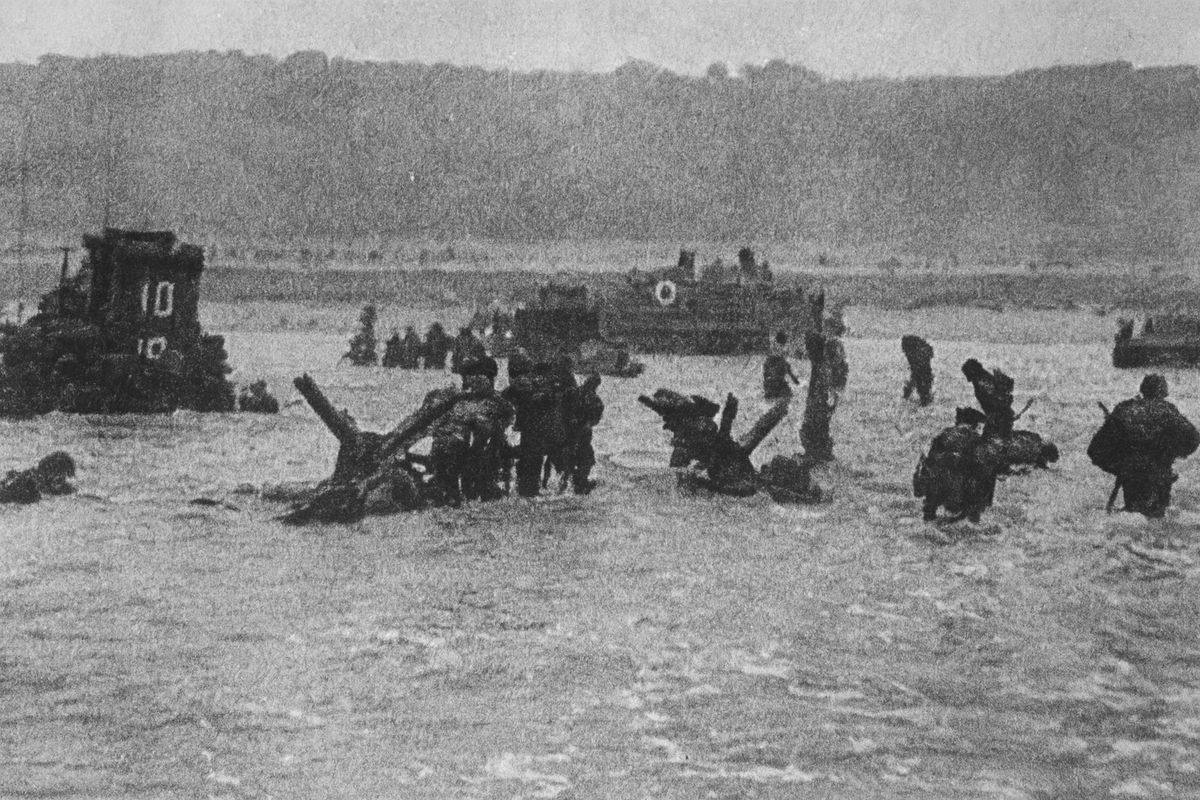
The June 19, 1944 issue of Life Magazine didn't arrive with fanfare or warning. It simply appeared—on kitchen tables, in corner drugstores, passed between neighbors who'd heard nothing from their boys overseas. The cover showed men struggling through surf under fire, and suddenly the war wasn't an abstraction anymore. It was right there: the weight of soaked uniforms, the chaos of bodies pushing forward, the German guns waiting on the bluffs above.
This wasn't propaganda. It was documentation in real time, printed on wartime paper while the outcome remained uncertain.
When Television Was Still a Rumor
On June 6, 1944, over 156,000 Allied troops launched the largest amphibious assault in military history. They crossed the English Channel in darkness and stormed five beaches—Utah, Omaha, Gold, Juno, and Sword—under a storm of machine gun fire and artillery. The Normandy landings broke open Hitler's Atlantic Wall and set in motion the liberation of Western Europe.
Back home, families had no CNN, no instant updates, no smartphone alerts. They had the radio, they had rumors, and they had Life.
For millions of Americans, the June 19 issue was the first visual proof of what had happened. The magazine's photographers—including Robert Capa, who landed with the first wave on Omaha Beach—captured images that were blurred, grainy, and brutally honest. Capa's camera shook because he was shaking. His photographs survived (barely—only eleven of his 106 exposures made it out of the darkroom intact) because they were shot in the middle of the most dangerous beach landing of the war.
Life didn't clean up the chaos. They printed it as it was.
Issue Data
Publication: Life Magazine
Issue Date: June 19, 1944
Historical Event: D-Day Normandy Invasion (June 6, 1944)
Featured Photographer: Robert Capa
Archive Significance: First major photographic documentation of the Normandy landings distributed to American civilians
The Architecture of Wartime Journalism
What separated Life from every other publication in 1944 was its refusal to choose between image and narrative. The magazine's writers provided strategic context and emotional depth, but the photographs did something words couldn't: they collapsed the distance between Iowa and Normandy, between safety and slaughter.
Each issue during World War II operated as both journalism and historical record. The editors understood they weren't just covering current events—they were creating the first draft of history. No other publication had Life's resources, its reach, or its willingness to show the war without softening the edges.
The June 19 issue captured that mission perfectly. It showed Americans what their sons were walking into, and it did so with a clarity that felt almost invasive. You couldn't look away. You weren't supposed to.
Why This Issue Still Matters
Among collectors of 20th-century ephemera, the June 19, 1944 Life is canonical. Not because it's rare (millions of copies were printed), but because it represents a specific intersection of history, journalism, and cultural memory that can't be replicated.
Original World War II issues of Life command attention for three reasons:
Unlike retrospective books or documentaries produced decades later, original Life magazines were printed during the war, on wartime paper stock, with headlines written before anyone knew how Normandy would end. That immediacy—the uncertainty baked into every page—makes them irreplaceable as historical artifacts.
Owning the June 19, 1944 issue isn't nostalgia. It's holding a primary source document from the most consequential week of the 20th century.
For Collectors, Historians, and Families
If you're searching for Life magazine June 19 1944, original WWII Life magazines, or D-Day collectible publications, you've likely discovered that authentic copies matter in ways reprints never will.
These magazines aren't just old reading material. They're time capsules. Reading them now provides something deeper than historical knowledge—they show you how people in 1944 processed the war, what they knew, and what they feared. You can imagine families in 1944 sitting under yellow lamplight, flipping through these pages, searching photographs for familiar faces, circling details that might connect to sons who hadn't written home yet.
The paper feels different. The advertisements are strange. The certainty we now have about the war's outcome is completely absent.
Explore the Archive
We maintain one of the most comprehensive collections of original Life magazines available, spanning from the 1930s through the final decades of the 20th century. Each copy is preserved as a complete historical document—not just the war years, but the entire sweep of American culture, politics, and daily life as it happened.
The June 19, 1944 issue is the cornerstone, but it's only the beginning. The complete archive tells the story of an entire century, one week at a time.
Browse Life Magazine CollectionWhether you're a collector building a historical library, a researcher working with primary sources, or someone honoring a family connection to the war, there's no substitute for the original artifact. Start with June 19, 1944. Then keep going.