
The Night Vogue Rewrote the Rules
How the October 1, 1971 issue transformed eveningwear from constraint into liberation
A woman stands alone in a darkened room. Sequins catch the light. Her ankle—yes, her ankle—becomes the focal point of desire. Around her wrist: stacked bangles in violet, green, and gold. On her lips: Max Factor's Sugarplum. She is not waiting to be noticed. She is the room itself.
This was the vision Vogue delivered on October 1, 1971, in an editorial spread titled "Lights" and "Night." But to call it merely a fashion feature would be to miss the point entirely. This was a manifesto in sequins and crochet—a declaration that eveningwear had shed its corseted past and stepped into something far more dangerous: freedom.
Archive Details
Publication: Vogue Magazine
Issue Date: October 1, 1971
Editor-in-Chief: Grace Mirabella
Featured Editorial: "Lights" and "Night"
Cover Photography: Richard Avedon
The Turning Point
By autumn 1971, the world was fracturing along every seam. The Vietnam War ground on. Feminists marched. Offices began, reluctantly, to accept women in pantsuits. The "youthquake" of the late '60s had blown through fashion like a hurricane, leaving shorter hemlines and looser silhouettes in its wake.
Yet something else was stirring. Glamour—real, unapologetic, glittering glamour—was staging a comeback. Studio 54 wouldn't open its doors until 1977, but the DNA of disco was already forming in the sequined gowns and body-conscious silhouettes of 1971. Eveningwear was shedding its rulebook. A woman could wear lace to her ankles one night, crochet the next, sequins the night after. The only requirement was that she shine.
Vogue's "Lights" editorial didn't just document this shift. It was the shift.
Grace Mirabella's Vogue: Glamour Meets Reality
Under editor-in-chief Grace Mirabella, Vogue in 1971 was recalibrating. Gone was the fantastical, untouchable vision of Diana Vreeland's reign. In its place: a magazine that acknowledged women's expanding lives while refusing to abandon beauty, craft, or couture.
The "Lights" spread embodied this balance perfectly. Here's what graced those pages:
Each look insisted on the same thing: a woman should feel powerful, sensual, radiant. Not decorative. Radiant.
Richard Avedon's Lens: Minimalism as Amplification
The October 1, 1971 cover bore Avedon's signature minimalism—a model's direct gaze, chic fall fashion, nothing extraneous. That aesthetic carried through to "Lights."
The photography was stark, purposeful:
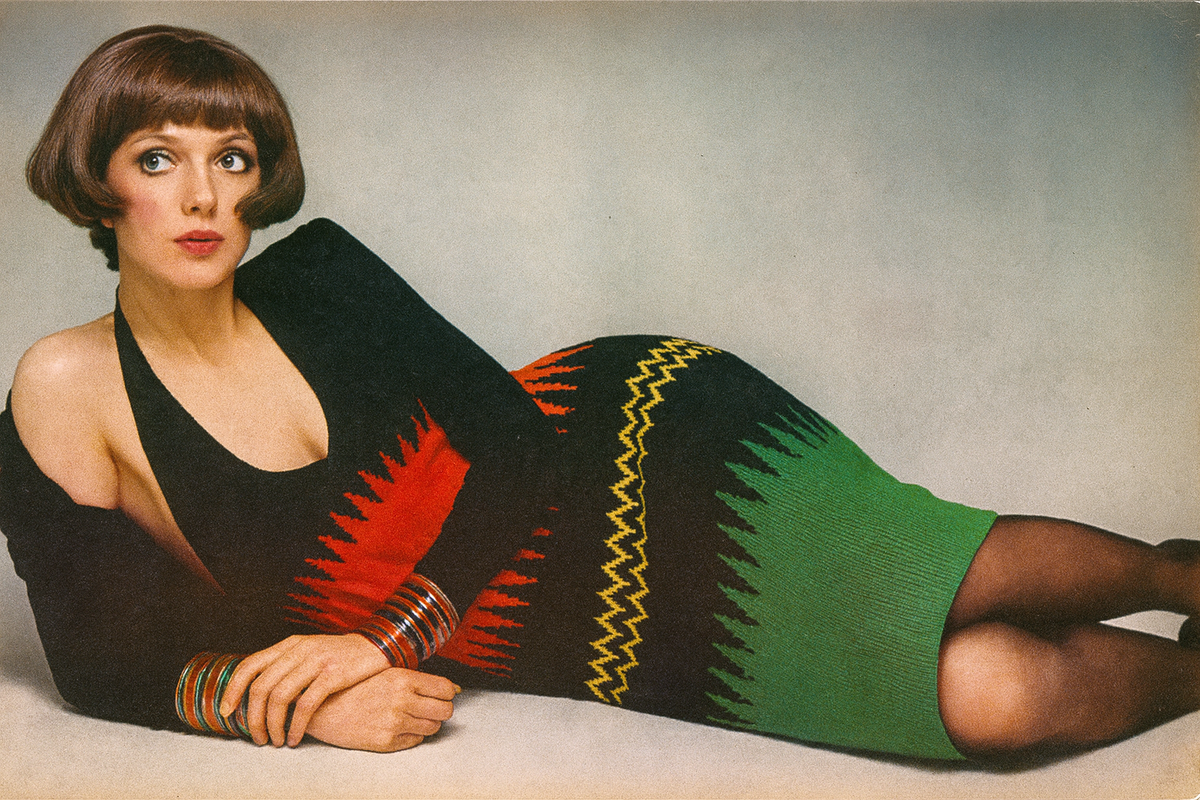
Full-length gowns shot against flat, gray-toned backgrounds, forcing all attention onto shimmer and drape. A model reclining in bold green and black crochet, photographed from below—an angle that celebrated body confidence without apology. A half-color portrait: black dress, red flame motif, nothing but stacked bangles. Minimal styling, maximum impact.
This wasn't the baroque fantasy of earlier Vogue eras. These images felt modern, unmediated, direct. The women in them weren't mannequins. They were personalities.
What the Editorial Understood
"Lights / Night" grasped something fundamental about 1971 that many fashion features missed: women wanted to be seen on their own terms.
Sequins weren't frivolous. They were spotlights, claiming space in a room.
Crochet wasn't quaint. It was tradition weaponized as modernity.
The body-conscious silhouette described as "bare for all it's worth and very close to the body" wasn't objectification. It was ownership.
Color rejected monochrome evening wear conventions. Black sequins, yes—but also red flame motifs, green crochet, lilac lace. The night had a palette, and it was vibrant.
Above all, Vogue centered the wearer. Not the dress. Not the designer. The woman herself, lighting up the room.
The Enduring Relevance
Sequins still dominate evening wear. Crochet returns to runways every few seasons. Beauty brands continue releasing fashion-coordinated palettes, exactly as Max Factor did in 1971.
But the editorial's deeper legacy is cultural. It captured women using fashion not to conform but to illuminate—to become, as Vogue wrote, the ones who "light up the room." That wasn't a styling tip. It was a philosophy.
Why Collectors Pursue This Issue
A Fashion Inflection Point
The spread captures eveningwear in transition, before the aesthetic fully crystallized into the late-'70s disco uniform.
Avedon's Photographic Legacy
His contributions to this era of Vogue represent some of the most influential fashion photography ever published.
Named Brands and Cultural Artifacts
Max Factor cosmetics, specific fabric treatments, styling details—these aren't just fashion notes. They're time capsules.
Cross-Disciplinary Appeal
Fashion historians, photography collectors, beauty archivists, and cultural researchers all find value here.
Physical Presence
An original issue means touching the same glossy pages women held in 1971, complete with period advertisements, layouts, textures. It's history you can hold.
Irreplaceable Authenticity
Unlike digital archives or reprints, a physical copy carries weight—literally and culturally.
The Final Word
The October 1, 1971 Vogue remains a milestone because it understood what many publications didn't: eveningwear was becoming more daring, colorful, and confident precisely because the women wearing it were.
Sequins sparkled. Ankles became erotic geography. Crochet entered the ballroom. Makeup fused with fabric as a unified statement.
For readers in 1971, it was an invitation to see themselves as the centerpiece. For readers now, it's proof that fashion is never just clothing—it's cultural history, preserved in glossy pages that still shine half a century later.
That's why vintage Vogue magazines aren't merely collectible. They're essential documents of who we were, and who we were becoming.
For Collectors and Historians
Vintage Vogue magazines function as more than style guides. They are living archives of cultural shifts, design innovations, and evolving definitions of beauty across decades.
Browse Vogue Magazine Collection