
Little Nellie, Bond's Flying Machine, and the 1960s Obsession with Spy Technology
How Esquire's March 1967 feature transformed James Bond's autogyro into a Cold War cultural artifact
When Americans picked up the March 1967 issue of Esquire, they weren't buying a magazine. They were buying a passport to the Cold War imagination—where helicopters exploded in volcanic craters, rockets fired from briefcases, and masculinity itself came with an instruction manual.
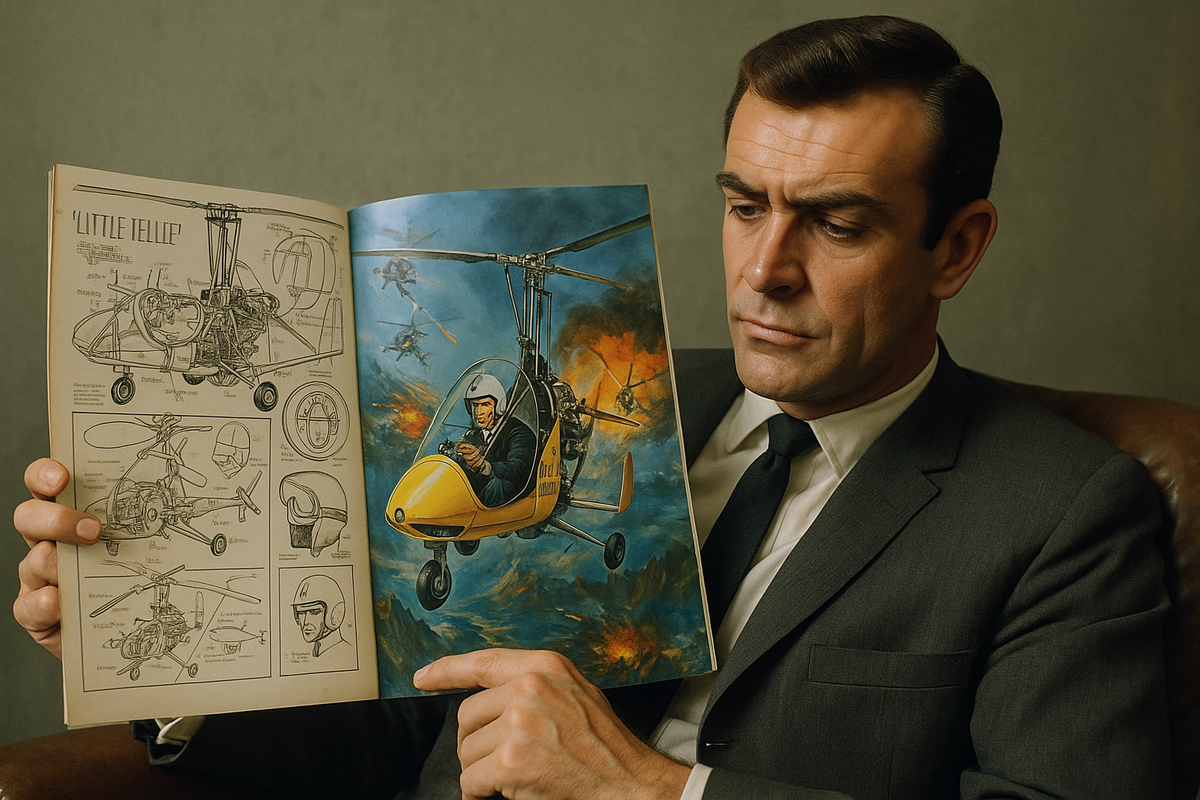
Tucked inside that issue was something extraordinary: "The Ultimate Weapon, Or Wait Till the Gun Shines, Nellie," a lavish dissection of James Bond's autogyro from You Only Live Twice. Technical schematics. Comic-strip explosions. A two-page painting of aerial carnage. It was Pop Art meets military fetish meets satire—and it was pure Esquire.
This wasn't a movie tie-in. It was a cultural diagnosis.
Archive Details
Publication: Esquire Magazine
Issue Date: March 1967
Feature Title: "The Ultimate Weapon, Or Wait Till the Gun Shines, Nellie"
Film Context: You Only Live Twice (Released June 1967)
Featured Artist: Roy Spencer
The Cold War, Packaged for the Coffee Table
Spring 1967. The Space Race raged. Nuclear brinkmanship dictated foreign policy. America was two years deep into Vietnam, and technology—whether satellite or submachine gun—dominated the national psyche.
Into this climate came You Only Live Twice, Sean Connery's fifth turn as 007. The film hit theaters in June, but Esquire got there first, using Bond's gadgetry as a lens to examine what technology meant to modern men. Little Nellie—a Wallis WA-116 autogyro armed with rockets, flamethrowers, aerial mines, and machine guns—was the perfect subject. She was absurd. She was aspirational. She was every Cold War fantasy compressed into four suitcases.
The feature treated her like a prophet.
How Esquire Dissected a Flying Arsenal
By 1967, Esquire had perfected a formula: marry visual spectacle to editorial sophistication, then season with irony. The Bond spread embodied this.
The Schematics
Readers opened to what looked like legitimate technical drawings—annotated diagrams showing how Little Nellie's components fit into suitcases, how the rotor assembly connected, where the weapons mounted. The presentation was straight-faced, almost clinical, as if any subscriber could assemble a spy autogyro in their garage. The joke was buried in the earnestness.
The Comic Panels
Opposite the blueprints: storyboards ripped from a Roy Lichtenstein fever dream. KAPOW! WHOOSH! VAROOM! Bond swooping, helicopters exploding, volcanic landscapes erupting in primary colors. Esquire wasn't just covering Bond—it was absorbing him into the Pop Art vernacular, making him part of the same cultural conversation as Warhol's soup cans.
Roy Spencer's Painting
Then came the centerpiece: a two-page oil painting by Roy Spencer. Bond in mid-dogfight, Little Nellie banking hard, enemy helicopters trailing flame. It was pulp illustration elevated to fine art, the kind of image that belonged in a gallery as much as a magazine. Spencer captured the film's kinetic absurdity while somehow making it gorgeous.
The Editorial Sleight of Hand
And through it all, the text walked a tightrope. Esquire mocked Bond's gadgetry—describing the autogyro with the winking tone of someone explaining a magic trick—while simultaneously venerating it. The magazine understood something crucial: you could laugh at masculine fantasies and participate in them at the same time. That duality was its genius.
What Little Nellie Represented
Strip away the machine guns and flamethrowers, and Little Nellie was a metaphor. In an era when technology felt both miraculous and menacing, when machines could either launch men to the moon or incinerate cities, Bond's gadgets offered a seductive illusion: that technology could be tamed, controlled, made elegant.
Little Nellie wasn't just a weapon. She was a promise that the modern world—chaotic, nuclear, incomprehensible—could be navigated with style and precision. That a man with the right tools could master the chaos.
Esquire recognized this. The feature treated Bond's autogyro not as a prop, but as a cultural artifact—a symbol of how men in the 1960s were being taught to relate to machines, violence, and power.
Visual Elements of the Spread
Technical Schematics
Step-by-step assembly sketches of Little Nellie, complete with tongue-in-cheek notes about parts and functions.
Helmet Diagrams
Drawings detailed Bond's supposed flight helmet, filled with fictional communication tools and weapon triggers.
Comic Panels
Storyboard sequences depicted aerial combat with Pop Art sound effects, bridging film and visual culture.
Roy Spencer's Painting
Two-page illustration dramatizing the battle between Bond's autogyro and villainous helicopters.
Parody Meets Admiration
The article balanced humor with genuine appreciation, both mocking and celebrating Bond's gadgetry.
Cultural Commentary
Treated gadgets as cultural icons that shaped masculine identity in the technological age.
The Legacy of "Wait Till the Gun Shines, Nellie"
Like Life during World War II, Esquire in the 1960s functioned as a cultural arbiter. It told men what mattered, what to admire, what to mock—and how to do both simultaneously.
The Bond feature succeeded because it refused to choose. It presented Little Nellie as ridiculous and magnificent, as fantasy and commentary, as product and art. That ambivalence is what made Esquire essential reading. The magazine understood that modern masculinity was built on contradictions, and it never pretended otherwise.
Why This Issue Matters to Collectors
Connery at His Apex
This issue landed during Sean Connery's commercial and cultural zenith as 007. Within a year, he would (temporarily) abandon the role. This is Bond before exhaustion set in.
Visual Innovation
The combination of technical illustration, comic art, and fine painting makes this spread unlike anything else in Esquire's archive. It's a masterclass in how magazines could function as art objects.
Cold War Artifact
Few publications captured the 1960s blend of anxiety and aspiration as precisely as Esquire. This issue doesn't just reflect that era—it crystallizes it.
The Golden Decade
The 1960s remain Esquire's most influential period, the years when it set the template for cultural criticism in American men's media. Issues from this decade command premium prices for good reason.
Pop Culture as High Culture
Esquire was among the first magazines to treat film, fashion, and gadgetry as subjects worthy of serious analysis. This feature exemplifies that editorial philosophy.
For collectors, owning this issue means possessing a document of how Americans consumed technology, masculinity, and cinema during one of the century's most volatile decades.
Conclusion
The March 1967 Esquire endures not because it covered a Bond film, but because it understood what Bond meant. "The Ultimate Weapon, Or Wait Till the Gun Shines, Nellie" treated an autogyro as a symbol, a joke, and a mirror—reflecting Cold War anxieties, masculine fantasies, and Pop Art sensibilities in equal measure.
The schematics, paintings, and comic panels weren't filler. They were arguments about how men related to machines, violence, and modernity.
Seventy years into the future, this issue remains what it was in 1967: a sophisticated artifact of its moment, valuable precisely because it refused to take itself—or its subject—entirely seriously.
That's why vintage magazines matter. They don't just record history. They reveal how people felt while living through it.
Where to Find It
For enthusiasts of Bond, Cold War culture, or magazine history, the March 1967 Esquire is indispensable.
Browse Esquire Magazine CollectionFrom "Little Nellie" to the era's finest essays and fiction, these issues capture a world negotiating its relationship with technology, style, and power—sometimes with humor, always with flair.