
When a Family Became a Movement
Inside Jet Magazine's Portrait of the McKissicks, August 1963
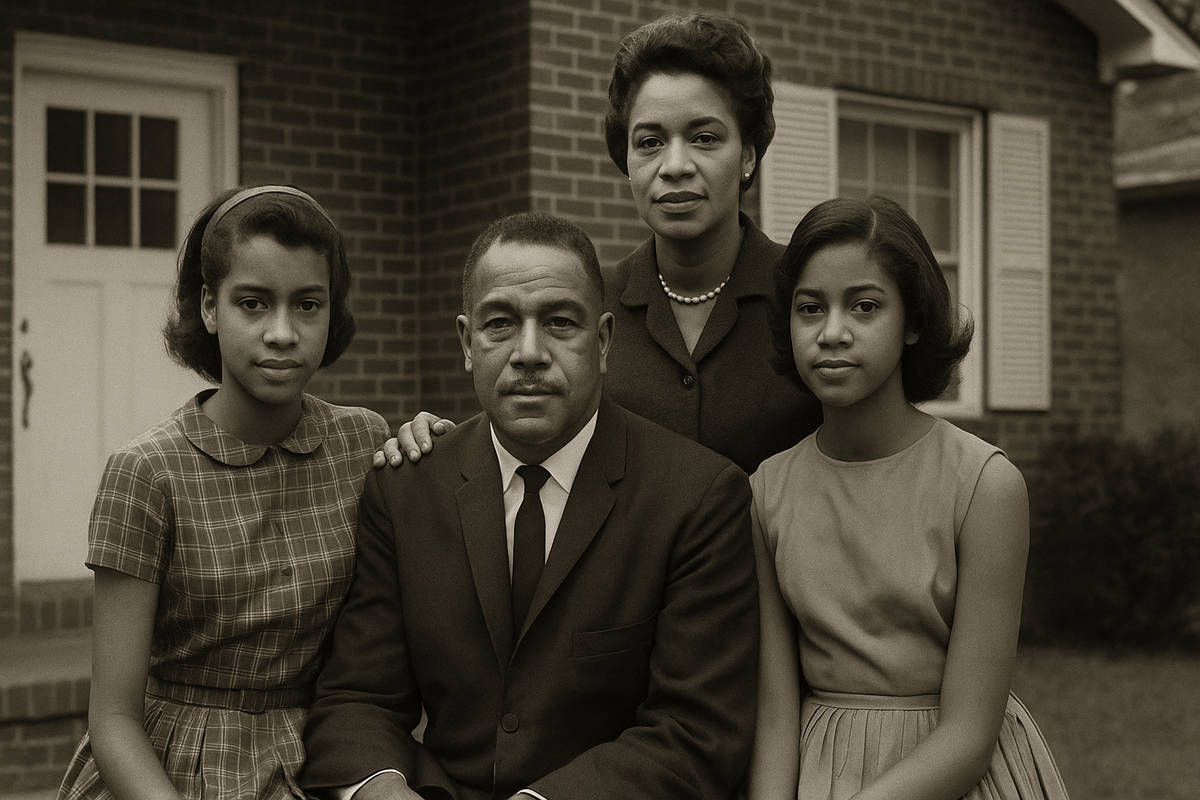
The photograph stops you cold.
Attorney Floyd McKissick stands between his daughters Andree and Jocelyn on the cover of Jet Magazine's August 1, 1963 issue. No one is smiling. Their eyes carry the weight of a family that has chosen to live on the razor's edge of history—integrating white schools, litigating segregation cases, turning their home into an organizing headquarters while death threats arrive by mail. The headline reads: "North Carolina's Bias-Battling McKissick Clan."
Three weeks later, Martin Luther King would deliver "I Have a Dream" at the March on Washington. But this issue of Jet captured something equally essential: the truth that the Civil Rights Movement was not won by speeches alone. It was won in living rooms that doubled as war rooms, by children who walked into hostile classrooms, and by families who understood that freedom demanded everything.
Archive Context
Publication: Jet Magazine
Issue Date: August 1, 1963
Featured Subject: Attorney Floyd McKissick and Family
Historical Significance: Published three weeks before the March on Washington, during the pivotal summer of the Civil Rights Movement
Archive Source: Original Magazine Collection
The Summer America Broke Open
The summer of 1963 was the hinge point. Birmingham's streets had run with fire hoses in May. Medgar Evers had been assassinated in his driveway in June. King sat in a jail cell writing his "Letter from Birmingham Jail," arguing that justice delayed was justice denied. The nation was watching the South, and the South was watching itself tear apart over a single question: Would segregation stand or fall?
Into this inferno, Jet Magazine published the McKissick story—not as breaking news, but as something more subversive. This was an intimate profile of what resistance actually looked like when you lived it seven days a week. Floyd McKissick was already a legal heavyweight, having forced the integration of the University of North Carolina's law school and representing clients in cases that cracked open segregated hospitals, schools, and public facilities across the state. But Jet's genius was showing readers what happened when the courtroom adjourned.
They saw Evelyn McKissick running what activists called "Freedom House," a base of operations where strategy sessions unfolded and young organizers gathered. They saw Andree and Jocelyn McKissick walking into Durham schools as integration pioneers, carrying textbooks and the knowledge that their presence was itself an act of defiance. This was not a story about a heroic individual. This was a story about a family that had made civil rights their operating system.
Jet's Radical Intimacy
By 1963, Jet had evolved into something mainstream American media could not replicate: a publication that treated Black life as the default, not the deviation. While Life and Time offered sporadic civil rights coverage framed for white anxiety, Jet gave its readers unfiltered access to the movement's engine room. Its pocket-sized format made it affordable and portable—passed between neighbors, read in beauty parlors, carried in purses. It was infrastructure.
The McKissick feature exemplified this approach. Readers learned that Floyd McKissick combined nonviolent philosophy with strategic hardness, warning that "you have to back up what you say in order to negotiate a settlement." They discovered that his home was not a refuge from the movement but its nerve center. They saw his daughters not as symbolic tokens but as young women whose school days were acts of political warfare.
Jet understood that its audience did not need the movement explained or justified. They needed to see themselves reflected in it—to know that other families were making the same impossible choices, enduring the same threats, holding the same faith that their sacrifices would compound into freedom.
The Architecture of the Article
The piece itself was structured as both journalism and testimony. Floyd McKissick emerged not as a distant legal tactician but as a father who had trained his children to participate in history. His legal victories—opening UNC to Black students, desegregating hospitals, defending clients trapped in Jim Crow's legal machinery—were presented alongside his family's daily realities.
A Family on the Frontlines
Floyd McKissick trained his daughters to participate in the struggle. Andree and Jocelyn integrated Durham schools while Evelyn supported activists from their home.
The Legal Battles
McKissick was attorney of record in cases that opened UNC to Black students, forced hospitals to admit Black patients, and secured rights for countless clients.
Non-Violence with Militancy
McKissick affirmed nonviolent protest while emphasizing strength and readiness, combining moral conviction with strategic toughness.
Community Organizing
The McKissick home became "Freedom House," a hub for planning, meetings, and youth mobilization—demonstrating the intergenerational nature of the struggle.
Jet's reporting captured McKissick's philosophy in full dimension. He affirmed nonviolence as both religious commitment and tactical necessity, but he rejected passivity. His leadership model combined moral conviction with operational toughness—a recognition that negotiation required leverage, and leverage required the willingness to disrupt.
The photographs worked in concert with the text. Unlike mainstream outlets that often depicted civil rights protests as chaos or spectacle, Jet's images emphasized dignity and deliberation. The McKissick family appeared not as victims or supplicants but as strategists in control of their narrative. The visual message was unmistakable: this family was not asking for permission. They were claiming what was already theirs.
Why This Issue Endures
For collectors and historians, the August 1, 1963 Jet represents a convergence of forces. It arrived at the apex of the movement's most visible summer, just weeks before the March on Washington permanently altered the national conversation. It documented a family whose contributions would ripple through decades—Floyd McKissick would later lead the Congress of Racial Equality (CORE) and become one of the movement's most influential voices.
But its deeper value lies in what it preserved about the movement's texture. History books record legislation and speeches. Jet recorded the granular reality: the kitchen-table meetings, the children's courage, the marriages that survived under impossible pressure, the homes that became institutions.
The cover itself has become iconic—that unflinching family portrait, those headlines that refused euphemism. For anyone studying how social movements sustain themselves across generations, this issue is a primary source without equivalent. It shows that revolutions are not ignited by individuals alone. They are carried by families willing to become the story they want history to tell.
A Living Document
What makes vintage Jet magazines irreplaceable is their proximity to the moment. These were not retrospective analyses written with the luxury of hindsight. They were dispatches from the front, created for readers who needed information and inspiration in real time. The urgency is embedded in every page.
When you hold the August 1, 1963 issue today, you are holding what the McKissicks' neighbors held that summer—the same ink, the same photographs, the same promise that resistance was not futile. You are touching an artifact created not for museums but for movement, and that immediacy has not diminished.
Collector Significance
Historical Timing
Published during the transformative summer of 1963, just weeks before the March on Washington, documenting leaders whose sacrifices shaped the nation's future.
Cultural Impact
Spotlights the role of everyday African American families in the struggle for equality, not just famous figures—showing civil rights as a lived, daily commitment.
Iconic Cover
The image of Floyd McKissick with his daughters Andree and Jocelyn remains one of the most memorable Jet covers, symbolizing dignity and generational continuity.
Primary Source Value
Civil rights-era Jet issues remain highly sought by historians, archivists, and families preserving tangible links to this pivotal chapter of American history.
Explore the Collection
Thousands of original Jet magazines spanning the 1950s through the 1970s document the Civil Rights Movement, Black political power, and cultural milestones that reshaped America.
Browse Jet Magazine CollectionEpilogue
The August 1, 1963 issue of Jet Magazine is not merely a collector's item. It is evidence of what it cost to dismantle Jim Crow—not in abstraction, but in the daily arithmetic of one family's life. Floyd McKissick and his family understood that freedom was not granted. It was litigated, integrated, organized, and lived into existence.
To hold this issue is to hold the summer when America's moral reckoning could no longer be postponed. It is to remember that the movement's most powerful weapon was not rhetoric but families who made resistance their inheritance, passing it from parents to children like a second heartbeat.
For anyone who understands that history is not background scenery but the accumulated choices of ordinary people under extraordinary pressure, this issue of Jet is essential. It is a reminder that we are still living in the world the McKissicks helped build—and that their story, preserved in these pages, remains unfinished.