
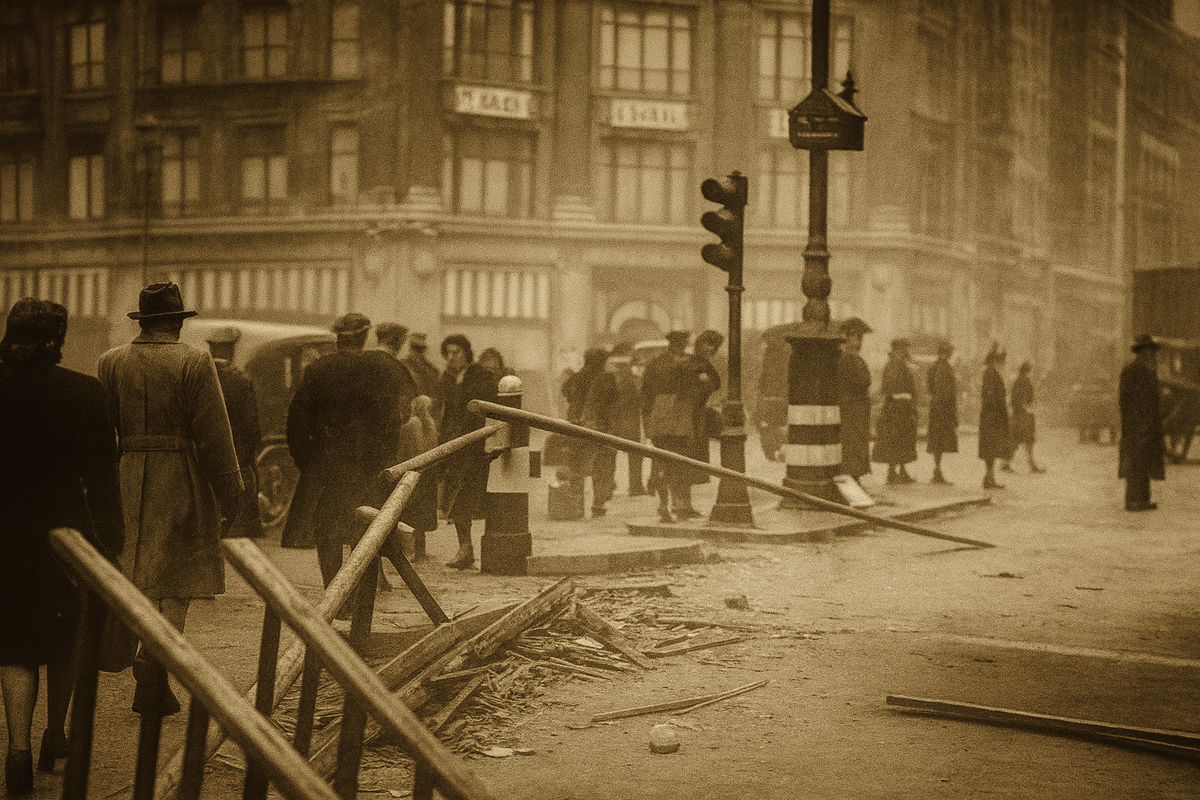
When America Saw London Burning
The Life Magazine Issue That Changed Everything
The date was January 13, 1941. America was still at peace. And on newsstands across the country, a magazine appeared that would crack open that fragile neutrality like a fissure in glass.
The cover of Life showed Frances Webb Dyer in a moonlit swimsuit—glamorous, carefree, utterly American. But turn the page, and you entered hell. Walter Graebner's photo-essay "London Stands Up to the Blitzkrieg" wasn't journalism. It was a transmission from a city on fire, delivered in black-and-white proof that modern war had arrived—and it didn't care about borders, neutrality, or wishful thinking.
For millions of Americans leafing through that issue, this was the moment the distant European conflict became visceral. Real. Unavoidable.
The City That Refused to Break
By January 1941, London had endured four months of systematic obliteration. Since September 1940, German bombers had hammered the capital in nightly raids designed to shatter British morale and collapse the war effort from within. The arithmetic was staggering: in 90 days, more than 100,000 bombs—high explosives and incendiaries—had fallen on a single city. Over 18,000 civilians were dead. Tens of thousands more were injured, displaced, or buried alive in the rubble of their own homes.
Graebner didn't sanitize it. His article showed Oxford Circus in ruins. The John Lewis department store reduced to skeletal walls. Working-class neighborhoods in the East End flattened into lunar landscapes. The Horefery School disaster in West Ham, where a single bomb killed hundreds sheltering in what they thought was safety. Rail stations blown apart. Gas mains erupting. Fires consuming entire streets.
But here's what made the essay unforgettable: London hadn't stopped. People queued for food. Went to work. Attended weddings and theater performances within sight of smoking craters. The Blitz wasn't just a story of destruction—it was a study in defiance at the cellular level.
Archive Intelligence
Publication: Life Magazine
Issue Date: January 13, 1941
Photo-Essay: "London Stands Up to the Blitzkrieg" by Walter Graebner
Cover Subject: Frances Webb Dyer
Historical Context: Published 11 months before Pearl Harbor, when America was still officially neutral
How Life Made War Immediate
In 1941, Life Magazine was the most powerful visual medium in America. It didn't report the news—it showed you the news, in two-page photographic spreads that no newspaper or radio broadcast could match. And in this issue, the images didn't illustrate Graebner's text. They were the text.
Mannequins scattered across the rubble at John Lewis, their limbs twisted like corpses—a visual metaphor no caption could improve.
Children asleep in Underground stations, bunk beds lining the Tube platforms where 150,000 Londoners sheltered each night.
A woman pulled alive from a collapsed building after 18 hours buried—rescue workers covered in dust, their faces blank with exhaustion.
Hospital wards moved underground, beds crammed into corridors, medicine adapting to Armageddon in real time.
Sandbags stacked outside 10 Downing Street, proof that even Churchill's war room was vulnerable.
A man selling bananas on a blasted street. A bride in white, stepping over rubble on her wedding day.
For Americans still insulated from the war, these images did what words alone never could. They collapsed distance. The Blitz wasn't happening "over there." It was happening here, on the coffee table, in your hands. And the subtext was impossible to ignore: if it could happen to London, it could happen to anyone.
The Deliberate Dissonance of the Cover
That Frances Webb Dyer cover wasn't an accident. It was editorial strategy.
Life understood something profound about wartime psychology: you couldn't bombard readers with unrelenting horror, or they'd shut down. So the magazine embedded its hardest truths inside a matrix of American normalcy—fashion, glamour, Hollywood, sports. The swimsuit model on the cover was a promise: the world you know still exists. But inside, Life made you confront the world that was coming.
This was the magazine's genius. It didn't preach or propagandize. It simply showed you what was happening and trusted you to draw your own conclusions. And for a nation still debating isolationism versus intervention, that approach was devastatingly effective.
The Human Equation of Survival
Graebner's reporting captured details that statistics couldn't:
What emerged from Graebner's account wasn't propaganda about British pluck. It was something more unsettling: proof that human beings could normalize almost anything, even nightly bombardment, if survival depended on it.
The Permanence of the Past
We consume today's news in seconds and forget it by morning. But Life magazines were designed to be kept. Studied. Passed down. They're time capsules that still hold their original emotional charge—fear, determination, grief, resilience—printed on paper and preserved for generations.
The January 13, 1941 issue is a reminder that history isn't just dates and battles. It's ordinary people enduring extraordinary circumstances. It's a city refusing to surrender. It's a magazine that showed Americans what was at stake before they were ready to see it.
And it's still here. Still speaking. Still showing us what courage looked like when the world was on fire.
Why This Issue Endures
Published before Pearl Harbor, before America entered the war, this issue captured Britain at its most isolated and vulnerable. It's a record of the moment when the outcome was still uncertain—when Hitler controlled continental Europe and London stood alone.
These images remain among the most searing visual records of civilian warfare published in the United States during the war. They weren't propaganda posters. They were documentary evidence.
This issue helped shift American public opinion. Isolationism was harder to defend when you'd seen what fascism looked like in practice.
Wartime magazines were read to pieces, discarded, pulped for paper drives. Surviving copies in good condition are scarce, particularly issues with intact photo spreads.
For families whose ancestors lived through the Blitz—or who served in the war that followed—this issue is a tangible link to their history. It's not abstract. It's the same pages their grandparents saw.
Explore the Archive
Thousands of original Life magazines—from the 1930s through the 1970s—are available in our collection. Follow entire decades of history, culture, and war as they were first reported, printed, and preserved.
Whether you're a collector tracking down wartime issues, a historian researching primary sources, or someone honoring family members who lived through these events, vintage Life magazines offer something irreplaceable: history as it was first seen, held, and understood by the people who lived it.
Browse Life Magazine Collection