
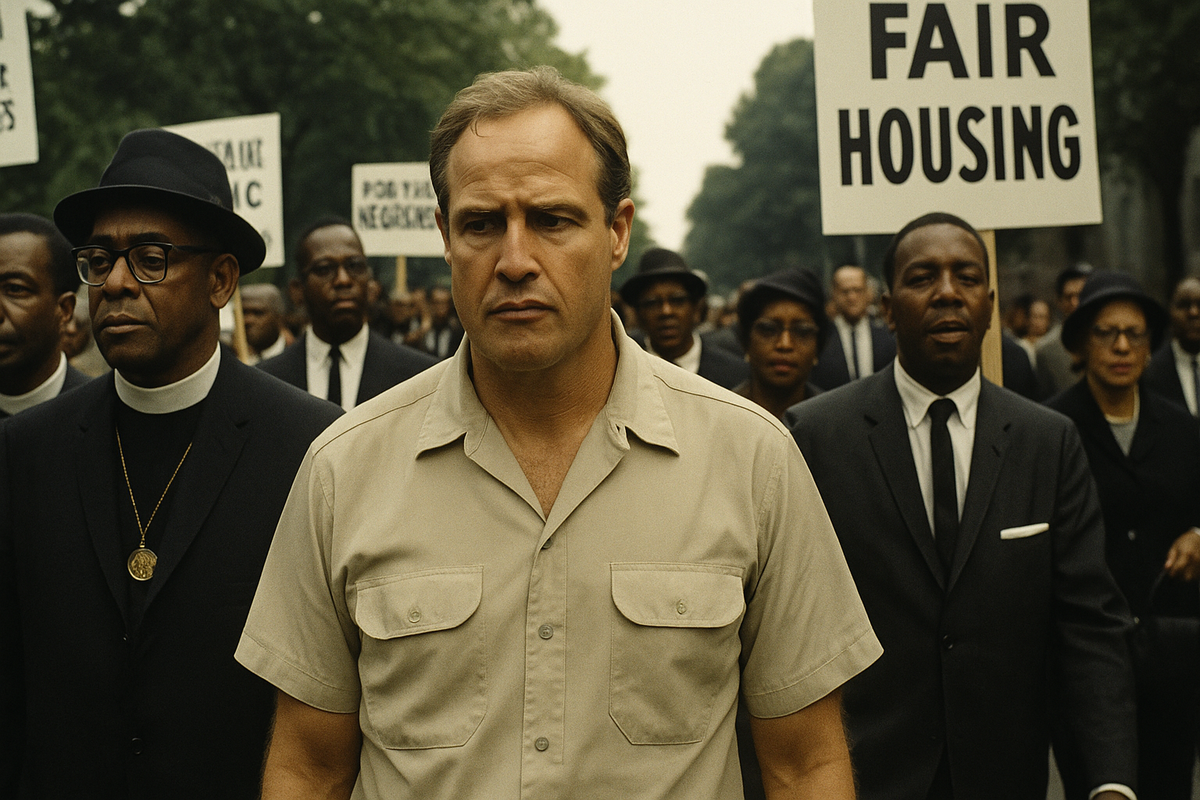
When Marlon Brando Joined the Picket Line
The October 1963 Ebony Magazine That Changed Everything
October 1963. America stood at a crossroads. Two months after Martin Luther King Jr.'s "I Have a Dream" speech echoed across the National Mall, one month after Birmingham's children faced down police dogs, weeks after Medgar Evers' blood stained a Mississippi driveway—Ebony magazine made a calculated gamble.
They put a white man on the story.
Not just any white man. Marlon Brando, Hollywood's most bankable rebel, stared out from the pages in stark black-and-white portraiture. No studio gloss. No matinee idol charm. Just the face of a man who had walked away from film sets to stand on picket lines, who had opened his checkbook for the Southern Christian Leadership Conference, who had decided his fame meant nothing if he stayed silent.
The article's title was blunt: "Brando Fights for Civil Rights."
What followed was something American media had rarely attempted—a full-throated examination of what it meant when celebrity met conscience, when Hollywood glamour collided with the brutal reality of housing discrimination, when one of the most famous actors alive looked into a camera and said the system was rigged.
For collectors and historians today, this issue represents more than vintage ephemera. It's a primary document of the exact moment when the Civil Rights Movement became impossible for mainstream America to ignore.
Archive Details
Historical Figure: Marlon Brando
Issue Date: October 1963
Archive Source: Ebony Magazine
Article Title: "Brando Fights for Civil Rights"
Author: Louie Robinson
The Year Everything Accelerated
By October 1963, the Civil Rights Movement had shed any pretense of being a regional concern. The March on Washington for Jobs and Freedom had drawn a quarter million people in August. Birmingham's spring protests had forced President Kennedy to address the nation about civil rights legislation. Medgar Evers' assassination in June had made martyrs visible on evening news broadcasts.
Into this maelstrom, Ebony placed Brando—not as a curiosity, not as a token ally, but as evidence of seismic cultural shift.
The magazine had already established itself as the authoritative voice on Black American achievement, politics, and culture. Founded in 1945 by John H. Johnson, Ebony combined the visual appeal of Life with the editorial authority of a publication that understood its audience's dual hunger: to see themselves reflected with dignity, and to document their own history as it unfolded.
When Ebony dedicated substantial space to a white celebrity's activism, it wasn't celebrity worship. It was strategic journalism. The message: this movement had grown so powerful that even Hollywood's most reluctant political voices could no longer pretend neutrality.
The Hollywood Enigma Goes to War
Brando's reputation in 1963 preceded him—method actor, box office titan, perpetual maverick. But Ebony's coverage, reported by Louie Robinson, revealed something the entertainment press had largely ignored: Brando's systematic, sustained involvement in civil rights organizing.
The article documented his financial commitments first. Thousands of dollars to the SCLC. Contributions to a scholarship fund for Medgar Evers' children. These weren't publicity stunts timed to film releases. They were quiet, repeated investments in movement infrastructure.
Then came the physical presence. Photographs showed Brando on Los Angeles picket lines organized by the Congress of Racial Equality (CORE), protesting housing discrimination. He stood shoulder-to-shoulder with Black clergy and demonstrators, holding signs demanding "Fair Housing for All." The images captured something Hollywood trades rarely showed: a star subjecting himself to the same risks, the same police hostility, the same public scorn as ordinary activists.
What transformed obligation into conviction, Brando explained, was hearing Martin Luther King Jr. speak. King's speeches forced him to confront an uncomfortable question: What was he doing with his platform? The self-interrogation led him from Hollywood soundstages to protest lines, from celebrity receptions to organizing meetings.
The Editorial Coup: What Ebony Could Do That No One Else Could
White newspapers might have treated Brando's activism as an oddity—famous actor plays protest. Entertainment magazines would have buried it or ignored it entirely, unwilling to alienate audiences or advertisers.
Ebony did neither.
The magazine framed Brando's involvement within the larger architecture of the movement while holding space for hard political analysis. In Robinson's interview, Brando didn't discuss his next film role. He discussed hiring discrimination in Hollywood studios, where casting directors routinely requested a "Chinese girl" or a "Negro girl" as if ordering from a catalog. He condemned the absence of Black writers, directors, and producers. He called out white Southerners for clinging to myths about interracial relationships and racial superiority.
Most pointedly, Brando criticized his Hollywood peers—actors and executives who stayed silent because speaking up might hurt their careers or their box office. The dangers of silence, he insisted, outweighed the dangers of action.
Only Ebony possessed both the access to secure this kind of candid interview and the editorial mandate to publish it without softening the edges. The result was a document that served dual purposes: validating Black readers who saw a powerful ally step forward, and challenging white readers who might still have believed civil rights was someone else's problem.
The Photographs That Made It Real
Ebony's visual storytelling matched its editorial ambition. The photo essay inside the October 1963 issue abandoned Hollywood iconography entirely.
Readers encountered Brando:
- At a reception for Martin Luther King Jr., microphone in hand, publicly increasing his pledge to the SCLC
- Marching through Los Angeles streets, surrounded by clergy and activists, signs raised high
- Confronting police as protests were broken up, facing down hostility alongside demonstrators
- Dictating letters to his secretary between film commitments, his activism bleeding into every corner of his schedule
These weren't publicity stills. They were evidence. Visual proof that the Civil Rights Movement had achieved something unprecedented: making civil rights activism a requirement of moral citizenship, even for those who lived insulated by wealth and fame.
The cover image itself signaled the shift. Brando appeared not as a Hollywood heartthrob but as a man marked by seriousness and resolve, photographed in high-contrast black-and-white that emphasized thought over glamour.
For Ebony's readers, these images carried institutional weight. This was their magazine, their editorial voice, their photographic archive—documenting not just what the movement was accomplishing, but who was showing up.
Ten Points of Historical Significance
The Ebony feature crystallized Brando's activism into specific, documentable actions:
Thousands donated to the SCLC and to the scholarship fund for Medgar Evers' children—tangible support, not symbolic gestures.
Joining CORE picket lines in Los Angeles targeting housing segregation, subjecting himself to the same risks as other demonstrators.
Crediting Dr. King's speeches with forcing his own reckoning about platform and responsibility.
Publicly condemning Hollywood's tokenism and systematic exclusion of Black professionals from writing, directing, and producing roles.
Photographed marching for "Fair Housing for All," addressing discrimination that kept Black buyers locked out of entire neighborhoods.
Speaking frankly about white Southerners' myths regarding miscegenation and racial superiority.
Describing how studios casually requested actors by race as if ordering supplies, revealing normalized discrimination.
Insisting that progress depended not on celebrities alone but on ordinary Americans "playing ordinary parts"—a recognition that lasting change required mass participation.
Criticizing Hollywood peers who stayed quiet to protect their careers, framing neutrality as a moral failure.
Maintaining that progress was inevitable if people acted with courage, even as activists faced violence and death.
Ebony's Legacy: Mirror, Megaphone, Archive
Ebony never positioned itself as neutral observer. From its 1945 founding, the magazine understood its purpose: to document Black American life with dignity, to celebrate achievement without apology, to hold power accountable, to serve as both mirror and megaphone for a community systematically excluded from mainstream media.
The Brando article exemplified this mission perfectly—blending politics, culture, entertainment, and activism into a single narrative that refused to choose between celebration and critique.
For modern readers and collectors, vintage Ebony issues function as living historical archives. They capture not just events but how those events were understood in real time by the communities living through them. The advertisements, the editorials, the photo essays, the letters to the editor—all of it forms a composite portrait of Black American life across decades.
This isn't nostalgia. It's primary source material.
Why This Issue Matters to Collectors
Historical Timing
Published weeks after the March on Washington and Medgar Evers' assassination, it serves as a primary document of 1963's urgency. Collectors acquire not just a magazine but a time capsule from the year America's racial reckoning went national.
Editorial Authority
Few magazines of the era devoted this much space to examining a white celebrity's role in civil rights, and none did so with Ebony's combination of insider access and unapologetic political clarity.
Photographic Archive
The images of Brando marching with CORE and standing alongside King are rare visual evidence of cross-racial solidarity in action. They document coalition-building that often gets lost in simplified historical narratives.
Cultural Artifact Status
Issues featuring civil rights leaders, major political moments, and entertainment figures are among the most sought-after Ebony covers. Historians, archivists, and families preserving cultural memory prize them as both documentation and heritage.
Condition Rarity
Sixty-plus years of handling, storage, and circulation mean finding intact copies grows harder annually. Issues in good condition command premium attention from serious collectors.
Investment Value
Owning this issue means possessing evidence of the moment when the Civil Rights Movement's moral authority became so overwhelming that even Hollywood's biggest star felt compelled to risk everything for it.
The Enduring Power of Witness
More than six decades after publication, "Brando Fights for Civil Rights" still speaks with urgency. It reminds us that justice movements have always required not just leaders but allies. That fame and platform carry moral obligations. That silence, when injustice is visible, constitutes complicity.
It also reminds us that the best historical journalism doesn't just report events—it interprets them, contextualizes them, and preserves them for generations who will need to understand how change actually happens.
For collectors, this issue isn't memorabilia. It's evidence. Evidence that courage can be contagious. Evidence that movements can reach critical mass. Evidence that when even the most reluctant voices join the chorus, history takes notice.
And evidence that Ebony was there to document it all.
For Collectors: How to Acquire Pieces of History
If you're building a collection focused on civil rights history, cultural journalism, or 20th century American media, the October 1963 Ebony represents an essential acquisition. It's one of the few issues where Hollywood celebrity and civil rights activism converge so directly, making it particularly valuable for comprehensive collections.
Browse Ebony Magazine CollectionExplore decades of documented history—political milestones, cultural icons, sports heroes, artistic legends, and social movements—all captured with Ebony's signature blend of honesty and pride.