
Lost Behind the Ranges
When America Looked Up at K2 While Europe Burned
On March 16, 1940, Americans opened their mailboxes to find something unexpected wedged between the war dispatches and depression-era anxieties: a vision of men climbing toward heaven.
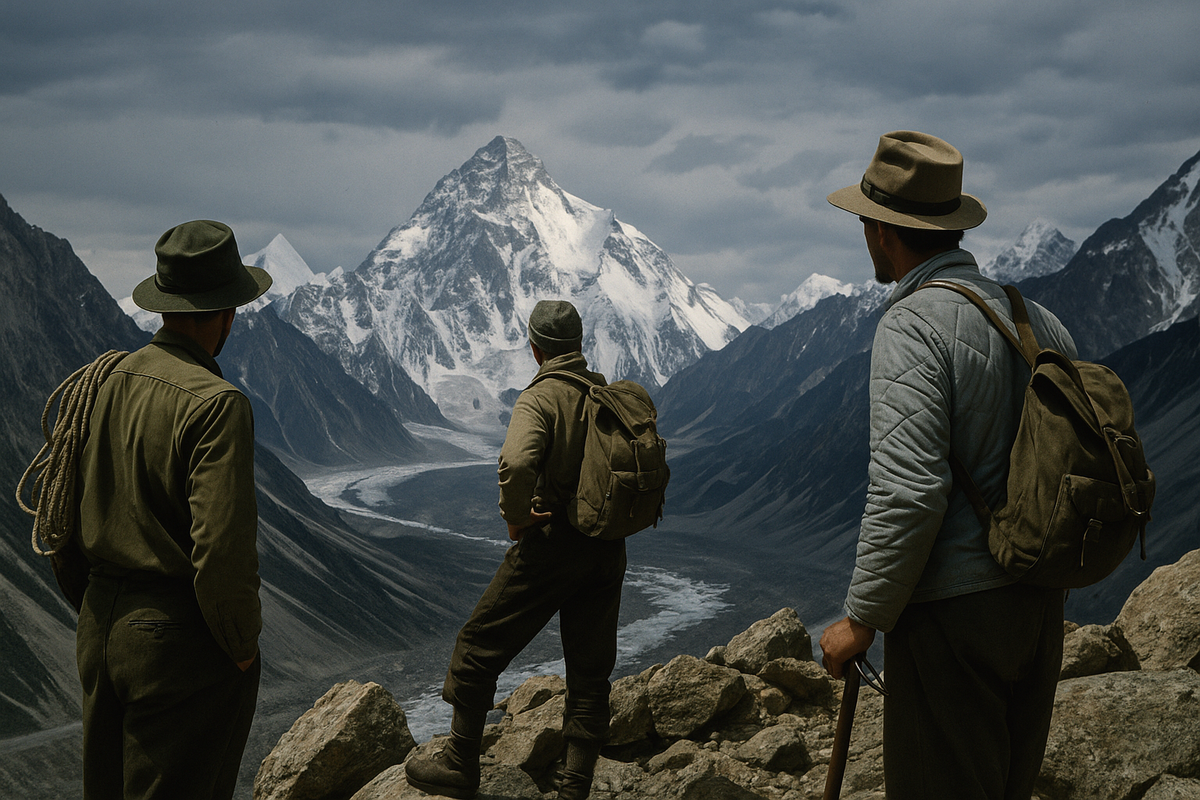
The Saturday Evening Post—that ubiquitous chronicle of American life—had placed on its cover not Norman Rockwell's small-town charm, but the Himalayan ranges. Inside, George C. Sheldon's "Lost Behind the Ranges" delivered 28,250 feet of frozen ambition: the story of American climbers who had thrown themselves at K2, the mountain that makes Everest look merciful.
The timing was everything. While Hitler's armies rolled across Europe and America clung to neutrality, the Post offered its readers a different kind of battle—one fought on ice walls and in thin air, where the enemy was nature itself and defeat came with honor intact.
This wasn't escape. It was rehearsal.
Historical Context
Featured Story: "Lost Behind the Ranges" by George C. Sheldon
Issue Date: March 16, 1940
Publication: The Saturday Evening Post
Expedition Leader: Fritz Wiessner
Mountain: K2 (28,250 feet) — Karakoram Range
The Expedition That Became Legend
Fritz Wiessner led them—a team that included Jack Durrance, Tony Cromwell, and Chappell Cranmer. They crossed Kashmir and Little Tibet with Sherpa guides, carrying rope, ambition, and the unshakable American conviction that impossible was just another word for not yet.
K2 had already earned its nickname: the Savage Mountain. Second to Everest in altitude but first in lethality, its slopes had turned back every expedition that dared approach. The weather turned without warning. The routes defied logic. And at 28,000 feet, where oxygen becomes a luxury, every decision carried the weight of survival.
Sheldon's account spared nothing. Avalanches. Frostbite. The grinding exhaustion of altitude. When Chappell Cranmer fell gravely ill, readers confronted the razor's edge between triumph and tragedy that defined every step above 20,000 feet. The photographs—climbers reduced to dark specks against impossible verticality—bridged the gap between a Kansas living room and the roof of the world.
The summit went unreached. But failure, Sheldon understood, was the wrong word. The expedition proved what Americans needed to believe in 1940: that some frontiers demanded everything, and attempting them was its own form of victory.
Why The Saturday Evening Post Mattered
By 1940, the Post had become America's mirror and window both. Norman Rockwell's covers celebrated the nation's soul. The fiction pages—featuring names like F. Scott Fitzgerald and William Faulkner—elevated popular storytelling to art. The advertisements (Colgate promising whiter teeth, Stetson selling Western masculinity, Aunt Jemima packaging nostalgia as breakfast) mapped the consumer desires of a nation crawling out of depression.
But the long-form journalism—pieces like "Lost Behind the Ranges"—did something more ambitious. They told Americans who they wanted to be.
The March 16, 1940 cover abandoned domestic comfort for raw ambition. Those climbers gazing at the Himalayas weren't just adventurers. They were stand-ins for a country about to test itself against forces it couldn't yet imagine. Six months later, the Blitz would begin. Fifteen months later, Pearl Harbor would end American neutrality forever.
This issue caught the nation in between—still looking outward with wonder, not yet staring into the abyss.
The Magazine as Monument
The Saturday Evening Post succeeded because it understood duality. It was simultaneously provincial and cosmopolitan, comforting and challenging, backward-looking and ambitious. A reader could find both recipes and reportage, both small-town values and global vistas.
This particular issue exemplifies that balance. The Himalayan expedition narrative sits alongside domestic fiction and household advertisements—high ambition literally bound together with everyday life. The magazine insisted these weren't contradictions. They were American.
For historians and collectors, that synthesis makes the Post invaluable. Each issue documents not just events but attitudes, not just facts but feelings. They show us what Americans were reading, buying, fearing, and dreaming in real time.
What Collectors Should Know
Historical Timing
Published in the last full year of American peace, this issue exists at a hinge point in history. The advertisements still promise abundance. The fiction still assumes a world where adventure is chosen, not assigned. Within two years, the Post's pages would be dominated by war bonds and victory gardens.
Rarity of Subject
High-altitude mountaineering narratives in mainstream American magazines were uncommon. Most climbing literature lived in specialized journals. Sheldon's piece brought technical difficulty and mortal stakes to a mass audience—a feat as remarkable as the climb itself.
The Wiessner Context
Fritz Wiessner's 1939 K2 expedition (recounted here in 1940) remains controversial in mountaineering history. Some called him reckless. Others recognized genius. This article captures the expedition before decades of analysis complicated the narrative.
Cultural Artifact
Beyond the climbing story, this issue preserves an entire ecosystem of 1940 America—the serialized fiction, the editorial cartoons, the advertisements that promised a prosperity the war would defer. It's a time capsule that happens to contain one of the era's great adventure stories.
Cover Appeal
While Rockwell covers dominate the collector market, adventure-themed issues—particularly with Himalayan imagery—attract a different, often more passionate subset of collectors. Mountaineering enthusiasts, exploration historians, and vintage adventure literature specialists all compete for the same finite supply.
Explore the Archive
Our complete collection of original Saturday Evening Post magazines spans from the Great Depression through World War II and into the postwar boom. Each issue offers unmediated access to the American century as it unfolded—no retrospective analysis, no historical distance, just the raw cultural document.
Browse The Saturday Evening Post Magazine CollectionWhat Remains
More than eighty years later, "Lost Behind the Ranges" endures not as a climbing story but as a cultural document. It captures Americans confronting the limits of human endurance at the precise moment history was about to test them in ways they couldn't foresee.
The climbers on K2 didn't reach the summit. Six months later, neither would Europe's democracies. But both kept climbing. Both understood that some struggles define you regardless of outcome.
Holding the March 16, 1940 Saturday Evening Post means holding that moment—when courage still looked like adventure, when frontiers still beckoned, when Americans still believed that any peak, however savage, could be approached with enough determination and rope.
The mountain is still there. So is the magazine. Both testify to what humans attempt when they refuse to look away from the impossible.