
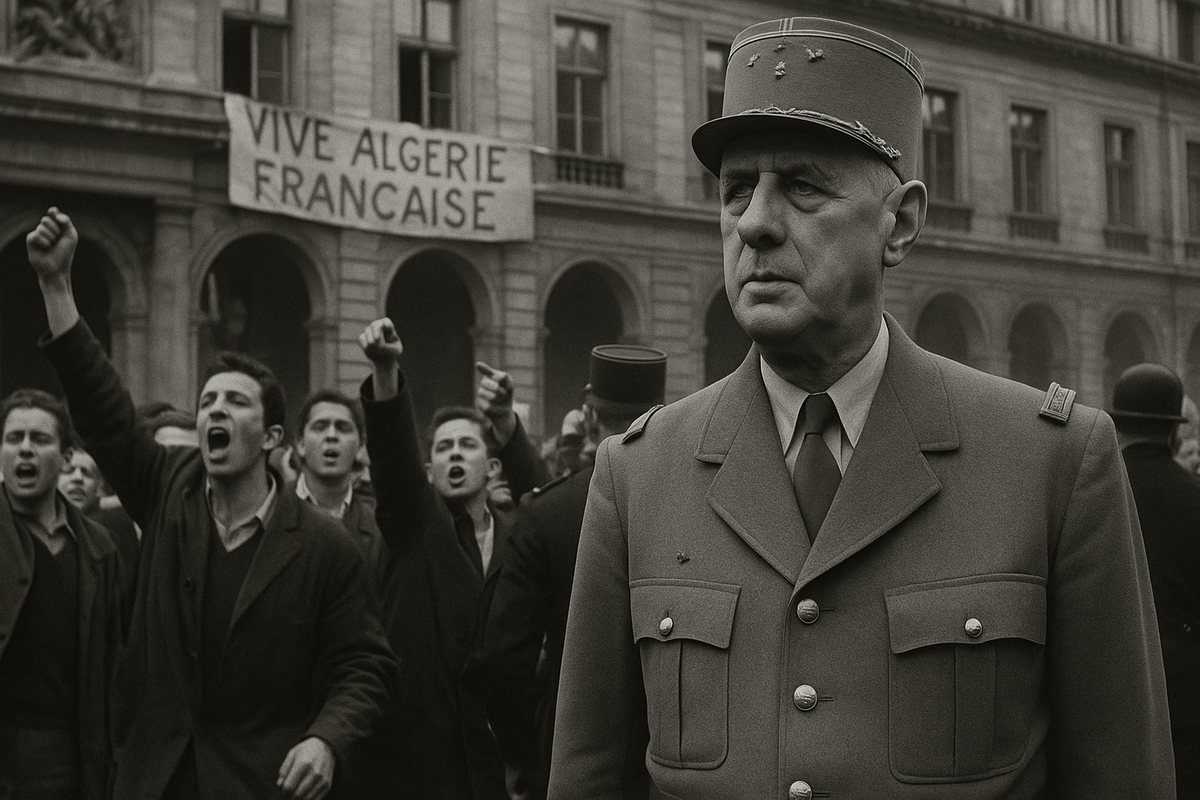
When France Nearly Fell: The Time Magazine That Captured De Gaulle's Resurrection
Inside the May 26, 1958 issue that documented the collapse of the Fourth Republic and the return of France's wartime savior
On May 26, 1958, Americans opened their mailboxes to find something extraordinary: not merely a magazine, but a dispatch from the edge of democratic collapse.
That week's issue of Time bore the stern, unmistakable face of Charles de Gaulle on its cover—a man who had once saved France from Nazi occupation and now stood ready to save it again, this time from itself. Inside those pages, readers discovered a nation tearing apart: paratroopers seizing Algiers, mobs storming the National Assembly in Paris, and a government so paralyzed that twenty-five administrations had risen and fallen in just twelve years.
This wasn't distant political theater. It was the death of the Fourth Republic, captured in real time.
For collectors and historians today, this single issue represents something rarer than most realize: the precise moment when postwar France pivoted from chaos to authoritarianism, when colonial war shattered democratic institutions, and when a general stepped forward with two words that would reshape Europe—"I am ready."
Archive Document
Publication: Time Magazine
Issue Date: May 26, 1958
Historical Figure: Charles de Gaulle
Historical Event: Fall of the Fourth Republic / Algerian Crisis
Archive Source: Original Print Edition
The Week France Broke
By spring 1958, the Algerian War had bled France for nearly four years. In Algiers, French settlers and sympathetic army officers had grown contemptuous of Paris politicians, whom they saw as too weak to win the war or protect French Algeria. Their contempt metastasized into rebellion.
On May 13, General Jacques Massu—hero of earlier Algerian campaigns—led a military-backed insurrection that toppled the colonial administration and demanded de Gaulle's return. Massu's paratroopers controlled the streets. Rumors spread through Paris that airborne units might soon land in the capital itself. The Fourth Republic, that rickety structure of revolving-door governments, faced its gravest constitutional crisis since World War II.
In Paris, Premier Pierre Pflimlin—capable but doomed—struggled to hold together an Assembly that had lost all authority. No one believed civilian rule could survive. The only question was whether France would descend into civil war or accept the return of the general who had led Free France against Hitler.
De Gaulle, waiting at his country estate in Colombey-les-Deux-Églises, understood the moment. He would not beg. He would not negotiate. He simply announced his availability: "I am ready."
How Time Made History Immediate
Time had perfected the art of transforming foreign crises into American living room drama. Rather than drowning readers in parliamentary procedure or colonial policy, the May 26 issue sketched the crisis as Shakespeare would have—complete with tragic heroes, doomed statesmen, and rebellious soldiers.
De Gaulle appeared in stark black-and-white on the cover, his military bearing and austere expression radiating wartime authority. Inside, the magazine introduced three men whose fates would determine France's future:
Charles de Gaulle, the general in exile, waiting with calculated patience for his country to call him back.
Pierre Pflimlin, the premier caught between military demands and parliamentary impotence, a competent man in an impossible position.
Jacques Massu, the defiant paratrooper whose rebellion in Algiers forced the crisis to its breaking point.
Where newspapers catalogued events, Time delivered atmosphere: the roar of crowds storming government buildings, the whispered rumors of coups, the electric tension in both Paris and Algiers. For Americans still learning to navigate the Cold War's complexities, this narrative style made distant chaos visceral and urgent.
The magazine did more than report. It interpreted, dramatized, and preserved. In an era before television saturated American homes with images from abroad, Time was how millions of readers saw the world beyond their borders.
What the Issue Revealed
The May 26, 1958 edition captured five interlocking dramas:
De Gaulle's Calculated Return
His readiness to reclaim power, leveraging his wartime legend to position himself as France's only salvation.
Pflimlin's Impossible Task
Trying to govern a nation that had stopped believing in civilian leadership.
Massu's Open Defiance
A soldier's rebellion that shattered the boundary between military and political authority.
Street Violence in Paris
Mobs overwhelming the symbols of democratic power, exposing how fragile the Fourth Republic had become.
The unspoken truth that Time's editors understood immediately: this wasn't a political crisis that would pass. It was regime change. The Fourth Republic was finished. The Fifth Republic—de Gaulle's republic, with its powerful presidency and weakened parliament—was already being born.
Readers in 1958 witnessed history as it happened. We, holding this issue now, witness how history was first understood.
Why Time Magazines Endure
The value of vintage Time magazines transcends their subject matter. They represent a specific form of cultural transmission—how America learned to see the world during the Cold War.
Time's editors understood that analysis without narrative felt bloodless, that photographs without context meant little, that Americans needed both information and interpretation. By mixing sharp reporting with vivid description, by pairing images with storytelling, Time made distant events immediate.
These magazines are time capsules in the most literal sense. They preserve not just what happened, but how it felt to watch events unfold without knowing the ending. They capture uncertainty, urgency, and the texture of a moment before it calcified into history.
Why Collectors Prize This Issue
The May 26, 1958 Time occupies a rare category: the magazine that captured a turning point before anyone fully grasped what had turned.
Historical Precision
Published days after the Algiers insurrection, this issue represents one of the earliest American interpretations of de Gaulle's comeback. It predates academic analysis, memoirs, and retrospective accounts. It is history without hindsight.
Iconic Figures at the Inflection Point
De Gaulle, Pflimlin, and Massu appear not as historical abstractions but as living actors in an unfinished drama. Their portraits in these pages show them exactly as Americans first encountered them.
Cultural Artifact
This is the same edition that Americans studied over breakfast tables in May 1958, wondering whether France might collapse into civil war. To hold it is to touch the exact moment of uncertainty.
Sustained Collector Demand
Issues documenting European crises of the 1950s—particularly those tied to de Gaulle and the birth of the Fifth Republic—command sustained interest from historians, institutions, and serious collectors.
When you hold this magazine, you hold the week when France's fate balanced on a knife's edge.
The Last Word
The May 26, 1958 issue of Time Magazine remains one of the most significant Cold War-era publications. Its coverage of the Algerian crisis, the paralysis of French democracy, and Charles de Gaulle's calculated return gave American readers both clarity and drama in equal measure.
To hold this issue now is to hold the moment when France changed course, when a republic fell and a new one rose from its ashes, when a general became the face of a nation once more. Thanks to Time's sharp reporting and unforgettable imagery, that transformation is preserved—ready for us to study, collect, and remember.
For anyone who values history, vintage Time magazines are not simply paper. They are witnesses.
For Collectors and Historians
If you're drawn to the pivotal moments when democracies falter and strongmen rise, the May 26, 1958 issue of Time Magazine belongs in your collection.
Browse Time Magazine CollectionWhether you collect Cold War memorabilia, study the mechanics of democratic collapse, or simply want to hold the same magazine your grandparents might have read—these issues offer something no digital archive can replicate.