
The Night American Marriage Went to Therapy—In Print
How a January 1953 Ladies' Home Journal feature cracked open the polished veneer of postwar domesticity and launched the most influential marriage advice column in American history
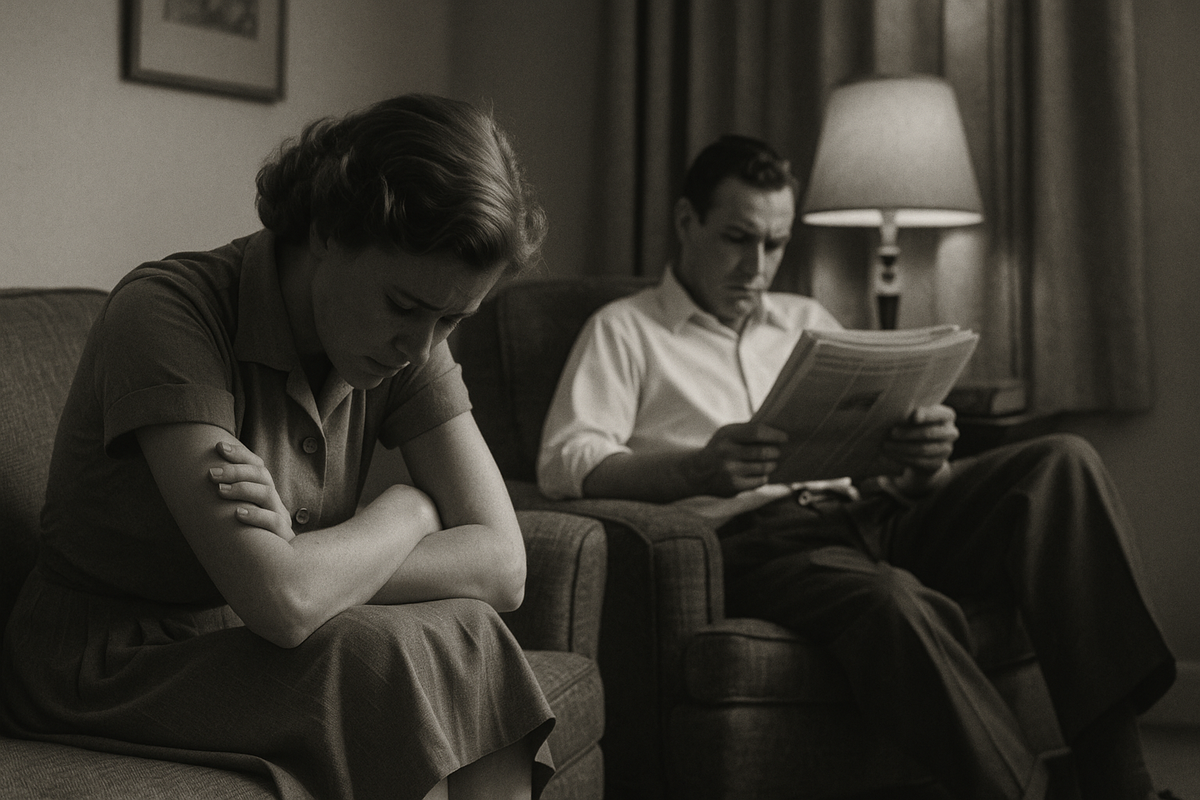
January 1953. A young woman named Diana sits alone in her living room, crying into her arms while her husband reads the newspaper behind her. She is 23 years old. She is in pain during sex. She feels unloved. Her husband thinks she's immature.
And seven million American women are reading about it over breakfast.
When Ladies' Home Journal published "Can This Marriage Be Saved?" that month, it didn't just launch an advice column. It cracked open the polished veneer of postwar domesticity and exposed what was festering underneath: the quiet desperation of suburban marriage, the unspoken sexual disappointments, the emotional starvation masked by white picket fences and casserole recipes.
This wasn't gossip. It was a cultural reckoning—delivered monthly, with photographs.
The Moment America Was Ready to Listen
The timing was everything.
By 1953, the machinery of postwar domesticity was running at full speed. Soldiers had come home, suburbs were sprawling outward like spilled milk, and the baby boom was remaking the American family in real time. Women's suffrage had been won three decades earlier, but its promise felt distant—muted by a culture that insisted a woman's highest calling was the kitchen and the nursery.
Yet beneath the surface, something was shifting. Early feminist currents were stirring. Conversations about sexuality—however coded—were beginning to surface. And millions of women were discovering that the dream they'd been sold didn't match the life they were living.
Ladies' Home Journal had spent decades at the center of these contradictions. Founded in the late 19th century, the magazine had grown into one of the most powerful voices in American womanhood, reaching millions of households each month with a carefully curated mix of fiction, fashion, recipes, health advice, and cultural commentary. It didn't just reflect women's lives—it shaped them.
And in January 1953, it did something radical: it told the truth.
Historical Context
Publication: Ladies' Home Journal
Issue Date: January 1953
Feature Debut: "Can This Marriage Be Saved?"
Cultural Expert: Dr. Paul Popenoe, Director of the American Institute of Family Relations
Archive Significance: First appearance of a marriage advice series that would run for decades and influence generations of American readers
Diana and Guy: A Marriage on the Brink
The inaugural case of "Can This Marriage Be Saved?" presented readers with Diana, 23, and her husband Guy, 25. Their story was laid bare with an unflinching specificity that must have felt shocking for the era.
Diana's testimony: She felt invisible. Guy never complimented her, rarely kissed her, refused to help with household chores. He scattered his clothes around the house and never washed a dish. When she asked for tenderness, he dismissed her as "immature." Their sex life was a source of anguish—she experienced pain, anxiety, nightmares. "I feel like I'm on trial for everything I do," she confessed to the counselor.
Guy's rebuttal: He saw his wife as a child. She cried too much, ruined their honeymoon, turned their home into chaos. He wanted "a clean, peaceful place," not a woman he described as lazy and perpetually dissatisfied. "Sometimes when Diana is crying for herself the way she does," he told the counselor, "I think I'll go crazy."
The magazine amplified this raw confession with striking photography: Diana slumped forward in despair, face buried in her arms, while Guy sat in the background reading his newspaper—a visual metaphor for the chasm between them. These weren't glamour shots. They were staged domestic crime scenes.
Enter the Expert: Dr. Paul Popenoe and the Science of Salvage
The article introduced Dr. Paul Popenoe, director of the American Institute of Family Relations, as the clinical authority tasked with diagnosing the marriage. His assessment was direct:
Diana and Guy were immature and self-absorbed, unprepared for the realities of married life. Their sexual relationship had collapsed because Guy rejected tenderness as "unmanly" while Diana compared him unfavorably to other men. Their communication was poisoned by criticism, neglect, and scorekeeping.
Popenoe's prescription: Stop the self-pity. Stop tallying grievances. Start cultivating tenderness, compliments, emotional generosity. Build a "new marriage" from the ruins of the old one—not by finding new partners, but by transforming attitudes.
For readers in 1953, this was revolutionary. Marriage problems weren't moral failures to be hidden—they were solvable puzzles. The advice was frank, sometimes brutally so, yet it arrived in a format that felt safe, authoritative, and constructive. It gave permission to acknowledge what many women had been whispering to themselves for years: This is hard. This isn't working. And maybe it's not just me.
The Architecture of Influence
What made the January 1953 issue so powerful wasn't just the content—it was the execution.
The magazine's cover maintained the era's domestic idealism, a strategic choice that made the interior revelations hit harder. Inside, the editorial mix was deliberate: fiction alongside advice columns, home design spreads next to raw marital confessions, poetry and recipes sharing space with cultural therapy.
The photography in "Can This Marriage Be Saved?" elevated the feature from abstract advice to visceral drama. Readers could see Diana's despair, Guy's detachment. The images turned marriage into a story you could witness, not just read about.
At its peak, Ladies' Home Journal wasn't merely a magazine—it was a national conversation. With circulation in the millions, it shaped how women understood family life, social expectations, and their own identities. Features like "Can This Marriage Be Saved?" helped prepare the cultural soil for the seismic debates about marriage, feminism, and women's liberation that would erupt in the 1960s and 1970s.
The column itself became a cultural institution, running for decades and influencing generations of readers. It was therapy before therapy was mainstream. It was #RelationshipGoals before social media. It was the first time American marriage went public—and survived.
Visual Storytelling
Photographs captured raw domestic tension, transforming advice into witnessed drama that readers could see themselves in.
Cultural Permission
The feature gave women permission to acknowledge marital struggle wasn't a personal moral failure but a solvable challenge.
Editorial Innovation
Strategic placement of frank marital confessions alongside traditional domestic content created powerful cognitive dissonance.
Therapeutic Mainstreaming
Introduced marriage counseling as a legitimate, accessible solution decades before therapy became culturally normalized.
Why Collectors Treasure This Issue
First Appearance
This issue launched "Can This Marriage Be Saved?", a series that became a household name and ran for decades, shaping how Americans thought about marriage counseling.
Cultural Landmark
It captures the postwar domestic ideal at its zenith—and the fractures already spreading beneath it.
Visual Documentation
The photographs of Diana and Guy are iconic representations of mid-century marriage conflict, offering historians a rare window into how marital struggle was visualized and legitimized.
Historical Threshold
It documents the mainstreaming of marriage counseling as a concept, a shift that would redefine American relationships for generations.
Women's History
Beyond fashion and recipes, this issue preserves the lived struggles of women wrestling with personal identity against cultural expectation—a primary source for understanding mid-century female experience.
Artifact Value
For collectors, this isn't just reading material. It's an artifact. Holding it means holding a piece of the moment when American marriage stopped being a private failure and became a public conversation.
A Story That Still Speaks
Diana and Guy's story unfolded more than 70 years ago, but the questions it raised—about love, expectations, communication, and the gap between romantic ideals and lived reality—haven't aged a day. That's what makes this issue more than a collectible. It's a time machine.
Explore the Archive
Discover the full collection of original Ladies' Home Journal magazines, including the January 1953 milestone issue. Each one carries the voices, struggles, and dreams of the generations that came before us.
Browse Ladies' Home Journal Magazine Collection