
Behind Russian Lines: The Saturday Evening Post Issue That Revealed the Cold War's Opening Act
Edgar Snow's August 11, 1945 dispatch from Soviet-occupied Austria documented the exact moment when Allied victory became superpower rivalry
On August 11, 1945, American families sat down with their weekly Saturday Evening Post expecting Norman Rockwell's comforting artistry and perhaps a diverting short story. What they got instead was a frontal view of the future—and it wasn't reassuring.
Buried inside that issue, beneath Rockwell's perfectionist double-cover study, Edgar Snow delivered a dispatch that would prove prophetic: "Behind Russian Lines in Austria." While the war in Europe had ended only three months prior, Snow's reporting made one thing brutally clear—the Soviets weren't waiting for conferences or committees to determine Austria's fate. They were already shaping it, block by block, ministry by ministry, radio station by seized radio station.
For collectors and historians alike, this single issue stands as a hinge point in 20th century journalism: the moment when America's most mainstream publication documented not victory's afterglow, but the shadow of the conflict to come.
Vienna Under New Management
Nazi Germany's surrender in May 1945 left Austria in geopolitical limbo. Annexed by Hitler in 1938, the country now found itself carved into Allied zones—but the Soviets held the prize: Vienna and the industrialized east. And they moved with startling speed.
Marshal Fyodor Tolbukhin didn't wait for Allied consensus. He authorized seventy-five-year-old Dr. Karl Renner, a Social Democrat with credibility from Austria's interwar years, to form a provisional government. On paper, it was a coalition: Social Democrats, Communists, and Christian Socials. In practice, Snow observed, the Communists secured outsized influence through one simple advantage—Moscow's backing.
Even Cardinal Theodor Innitzer, shepherd of Austria's Catholic faithful, signaled accommodation. He declared the Soviet-sponsored regime "satisfactory"—a diplomatic calculation that revealed how quickly Austria's oldest institutions bent to the new reality.
For American readers still celebrating VE-Day and waiting for news from the Pacific, Snow's reporting landed like cold water: Europe's war had ended, but the struggle for its soul had just begun.
Archive Snapshot
Publication: The Saturday Evening Post
Issue Date: August 11, 1945
Featured Article: "Behind Russian Lines in Austria" by Edgar Snow
Cover Artist: Norman Rockwell (double illustration study)
Historical Context: Published three months after VE-Day, during the final weeks of the Pacific War, documenting the earliest stages of Soviet political consolidation in occupied Austria
The Post at Its Peak
By 1945, The Saturday Evening Post reigned as America's most influential weekly. Its circulation topped millions. Its covers—dominated by Norman Rockwell's idealized Americana—hung in barbershops, living rooms, and doctors' offices across the country. Inside its pages, readers found fiction from the nation's top writers, humor columns, advertisements for Camel cigarettes and Chevrolet sedans, and increasingly, serious foreign reporting that refused to sugarcoat the postwar landscape.
The August 11 issue embodied this duality perfectly. Rockwell's cover presented two nearly identical illustrations side by side—an artist's meditation on perfectionism, showcasing the meticulous craftsmanship Americans prided themselves on during the war years. It was comforting. It was familiar.
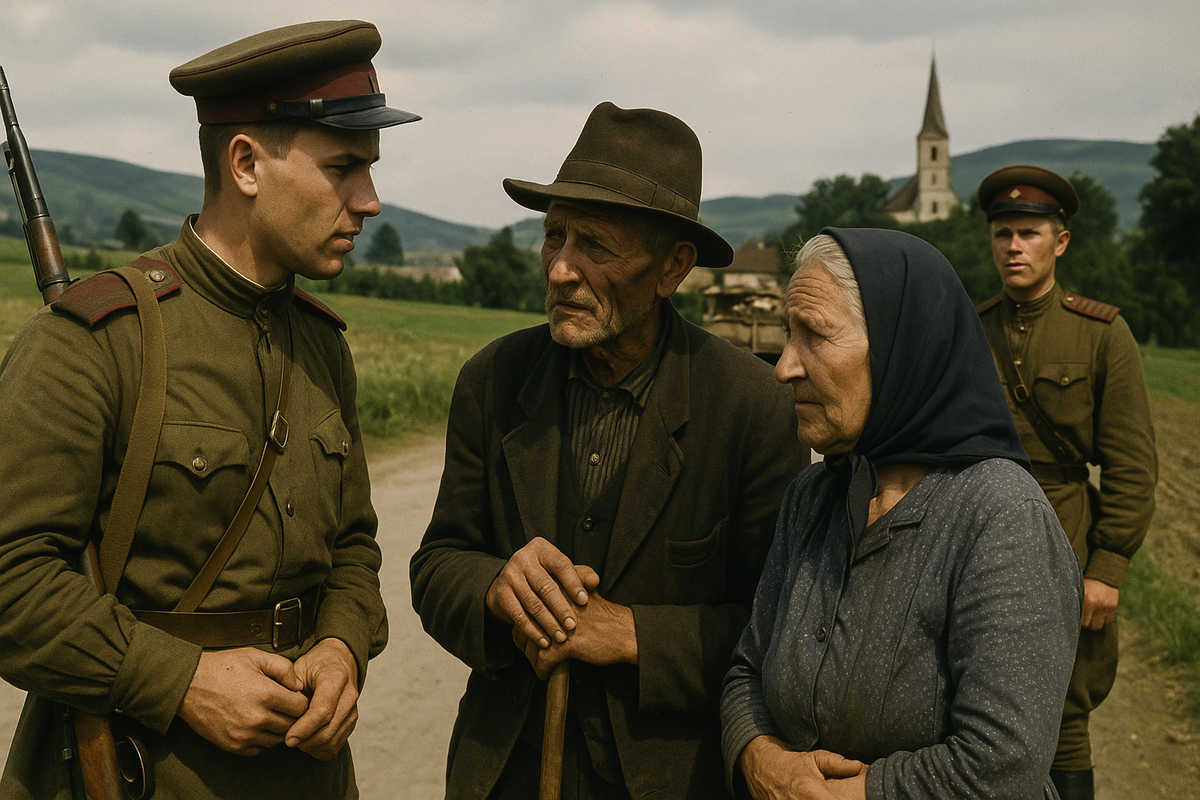
Turn the page, and Snow's article presented something else entirely: portraits of Renner, Tolbukhin, and Cardinal Innitzer stared out at readers, alongside stark photographs of Red Army soldiers inspecting warehouses, supervising reparations shipments, and mingling with Austrian peasants under occupation. These weren't abstract geopolitical theories—they were visual proof of what "liberation" looked like when the liberator had its own agenda.
The Post understood what Life magazine had pioneered: images don't just illustrate stories; they authenticate them. For a nation still learning to read the tea leaves of postwar Europe, these photographs transformed Snow's reporting from distant news into immediate reality.
What Snow Witnessed
Snow's account catalogued the machinery of Soviet control with clinical precision:
Dr. Karl Renner's Resurrection
Plucked from retirement by the Soviets, Renner provided legitimacy to a government formed entirely under Red Army supervision. He was Austria's past, enlisted to ratify its present.
Marshal Tolbukhin's Mandate
With a single directive—"go ahead"—the Soviet commander granted Renner authority to act before British or American forces could establish governance in their own zones.
Cardinal Innitzer's Pragmatism
The Church's acceptance signaled more than diplomacy; it revealed how completely the Soviets had consolidated their position. Even Vienna's spiritual authority acknowledged the new order.
Security Apparatus Rebuilt
Within weeks, Austria's police force doubled in size—staffed, trained, and overseen by Soviet officers.
Information Lockdown
Newspapers resumed publication, radio broadcasts returned to the airwaves. But every word passed through Soviet censors first.
Economic Extraction
Factories requisitioned. Warehouses emptied. Freight trains loaded with reparations rolled eastward while Austrian civilians faced rationing and shortages.
Contradictions on the Ground
Snow captured the strange texture of occupation: Soviet soldiers chatting amiably with peasants one moment, stripping industrial assets the next.
Political Theater
The coalition government bore all the trappings of democracy—parties, debates, representation. But the tilt toward Communist control was unmistakable, protected by armed force.
The Cold War's Opening Scene
Though that term wouldn't enter common usage for another year, Snow's reporting documented its genesis: the point where Allied cooperation dissolved into competition for Europe's future.
Why This Issue Matters to Collectors
Chronological Precision
Published in the war's final weeks, it captures the exact moment when triumph curdled into uncertainty. Few publications documented this transition in real time.
Rockwell's Artistry
The double-illustration cover ranks among his most conceptually intriguing Post works—a meta-commentary on creative process that contrasts sharply with the geopolitical hardball inside.
Editorial Range
From fiction and sports coverage to Snow's unflinching foreign correspondence, this issue showcases the Post operating at full capacity—entertainment and enlightenment in equal measure.
Primary Source Authority
Snow's firsthand observations preserve details that sanitized histories often omit: the texture of occupation, the calculations of local leaders, the daily realities of life under foreign control.
Material Culture
The advertisements alone—for household goods, automotive products, wartime consumer brands—provide a snapshot of American domestic life at the war's end.
Historical Artifact
This isn't just a magazine. It's a time capsule from the pivot point between two eras.
Explore the Archive
Our collection features hundreds of original Saturday Evening Post issues spanning the 1930s through the 1970s. Each one documents American culture, politics, warfare, literature, and visual art as they unfolded—no retrospective filter, no historical revisionism, just the raw record of how the nation understood itself decade by decade.
Browse The Saturday Evening Post Magazine CollectionThe Moment Everything Changed
The August 11, 1945 Saturday Evening Post remains essential reading for anyone studying the war's aftermath. Edgar Snow revealed how the Soviets moved decisively in Vienna, how Austrian leaders navigated impossible choices, and how ordinary citizens adapted to occupation's contradictions.
For 1945 readers, it delivered an uncomfortable truth: peace would be no simpler than war. For collectors today, it represents the exact moment—preserved in ink and paper—when World War II's conclusion became the Cold War's beginning.
Hold this issue in your hands, and you're holding the crossroads itself: the instant when one global conflict ended and another, longer struggle began.