
Love, Loss, and Independence: Priscilla Presley's Journey After Elvis
How the August 1973 Ladies' Home Journal captured a woman finding her voice—and a nation redefining marriage, motherhood, and freedom
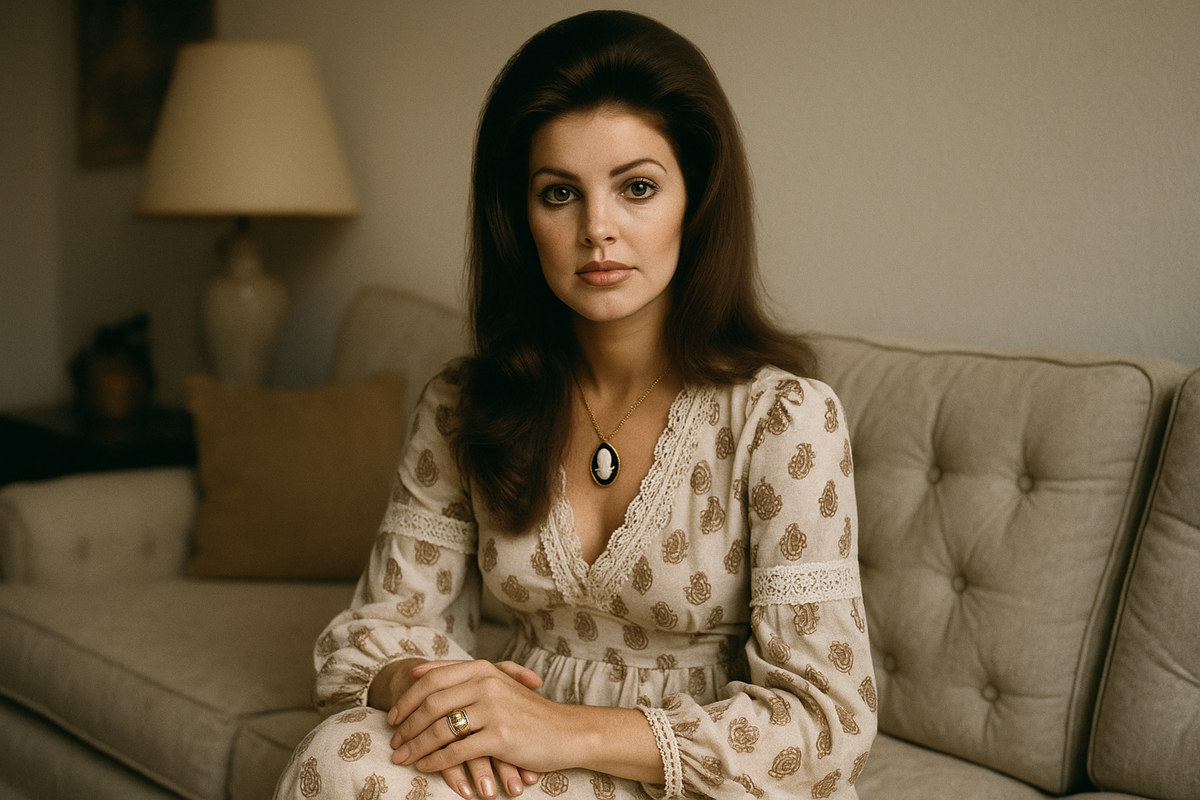
The woman on the cover wore a soft patterned gown with lace trim, bold rings, and a cameo necklace. She looked directly at the camera—elegant, composed, unmistakably herself. This wasn't Elvis Presley's wife. This was Priscilla Presley, alone, speaking for the first time.
When the August 1973 issue of Ladies' Home Journal reached American newsstands, it carried something extraordinary: "My Life With and Without Elvis Presley," the first in-depth interview Priscilla gave after her divorce. Published just months after their separation was finalized, the feature brought the private life of America's most famous couple into millions of living rooms. But it did something more radical than that. It gave voice to a woman who had spent years in silence, and in doing so, became a touchstone for a generation of women redefining their lives.
A Moment of Cultural Reckoning
The early 1970s marked a seismic shift in American life. Divorce rates were climbing. The women's liberation movement was dismantling traditional domestic roles. Magazines like Ladies' Home Journal—once devoted almost exclusively to recipes and homemaking—were evolving into platforms for examining the complexities of women's lives.
Priscilla's story landed squarely in this cultural moment. She had married Elvis in Las Vegas in 1967 at just 21, after a courtship that began when she was 14 and he was stationed in Germany. By the early 1970s, the strains of fame, relentless public scrutiny, and Elvis's demanding lifestyle had fractured their marriage. They separated in August 1972. The divorce was finalized in 1973.
What made the Journal feature remarkable was its timing and its honesty. Priscilla spoke openly about identity, personal growth, and life beyond Elvis—themes that mirrored the broader struggles of American women seeking fulfillment outside the boundaries of marriage. For readers across the country, her reflections weren't celebrity gossip. They were a mirror.
Archive Details
Historical Figure: Priscilla Presley
Issue Date: August 1973
Archive Source: Ladies' Home Journal
Feature: "My Life With and Without Elvis Presley"
Cultural Context: First major post-divorce interview, published during the height of second-wave feminism
The Magazine That Reflected Women's Lives
By 1973, Ladies' Home Journal had established itself as one of the most influential women's magazines in America. Its mission was straightforward: reflect the realities of women's daily lives while shaping cultural attitudes. The August issue delivered on that mission with precision.
The Priscilla Presley feature wasn't simply about a famous husband. It was about finding a voice after years of silence. The article combined striking photography with narrative depth—a full-page portrait showcased Priscilla as confident and poised, not merely as "Elvis's wife," but as a woman stepping into her own identity. Intimate details of her marriage followed: the joys of motherhood with Lisa Marie, born in 1968; the strains of life in the spotlight; the near-impossibility of privacy; the longing for normalcy.
Her discussion of returning to personal passions—dance, karate, pursuits she had set aside during her marriage—spoke to something universal. Women everywhere were reclaiming dreams deferred.
The Journal understood the power of personal storytelling. Just as Life magazine had used photojournalism to make distant wars feel immediate, Ladies' Home Journal used confessional narratives and evocative imagery to make women's private struggles visible, relatable, and culturally significant.
The Architecture of the Feature
The cover itself signaled a shift. Instead of an idealized housewife or domestic tableau, readers saw Priscilla Presley—glamorous yet approachable, celebrity yet everywoman. This stylistic choice reflected the magazine's evolution from prescriptive homemaking manual to chronicler of real women's real lives.
Inside, the article struck a delicate balance. It acknowledged the Elvis mythos while centering Priscilla's voice. Her reflections carried tenderness and honesty in equal measure—gratitude for the past, determination for the future. This fusion of celebrity culture and women's empowerment defined the Journal in the 1970s.
The narrative traced her journey with clarity: meeting Elvis in Germany at 14; the 1967 Las Vegas wedding that became a media spectacle; motherhood as both joy and anchor; the weight of constant public attention; the marriage strains caused by long absences and Elvis's fame; the wrenching 1972 separation; and finally, rediscovering herself through new interests and independence.
While never explicitly political, the feature embodied the core themes of second-wave feminism: self-discovery, autonomy, empowerment. Priscilla's story became, in effect, a case study in what liberation looked like for one woman navigating divorce in 1970s America.
Key Themes in the August 1973 Feature
Meeting Elvis in Germany
At 14, Priscilla first met Elvis while he was stationed in Germany, beginning a romance that shaped her adolescence.
Las Vegas Wedding (1967)
Their marriage was a media spectacle, reflecting both glamour and public fascination.
Motherhood
The birth of Lisa Marie Presley in 1968 was a source of profound joy, grounding Priscilla's life even as public pressures grew.
Life in the Public Eye
She described the challenges of living under constant attention, where privacy was nearly impossible.
Marriage Strains
Long absences, Elvis's fame, and the lack of personal freedom strained their relationship.
Separation in 1972
Priscilla candidly shared the difficulties of deciding to leave, balancing her identity as a mother with her need for independence.
Rediscovering Self
After the separation, she pursued karate, ballet, and new interests, symbolizing her reclaiming of personal identity.
Reflections on Independence
She expressed both gratitude for her past and excitement for a future defined on her own terms.
A Universal Story
Beyond celebrity, her reflections resonated with women across America who were themselves navigating divorce and new roles.
A Feminist Undercurrent
While never explicitly political, her story embodied the themes of 1970s feminism: self-discovery, autonomy, and empowerment.
The Journal's Enduring Legacy
Ladies' Home Journal endures in cultural memory because it was never just about recipes and fiction. It was a chronicle of women's lives across generations—from suffrage through postwar domesticity to second-wave feminism. The magazine served as both mirror and map, reflecting who women were while charting where they might go.
The August 1973 issue exemplifies this legacy. It captured not just a celebrity confession but a universal story of love, loss, and renewal. Today, as divorce and independence carry far less stigma, this issue reminds us how radical it was for a woman like Priscilla Presley to speak so openly, so soon.
Why This Issue Matters to Collectors
Historical Timing
Published the same year as the divorce, it captures a pivotal moment in both Presley family history and American culture. The wound was still fresh; the future uncertain.
Celebrity Landmark
This is Priscilla Presley's first major post-divorce interview—a primary source document prized by Elvis historians and cultural scholars.
Visual Time Capsule
Beyond the cover story, the issue preserves period-perfect advertisements for Stayfree Maxi Pads, Hour After Hour deodorant, and Minwax wood finishes. It's 1970s consumer culture frozen in print.
Cultural Artifact
The issue documents changing gender roles in real time, making it valuable not just to celebrity enthusiasts but to anyone studying the evolution of American women's lives.
Owning this issue means holding both a celebrity memoir and a feminist-era artifact in your hands.
Building Your Collection
For those drawn to celebrity history, feminist culture, or vintage print media, the August 1973 Ladies' Home Journal belongs in any serious collection of American cultural artifacts.
Browse Ladies' Home Journal Magazine CollectionA Final Word
The August 1973 Ladies' Home Journal was more than paper and ink. It was a stage on which Priscilla Presley—once defined entirely by her marriage to Elvis—declared her independence. Her reflections gave voice to countless women redefining themselves in that turbulent decade.
For collectors, it remains a piece of living history. For readers, it stands as an honest, powerful, and enduring story of a woman finding her own place in the world.