
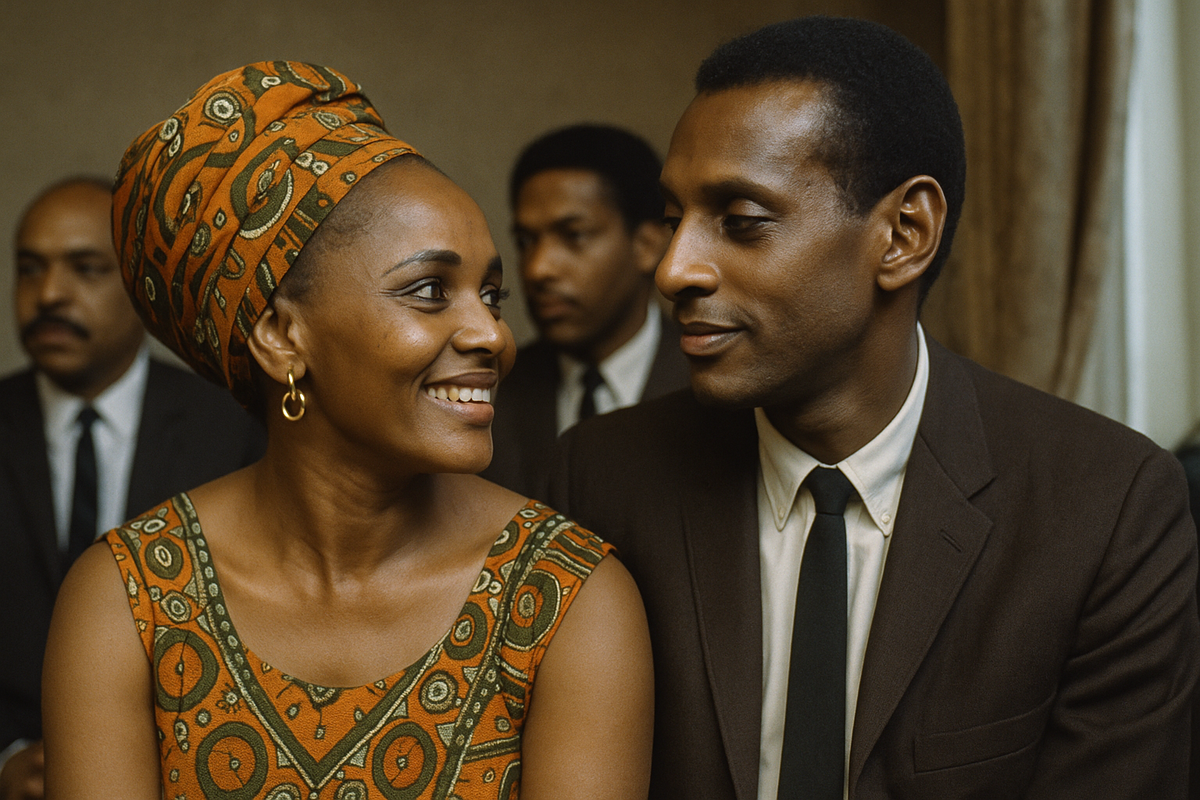
When Love Became a Revolution
Inside Jet's 1968 Cover Story on Miriam Makeba and Stokely Carmichael
On March 28, 1968, a pocket-sized magazine hit newsstands across Black America with a cover that stopped conversations mid-sentence. Against a striking orange backdrop, Miriam Makeba danced in traditional African attire—a visual manifesto of pride, defiance, and belonging. The headline crowned her "Africa's First Lady of Freedom Fighters."
Inside those pages, Jet Magazine wasn't just reporting a romance. It was documenting the collision of two freedom movements—African liberation and Black Power—embodied in the relationship between South Africa's exiled singing icon and America's most electrifying revolutionary organizer, Stokely Carmichael.
This wasn't celebrity gossip. This was geopolitics in a love story.
Two Continents, One Struggle
By 1968, both Makeba and Carmichael had become targets of empires. She had been exiled from South Africa for using her voice—literally and figuratively—to expose apartheid's brutality. He had transformed the Student Nonviolent Coordinating Committee (SNCC) from a civil rights organization into the vanguard of Black Power, preaching self-determination and economic independence. The white establishment on both sides of the Atlantic considered them dangerous.
Makeba, known worldwide as "Mama Africa," had built an international career performing before packed houses while turning every stage into a platform for liberation. Her music carried the pulse of anti-colonial struggle. Carmichael's speeches ignited younger activists while drawing FBI surveillance and accusations of sedition. When these two forces merged—personally and politically—it sent a signal across the Black diaspora: the freedom struggle recognized no borders.
Jet understood what this meant. While mainstream publications either ignored Black activists or distorted their stories, Jet placed Makeba and Carmichael front and center, recognizing that its readers didn't just want entertainment news. They wanted to see their lives, their politics, and their global connections reflected back with dignity and precision.
Issue Details
Publication: Jet Magazine
Issue Date: March 28, 1968
Featured Figures: Miriam Makeba & Stokely Carmichael
Cover Headline: "Africa's First Lady of Freedom Fighters"
Historical Context: Published weeks before the assassination of Dr. Martin Luther King Jr.
What Jet Reported
The magazine's coverage crackled with intimate detail and political weight. Jet documented how Makeba would fly into New York for just 24 hours between concert tours to be with Carmichael. It described their appearances together at African embassy events in Washington, where diplomats and activists watched the romance fuel both whispers and declarations of solidarity.
For Jet's readers, this reporting revealed the architecture of Pan-Africanism in real time. The freedom struggle wasn't confined to Birmingham or Selma—it stretched from the streets of Washington to the townships of Johannesburg, embodied in the partnership between a freedom singer and a revolutionary theorist.
The article portrayed Makeba as "a woman with a capital W"—admired for her talent, her strength, and her unshakeable commitment to liberation. This representation mattered. For young Black women in 1968, she modeled a form of independence and dignity that mainstream media rarely acknowledged existed.
The Stakes Were Clear
Jet's editors didn't sanitize the complexities. The article acknowledged that some within the Civil Rights establishment worried Carmichael's militant reputation could damage Makeba's international career. Others celebrated their union as proof that love itself could be an act of resistance—a refusal to let white supremacy dictate the terms of Black intimacy or solidarity.
The magazine framed their relationship as more than personal. It was a living symbol of Pan-African unity, a cross-Atlantic bond that tied African liberation to American Black Power. SNCC activists debated its implications. Global observers watched to see if this partnership would reshape the conversation about freedom on two continents.
It did.
Why This Issue Matters Now
The March 28, 1968 issue stands as one of Jet's most significant cultural artifacts for reasons that compound with historical distance.
Timing
Published just weeks before the assassination of Dr. Martin Luther King Jr., this issue captures Black America at a crossroads—debating whether the path forward meant nonviolence or militancy, integration or self-determination. The mood in these pages carries the tension of that unresolved question.
Historical Figures
Makeba and Carmichael weren't just celebrities. They were architects of liberation movements whose influence stretched across decades. This issue immortalizes them at the height of their powers, before exile, before disillusionment, when revolution still felt inevitable.
Documentary Value
Jet's coverage provides primary source material for understanding how Pan-Africanism moved from theory to lived experience. It shows how music, politics, and personal relationships became inseparable in the Black radical tradition.
Cultural Preservation
For collectors, historians, and families preserving heritage, original issues like this function as more than reading material. They are time capsules—unmediated voices from an era when the world seemed on the verge of transformation.
Jet's Indispensable Role
The magazine's importance extends beyond any single issue. Jet chronicled Black life with an intimacy and consistency that no other publication matched. It didn't flinch from controversy or complexity. It told the truth as Black communities experienced it: cultural, political, and profoundly human.
In an age when history arrives fragmented through algorithms and social media feeds, these magazines offer something increasingly rare—a continuous narrative thread. They let readers trace entire decades of Black culture, politics, and leadership as events unfolded, week by week, decision by decision.
For Collectors and Historians
Investment Value
Original Jet magazines from the 1950s through the 1980s remain available for those who understand their significance. Each issue represents a piece of the larger story—the Civil Rights Movement, the Black Arts Movement, the evolution of Black political thought, the careers of icons who shaped American culture.
Research Access
Whether you're a serious collector evaluating investment-grade pieces, a historian conducting primary research, or someone honoring the memory of family members who lived through these years, these magazines offer direct access to the past.
Complete Archive
Browse thousands of original issues spanning decades of Black history, culture, and politics. Each magazine is a primary document—preserved, authentic, and irreplaceable.
Explore the Collection
Access thousands of original Jet magazines from the 1950s through the 1980s. Each issue is a primary historical document, preserved for collectors, researchers, and families honoring their heritage.
Browse Jet Magazine CollectionThe March 28, 1968 issue endures because it captured a moment when personal lives carried political meaning, when love symbolized resistance, and when Black liberation refused to recognize national boundaries. The romance between Miriam Makeba and Stokely Carmichael represented something larger than itself—proof that the struggle for freedom could be tender, could be beautiful, could bridge oceans.
Jet made sure that story reached every Black household in America. Holding this issue now means holding that mission—a pocket-sized magazine with the audacity to tell Black people they were connected to something global, something powerful, something worth fighting for.
That message hasn't lost its urgency.