
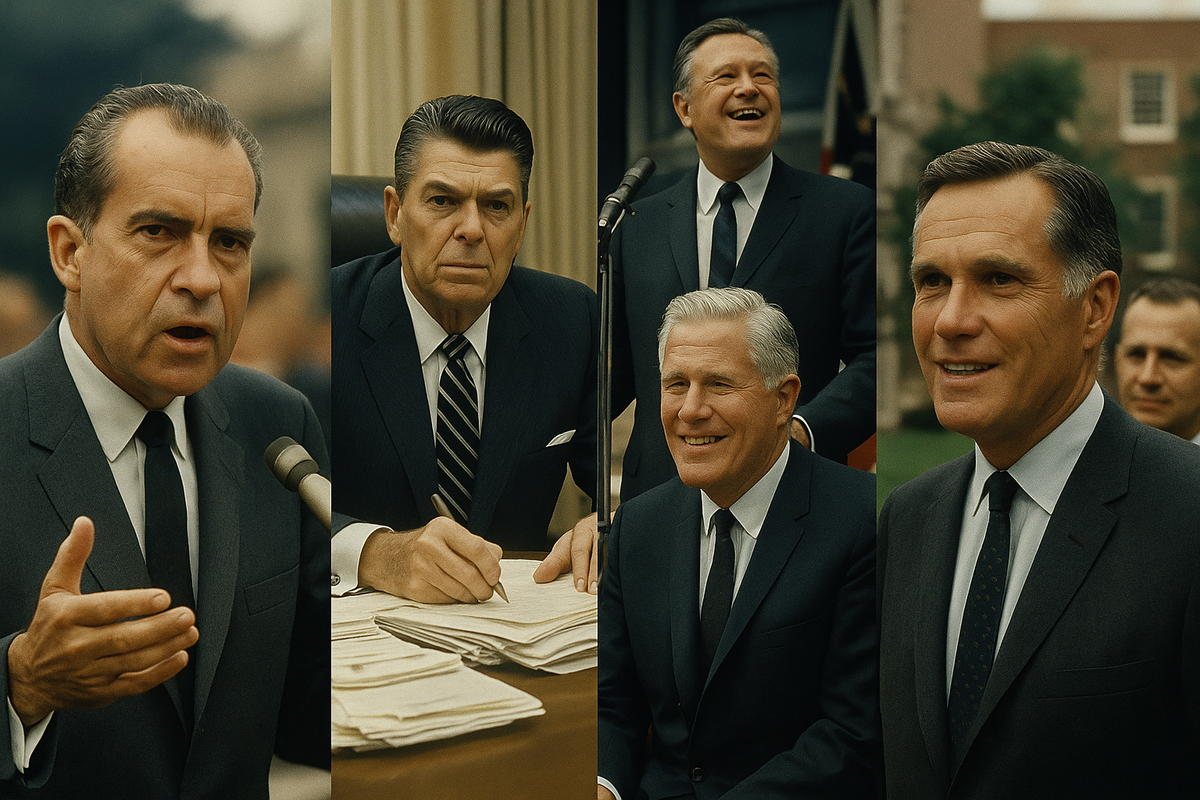
The Last Lineup Before the Fall
Six portraits. One cover. No one yet knew which face would claim the presidency—or that this magazine captured the Republican Party at its most fractured, hungry, and unpredictable moment before the chaos of 1968 rewrote American politics forever.
When the October 20, 1967 issue of Time Magazine hit newsstands, it arrived like a starting gun. Richard Nixon, Nelson Rockefeller, George Romney, Ronald Reagan, Charles Percy—each stared out from the cover in stark black-and-white, a visual gauntlet thrown down for the nomination. For readers that fall, this wasn't campaign gossip. It was a roadmap to power, published at the precise instant the GOP was clawing its way back from Barry Goldwater's 1964 annihilation.
What makes this issue irreplaceable isn't just its timing. It's what Time's editors caught on record: Reagan as an untested governor with "grassroots enthusiasm" but no national machinery. Nixon as the grinding comeback artist still wearing the "loser" label. Romney's Vietnam stumble already calcifying into political legend. This was the field before anyone knew the outcome—raw ambition frozen in newsprint.
Archive Details
Publication: Time Magazine
Issue Date: October 20, 1967
Historical Figures: Richard Nixon, Ronald Reagan, Nelson Rockefeller, George Romney, Charles Percy
Context: Republican Presidential Primary Field, 11 months before the 1968 election
Significance: Documents GOP transformation and captures future presidents before their defining moments
A Nation Cracking Open
The fall of 1967 belonged to fire and fury. Vietnam protests were escalating from teach-ins to open rebellion. Lyndon Johnson's approval ratings were hemorrhaging. American cities had burned that summer. The civil rights movement had splintered into competing visions of liberation and militancy. Culturally, the country was tearing itself in half.
For the Republican Party, this chaos represented opportunity—if they could avoid repeating Goldwater's suicide run. The challenge was existential: find a candidate who could unify warring factions, reassure a rattled middle class, and capitalize on Johnson's collapse without alienating the millions who'd voted Democratic for a generation.
Time's coverage of the 1967 Republican Governors' Conference—42 governors and 70 aides aboard the S.S. Independence for a Caribbean cruise—revealed a party engaged in high-stakes political theater. The magazine didn't just report positions. It mapped personality against ideology, ambition against electability, in prose that crackled with narrative momentum.
The Contenders: Ambition in Black-and-White
Time's profiles worked because they understood what modern political coverage often forgets: campaigns are human dramas, not policy white papers.
Time wove these portraits into something larger than candidate profiles. They became a diagnostic of the Republican soul: torn between Goldwater's True Believer conservatism and Eisenhower's pragmatic centrism, desperate for victory but unsure which formula would deliver it.
Visual Storytelling as Political Analysis
The cover design itself was an editorial statement. Six faces lined up like a police lineup—an implicit question hanging over each portrait: Which one? The stark black-and-white photography stripped away color and context, forcing readers to confront raw ambition and political possibility.
Inside, the photography performed different work. Nixon on tour, projecting seasoned competence. Reagan at his desk, drowning in constituent mail—the visual grammar of populist appeal. Rockefeller in motion, dynamic but embattled. Romney with his family, projecting stability even as his campaign crumbled.
Time understood what television was teaching politics: image wasn't separate from substance. It was substance. The candidate's brand—how they appeared, where they stood, who surrounded them—mattered as much as their position papers. These photographs weren't decoration. They were evidence.
Why This Issue Commands Collector Attention
Published eleven months before the election, it documents the Republican field in its purest form—before Nixon's machine ground down the opposition, before Reagan's star rose high enough to threaten, before Romney's campaign collapsed entirely.
These images of Nixon, Reagan, Rockefeller, and Romney precede their transformation into American political icons. Reagan hadn't yet become the conservative movement's patron saint. Nixon hadn't yet achieved his comeback or his disgrace. The photographs preserve them as they were: hungry, uncertain, possible.
This issue captures the GOP mid-transformation, transitioning from Eisenhower's moderate pragmatism toward Reagan's conservative revolution. The tensions Time documented—establishment versus insurgent, moderate versus movement conservative—would define Republican politics for the next half-century.
Election-year issues, particularly those featuring future presidents in competitive fields, command premium prices among serious collectors. This issue offers both Nixon (who won) and Reagan (who would) before either had secured their place in history.
The Enduring Power of Primary Sources
Time's political coverage from this era remains compelling because it refused to flatten complexity into talking points. The magazine gave readers analysis and drama, context and personality, big-picture themes and human-scale detail.
The October 20, 1967 issue didn't just cover candidates. It captured a nation's anxiety, a party's identity crisis, and the raw mechanics of political ambition in an age before focus groups sanitized every message. Reading it now feels like eavesdropping on history—unfiltered, immediate, consequential.
For collectors and historians, these magazines function as time capsules from an era when political journalism still trusted readers with nuance, when a single issue could deliver both Kremlin intrigue and Hollywood gossip, civil rights analysis and book reviews, all bound together under that iconic red border.
Building a Political Archive
This issue anchors any serious collection of 1960s political ephemera. Paired with Time's coverage throughout the 1968 campaign season, it tells the complete story of Nixon's resurrection, Reagan's emergence, and the Democratic Party's spectacular implosion at the Chicago convention.
Explore Vintage Time Magazine Archives
Build your collection with authenticated original issues
Browse Time Magazine CollectionThe Artifact and the Echo
The October 20, 1967 Time Magazine endures because it preserved uncertainty. When it published, no one knew Nixon would win, resign in disgrace, and reshape presidential power. No one knew Reagan would define conservatism for two generations. No one knew 1968 would bring assassinations, riots, and a fundamental reordering of American politics.
This issue captured six men chasing the same prize, documented by journalists who understood that presidential campaigns reveal as much about the nation as about the candidates. It's more than journalism. It's evidence of America at a hinge point, recorded in the glossy pages of a magazine that helped shape how millions understood the stakes.
For anyone who values political history preserved at the source, this issue isn't just collectible. It's essential.