
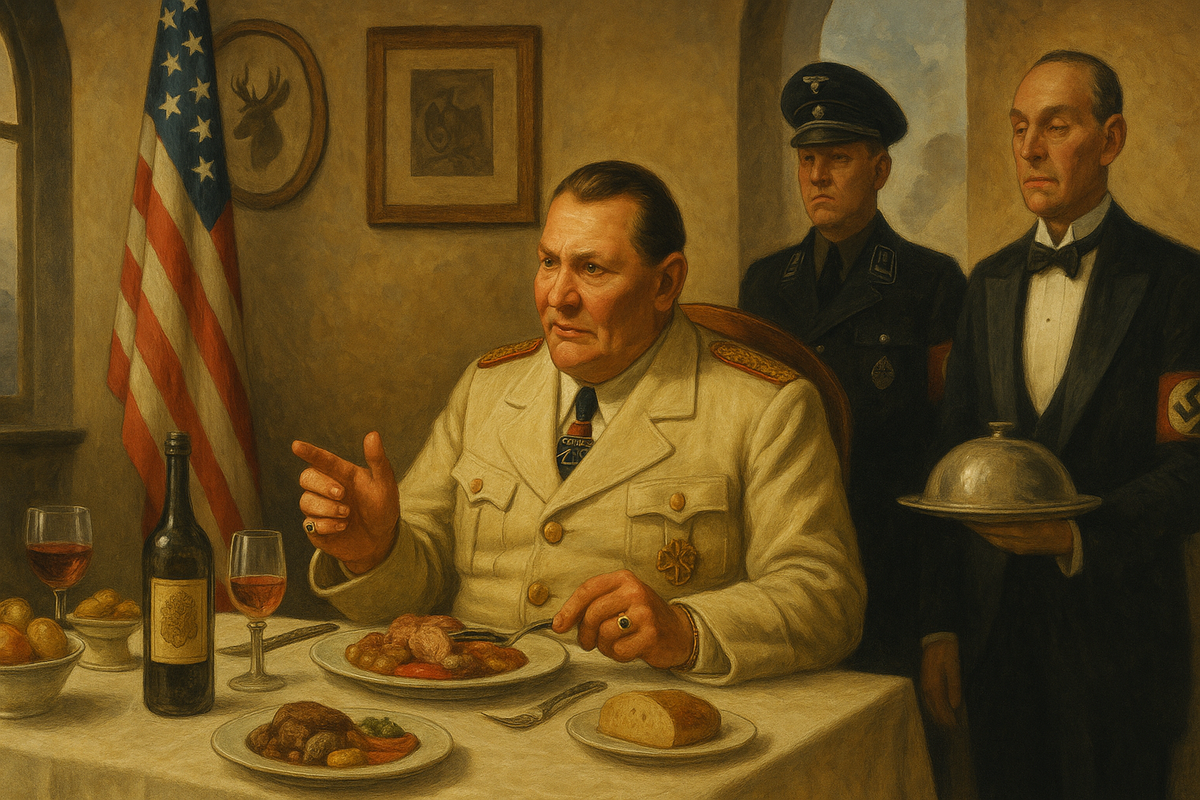
Lunch with Göring: Power, Propaganda, and Paradox in 1940 Europe
Inside Hermann Göring's grotesque theater of fascism—as witnessed by The New Yorker in March 1940
On March 23, 1940, The New Yorker published something extraordinary in its Reporter at Large section: a firsthand account of lunch with Hermann Göring at Karin Hall, his hunting estate outside Berlin. While Europe burned and America debated intervention, the magazine's correspondent sat across from Hitler's Reichsmarschall, watching him stuff himself with lavish courses, fuss over toy trains, and parade his vanity like a Renaissance prince.
The piece was jarring—not because it revealed Göring's brutality, but because it exposed something more unsettling: the grotesque theater of fascism itself. Power dressed in gaudy jewelry. Terror served with wine engraved with family crests. Barbarism wrapped in buffoonery.
For American readers still clinging to neutrality, this wasn't diplomatic reporting. It was a warning shot.
Archive Details
Historical Figure: Hermann Göring, Reichsmarschall of Nazi Germany
Issue Date: March 23, 1940
Archive Source: The New Yorker Magazine
Feature: Reporter at Large series
Cover Artist: W. Cotton
The Moment
By spring 1940, the war Hitler started in Poland six months earlier had settled into an uneasy pause. France and Britain had declared war but hadn't fought one. Americans watched from across the Atlantic, divided between isolationists who wanted no part of Europe's mess and interventionists who saw the Nazi threat clearly.
Göring sat at the center of it all. As Reichsmarschall and head of the Luftwaffe, he was Hitler's designated successor, the regime's most visible face after the Führer himself. He controlled Germany's air force. He oversaw the Four Year Plan that militarized the economy. He collected art, built monuments to himself, and staged his life as grand opera.
The New Yorker profile captured him at this peak—months before his Luftwaffe would pummel Rotterdam, months before the Battle of Britain would tarnish his reputation, before the Eastern Front would expose his incompetence. In March 1940, Hermann Göring still believed himself invincible.
The article brought American readers inside that delusion.
The New Yorker's Gambit
While newspapers delivered wire service dispatches, The New Yorker specialized in something else: atmosphere, detail, the texture of power. Its Reporter at Large series gave correspondents room to narrate not just events but their experience of events—with wit, precision, and a sharp eye for revealing contradictions.
The Göring piece deployed this approach masterfully. Readers weren't told Göring was dangerous and absurd. They saw it:
The dining hall with its endless courses and heraldic excess. Göring barking at servants, then cooing over miniature railways and toy airplanes. His manicured hands heavy with rings. His uniforms like costume drama. His hunting preserve stocked with animals he could shoot without risk.
The article let these details speak. It didn't editorialize about fascism's essential nature—it showed fascism performing for itself, drunk on spectacle, sustained by violence that lurked just offstage in the form of SS guards and constant surveillance.
At a time when much American press coverage still treated Nazi leaders as legitimate statesmen, The New Yorker delivered something sharper: journalism as portraiture, rendering Göring so vividly that readers couldn't mistake the menace beneath the medals.
Cotton's Rabbit
The March 23, 1940 cover, painted by W. Cotton, shows a butler bowing toward a rabbit peeking from behind an armchair. It's whimsical, domestic, gently absurd—classic New Yorker humor with no obvious connection to the Göring piece inside.
That disconnect is the point. The magazine's genius lay in its range: war reportage alongside fiction and poetry, cultural criticism next to cartoons, Göring's grotesque banquet sharing pages with advertisements for spring fashions. This wasn't scattershot editing. It was The New Yorker positioning itself as a cultural lens, not a news bulletin—a magazine for readers who wanted to understand the world without surrendering sophistication or irony.
The rabbit and the Reichsmarschall coexisted because that's how intelligent people actually experienced 1940: horror and normalcy braided together, the absurd and the apocalyptic occupying the same moment.
The Spectacle Itself
The article's most powerful moments came from its refusal to look away from Göring's excess:
The Table
Multiple courses, wine bottles bearing his personal crest, servants constantly refilling plates and glasses while Göring held court.
The Estate
Karin Hall mixed Renaissance grandeur with hunting lodge kitsch—heraldic displays, stuffed animals, vast rooms designed to dwarf visitors and announce importance.
The Toys
Göring showed off his collections like a child: model trains, miniature aircraft, elaborate dioramas. Playthings of power.
The Costume
Flamboyant uniforms, ostentatious jewelry, carefully manicured hands. He dressed like he ruled an empire, not governed a modern state.
The violence underneath: Guards everywhere. SS men watching. The constant reminder that this theater was built on terror, that Göring's indulgences were extracted from a brutalized population.
Together, these details created a portrait that transcended simple condemnation. The article revealed fascism as performance art—vicious, vain, absurd, and absolutely deadly serious about its own mythology.
Why It Endures
The March 23, 1940 issue matters because it demonstrates what journalism can accomplish when it refuses to choose between literary craft and moral clarity. The New Yorker didn't write propaganda. It didn't flatten Göring into a cartoon villain or make excuses for him as a complex figure. It simply rendered him—precisely, ironically, devastatingly.
The result was more powerful than editorials condemning Nazism could have been. By letting readers see Göring's world—the banquets and the brutality, the jewels and the cruelty, the playacting and the terror—the article made fascism comprehensible in a way that abstraction never could.
This is why The New Yorker would become one of the 20th century's essential magazines. It understood that readers needed more than information. They needed interpretation, context, the ability to see what power looked like when it stopped pretending to be anything but itself.
Why Collectors Seek This Issue
For anyone building a collection of 20th-century journalism, the March 23, 1940 New Yorker represents several convergent values:
Historical Timing
Published in the brief window between Poland's fall and France's collapse, it captured Göring at maximum power and confidence—a fleeting moment before his reputation began its long decline.
Journalistic Rarity
Few American publications in early 1940 offered such an intimate, critical portrait of a Nazi leader. Most coverage remained diplomatic or abstract. The New Yorker delivered the man himself, in all his contradictions.
Cultural Artifact
The Cotton cover, the Reporter at Large format, the magazine's distinctive voice—this issue embodies The New Yorker at a pivotal moment in its evolution from Jazz Age sophistication to wartime seriousness.
The Paradox Preserved
Owning this issue means holding physical evidence of how Americans understood—or failed to understand—the Nazi threat before Pearl Harbor forced clarity.
This isn't just collectible magazine content. It's a primary source that shows how one of America's most influential cultural institutions chose to depict evil: not as distant abstraction but as grotesque, particular, human spectacle.
For Collectors and Historians
If you're drawn to the intersection of journalism, literature, and history—if you want to understand how Americans processed the descent into total war—the March 23, 1940 New Yorker belongs in your collection.
Browse The New Yorker Magazine CollectionYou'll find not just this issue but decades of cultural commentary, wartime reporting, fiction, and art that shaped American consciousness. These aren't reproductions or digital scans—they're original copies that sat in living rooms and subway cars, that were read and argued over, that served as primary evidence of their moment.
Final Note: "Lunch with Göring" stands as a masterclass in how to write about power without flinching or grandstanding. It offered 1940 readers a window into the Nazi inner circle that was both intimate and damning. Today, it serves as a reminder that The New Yorker was never just a humor magazine or a cultural digest. It was—and remains—a chronicle of how intelligent people tried to make sense of their world when the ground was shifting beneath them.
This issue captures that effort perfectly: serious without being solemn, literary without losing urgency, preserving the grotesque details that lesser publications would have sanitized or sensationalized.
That's why collectors seek it. That's why it endures.