
The Day America Met Marilyn Monroe
How Life Magazine's April 7, 1952 issue transformed a contract player into a cultural earthquake
On April 7, 1952, a shopkeeper in Des Moines slid a fresh copy of Life Magazine across the counter. A housewife in Baltimore found it in her mailbox. A GI stationed in Seoul thumbed through it in a mess hall half a world away. They all saw the same thing: a woman who would redefine what it meant to be famous in America.
This wasn't just another celebrity profile. This was the issue that transformed Marilyn Monroe from a contract player into a cultural earthquake.
Archive Details
Historical Figure: Marilyn Monroe
Issue Date: April 7, 1952
Archive Source: Life Magazine
Feature Title: "Hollywood Topic A-Plus"
Hollywood at the Crossroads
America in 1952 stood between two worlds. The war was over, but the Cold War had settled into the national psyche like permanent fog. Television sets were multiplying in living rooms, siphoning audiences from movie palaces. Hollywood needed more than stars—it needed phenomena.
Monroe had been grinding through bit parts for years. Blink and you'd miss her in All About Eve (1950) or The Asphalt Jungle (1950). She'd posed for a nude calendar when rent was due, the kind of scandal that should have ended a career before it began. Instead, it detonated public curiosity. By early 1952, she was fielding 5,000 fan letters a week and starring in Clash by Night and Don't Bother to Knock.
Life's April 7 feature—titled "Hollywood Topic A-Plus"—arrived at the inflection point. The magazine didn't just profile an actress on the rise. It coronated her as "the genuine article," separating Monroe from the endless parade of studio-manufactured starlets who flamed out before their second picture wrapped.
For a nation entering an age of mass media and consumer plenty, Monroe became both mirror and promise—a working girl who made it, a blonde bombshell who read Bartók.
The Power of Life
By 1952, Life Magazine held unmatched authority over American visual culture. With millions of copies circulating weekly, it didn't just report the world—it curated which parts of the world mattered. Politics, war, art, celebrity: all filtered through Life's lens and delivered to kitchen tables from coast to coast.
The Monroe feature deployed every weapon in Life's arsenal. This wasn't publicity stills and studio-approved puffery. This was journalism wrapped in intimacy.
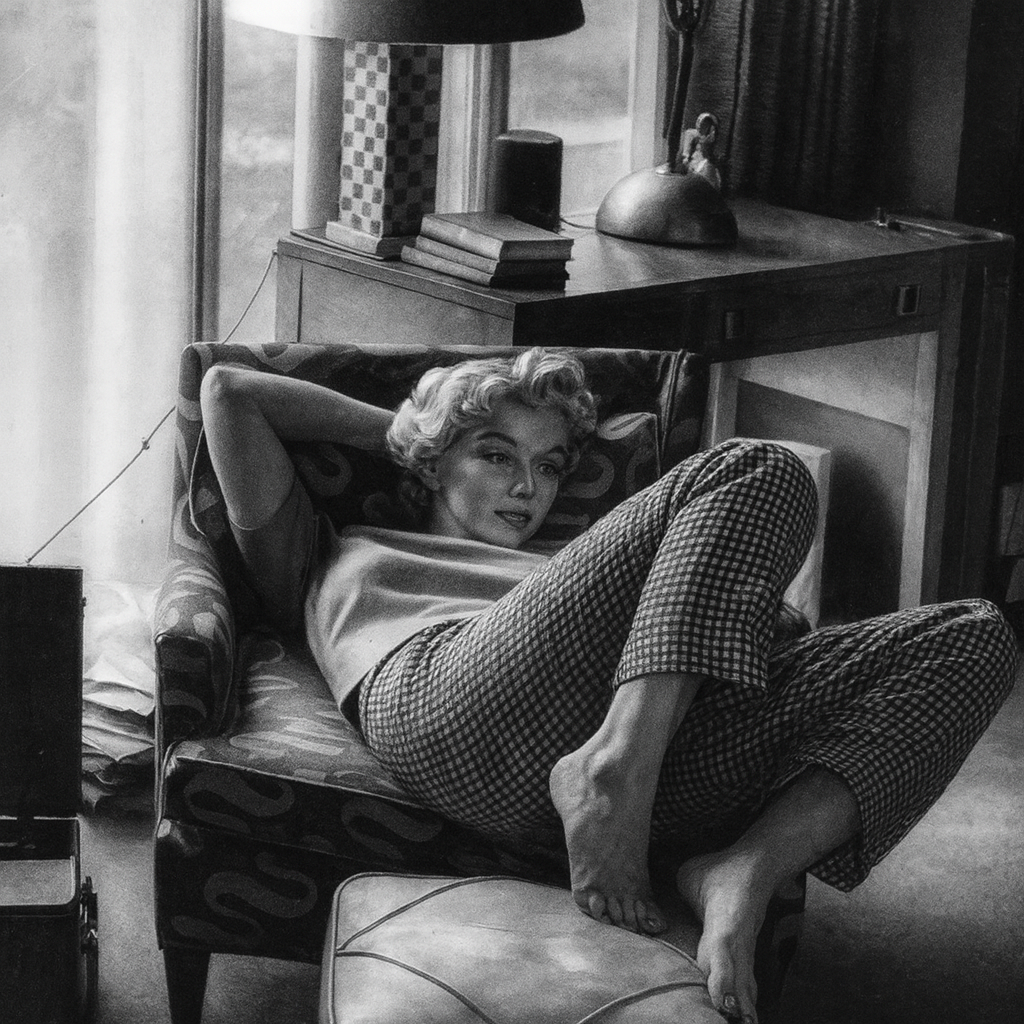
At home: Monroe barefoot in checked pants, sprawled in a chair, listening to records. The caption noted her unexpectedly sophisticated taste—Hungarian composer Béla Bartók spinning on the turntable. The image shattered the dumb-blonde archetype before it could fully calcify.
In motion: A sequence called "How to Ask for a Job" showed Monroe re-enacting an audition, cycling through poses—leaning forward conspiratorially, laughing with abandon, watching with shrewd attention. The photos captured intelligence and humor in equal measure with beauty.
In her own words: "The Monroe Doctrine" let her speak directly to readers. "I dress for me," she said of her clothes. "A man can appreciate them." On womanhood: "I'm very definitely a woman and I enjoy it."
The effect was revolutionary. Readers didn't just see Monroe—they met her. Life transformed a studio commodity into a three-dimensional human being, which paradoxically made her more mythic, not less.
Visual Storytelling as Cultural Alchemy
The cover presented Monroe in classic Hollywood glamour: direct gaze, bold confidence, star power distilled into a single image. But the interior spreads told a more complex story.
Where fan magazines of the era trafficked in fantasy and airbrushing, Life combined journalistic credibility with startling candor. The photographs worked like a visual biography in miniature—home life, humor, ambition, self-awareness. Text and image weren't separate elements; they fused into something greater than either alone.
This was Life's genius. While illustrated weeklies like The Saturday Evening Post still relied heavily on drawings and paintings, Life understood that photography carried the weight of evidence. These weren't idealized renderings—they were proof that Marilyn Monroe existed, that she was real, that she mattered.
The magazine even positioned her within Hollywood's lineage, drawing comparisons to Jean Harlow while making clear that Monroe represented something new. She was both heir and innovator, linking the studio system's golden age to whatever was coming next.
What the Issue Revealed
The Endurance of Physical Media
These vintage Life magazines endure because they remind us that history lives in objects, not just data. Life didn't just report on Marilyn Monroe. It built her.
In an era when celebrity images flood screens and evaporate within hours, the permanence of these magazines feels almost radical. They were designed to be kept, studied, returned to. For families, they're direct lines to what grandparents read over morning coffee. For collectors, they're time capsules that can't be replicated by any digital archive.
The tactile experience matters. The weight of the paper, the smell of aging pulp, the knowledge that these exact pages sat in living rooms when Eisenhower was president—that's irreplaceable.
Why Collectors Covet This Issue
This isn't reading material. It's a primary source—1950s cultural history preserved in ink and paper.
Explore the Collection
Our archive holds thousands of original Life magazines spanning the 1930s through the 1970s. Each issue documents its moment—war, fashion, politics, film, the full spectrum of mid-century American life.
Whether you're building a serious collection, researching cultural history, or connecting with the past your family lived through, these magazines offer something no screen can deliver: history as it was first told, held in your hands.
Browse Life Magazine CollectionThe Transformation Captured in Print
The April 7, 1952 issue of Life Magazine remains among the most significant celebrity features ever published. By declaring Marilyn Monroe "the genuine article," the magazine didn't just predict her stardom—it catalyzed it.
These pages brought Monroe into American homes with an intimacy and authority no other medium could match. What they offer now transcends nostalgia. They're artifacts that shaped how the world understood one of the twentieth century's most enduring figures.
For anyone who values cultural history, vintage Life magazines aren't collectibles—they're witnesses. And in this particular issue, you're holding the moment when Norma Jeane became immortal.