
The Magazine That Captured Marilyn Monroe Becoming Immortal
How Life Magazine's May 25, 1953 issue documented the exact moment a movie star crossed into myth
On May 25, 1953, Americans opened their mailboxes to find something extraordinary: photographic evidence of a movie star crossing the threshold into myth.
Life Magazine's cover that week featured Marilyn Monroe and Jane Russell in a blaze of Technicolor glamour—two of Hollywood's most magnetic performers staring directly into the camera, daring readers not to look. Inside, a sprawling photo-essay titled "Marilyn Takes Over as Lorelei" documented Monroe's transformation into the role that would define her forever: the diamond-obsessed, unapologetically ambitious Lorelei Lee in Gentlemen Prefer Blondes.
This wasn't merely publicity. It was Life doing what it did better than any publication in America—turning entertainment into cultural event, celebrity into icon, and a single film into a referendum on postwar desire, femininity, and spectacle.
For collectors today, this issue represents something rarer still: the exact moment Monroe stopped being a starlet and became Marilyn.
Archive Details
Historical Figure: Marilyn Monroe & Jane Russell
Issue Date: May 25, 1953
Archive Source: Life Magazine
Featured Film: Gentlemen Prefer Blondes (1953)
Cultural Significance: Documents Monroe's "Diamonds Are a Girl's Best Friend" performance—one of cinema's most iconic moments
The America That Opened This Magazine
Spring 1953 was a hinge moment in American life.
Dwight Eisenhower had just taken office, promising stability after two decades of depression and war. The Korean War would end with an armistice that July. Television was colonizing American living rooms—I Love Lucy commanded millions of viewers weekly—but Hollywood fought back with what TV couldn't deliver: big-screen Technicolor musicals that turned escapism into spectacle.
Consumer abundance defined the era. Suburban homes multiplied. Advertisers sold not just products but lifestyles. Even within this issue of Life, ads for Aqua Velva aftershave, Coronet Brandy, and Dubble Bubble Gum crowded the margins, proof that entertainment and consumption had become inseparable.
Against this backdrop, Marilyn Monroe was no longer rising—she was arriving. Life recognized the significance and gave readers front-row seats to her coronation.
Why Life Could Do What No One Else Could
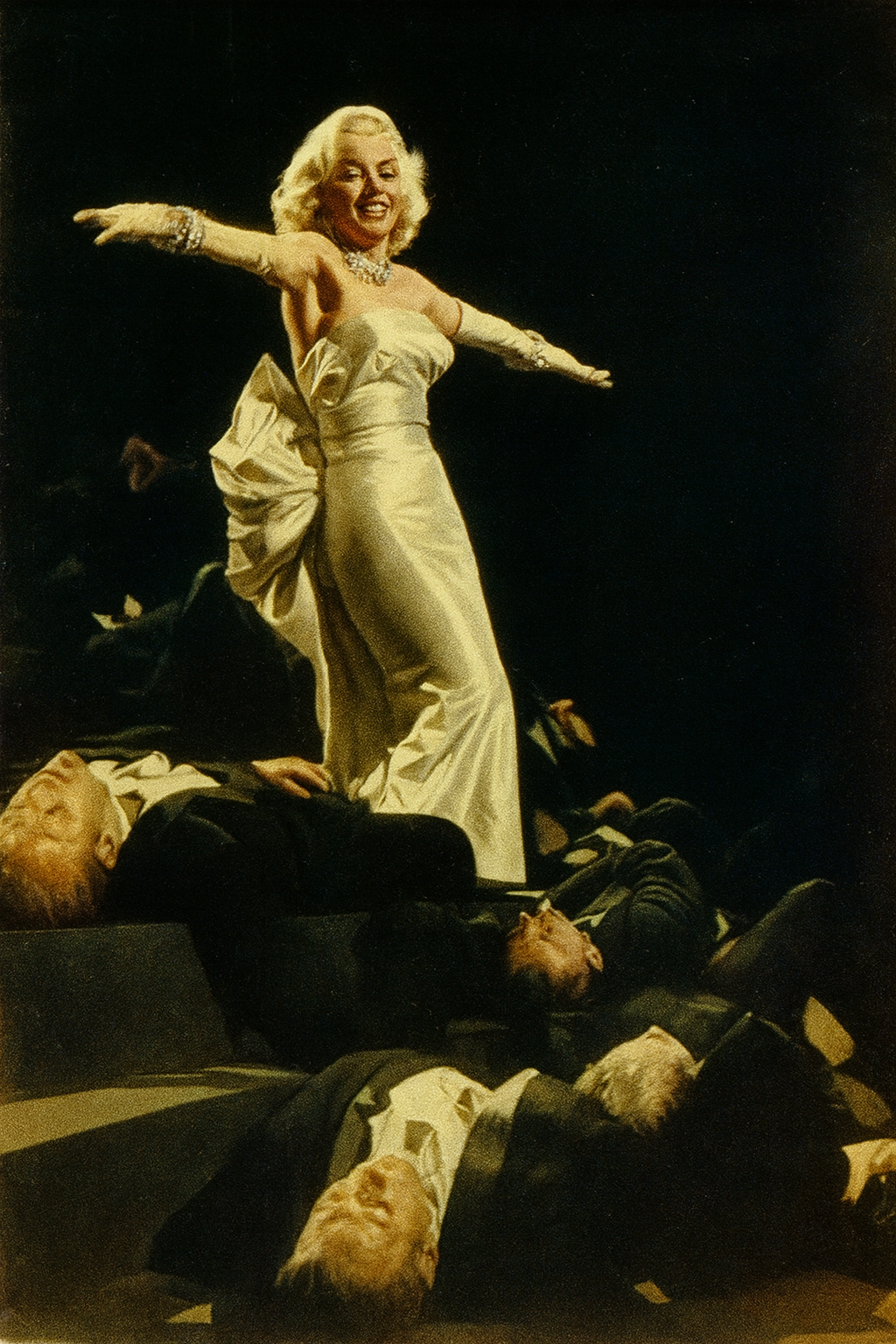
By 1953, Life Magazine had perfected a singular editorial alchemy: photography as narrative, image as argument. While other publications relied on text-heavy film reviews, Life understood that a single image of Monroe in her pink satin "Diamonds Are a Girl's Best Friend" gown—surrounded by tuxedoed admirers sprawled at her feet—conveyed more about the film's audacity than a thousand words of criticism.
The magazine's treatment of Gentlemen Prefer Blondes demonstrated this mastery across multiple spreads:
The Iconic Moment Preserved: A full-page photograph captured Monroe mid-performance in "Diamonds Are a Girl's Best Friend," the musical number that would become her most enduring image. The gown, the gesture, the knowing smile—Life froze it all for posterity.
The Playful Contrasts: Six-year-old George Winslow as "Young Admirer" Henry Spofford III, seated adoringly at Monroe's table. Then Charles Coburn as the "Old Admirer," gallantly draping a blanket over her shoulders. The photos emphasized the film's comic range while underscoring Monroe's ability to command attention across generations.
Jane Russell's Sharp Wit: Russell appears in a courtroom scene wearing a blonde wig, parodying Monroe's Lorelei with theatrical flair. Another spread shows Russell among Olympic athletes as "Lorelei's Pal Dorothy," providing comedic counterweight to Monroe's shimmer. The photos celebrated their partnership while showing that Russell more than held her own.
The captions matched the visual sophistication—witty, informed, occasionally arch. Life noted that Monroe made Lorelei "the least innocent and most sparkling" version yet, a character "unapologetically focused on jewels." This wasn't fawning publicity; it was cultural commentary disguised as entertainment coverage.
The Cover as Cultural Statement
The dual-star cover announced something significant: two women at the absolute peak of Hollywood glamour, sharing billing in an era when studios typically pitted actresses against each other. Monroe and Russell stare outward with equal confidence, equal claim to the viewer's attention.
Life had abandoned illustrated covers years earlier, insisting on photography's documentary power. Even when staged—and this cover was meticulously staged—the photographs carried an aura of authenticity, of capturing something real. The magazine brought Hollywood into American homes not as fantasy but as accessible spectacle, glamorous yet somehow attainable.
Inside, the layout alternated between full-page showstoppers and sequential photo narratives. The design mirrored the film's own rhythm: big production numbers punctuated by intimate character moments, all threaded together with sharp humor.
What This Issue Preserved
The Birth of an Icon
Monroe's "Diamonds Are a Girl's Best Friend" performance became one of cinema's most referenced images—endlessly parodied, homaged, and studied. Life captured it not as memory but as contemporary event.
Hollywood's Last Stand
The 1950s musical represented the film industry's response to television's threat—opulent, colorful, impossible to replicate on a small black-and-white screen. This issue documents that defiance.
The Partnership Model
Monroe and Russell's collaboration challenged the competitive dynamic Hollywood typically imposed on its leading women. The Life spread celebrates their chemistry rather than manufacturing rivalry.
Consumer Culture's Visual Language
The advertisements surrounding the feature—spirits, cosmetics, household products—reveal how thoroughly entertainment and commerce had merged by midcentury. The magazine itself was part of this ecosystem, selling both products and dreams.
The Enduring Power of Print
Life's great issues—whether covering D-Day, the March on Washington, or Marilyn Monroe—endure because they function as time capsules. They don't merely report what happened; they preserve how it looked, how it felt, how people encountered it in the moment.
The May 25, 1953 issue captured Monroe at the precise instant she transcended actress to become archetype. It preserved Russell's intelligence, the spectacle of Technicolor musicals, and the consumer optimism surrounding both. In an era of ephemeral digital content, these printed pages remain permanent testimony.
Why Collectors Prize This Issue
In the market for vintage Life magazines, the May 25, 1953 edition commands particular attention:
Monroe on the Cover
Any cover featuring Monroe appreciates in value. She remains among the most collected figures in American popular culture, her image synonymous with a particular vision of Hollywood glamour.
The Gentlemen Prefer Blondes Feature
This spread documents the creation of Monroe's signature performance in real time, not retrospectively. It's primary source material, not nostalgia.
Dual-Star Appeal
Russell's presence adds depth for collectors interested in Hollywood's broader landscape, not just Monroe alone.
Period Advertising
The original ads function as cultural artifacts, offering unfiltered glimpses into 1950s consumer desires and marketing strategies.
Condition Matters
Seven decades later, pristine copies grow increasingly rare. Each surviving issue represents a fragile link to a specific moment in American media history.
Owning this magazine means possessing the actual pages that 1953 readers held—the same photographs, the same layout, the same confluence of image and text that shaped how millions experienced Monroe's emergence.
A Permanent Record
The May 25, 1953 Life Magazine stands among the publication's most significant Hollywood issues. Its coverage of Monroe and Russell in Gentlemen Prefer Blondes delivered glamour and cultural documentation in equal measure.
For 1953 readers, it offered immersion in Technicolor spectacle and proximity to rising icons. For today's collectors, it represents something more valuable: a magazine that captured transformation as it occurred, preserving Monroe's ascent to immortality at the precise moment it happened.
Holding this issue means holding a fragment of 1953—Eisenhower's optimism, Hollywood's defiance, and the enduring influence of Life's photojournalism. The past doesn't just speak through these pages. It performs.
For Collectors and Cultural Historians
If you're drawn to Marilyn Monroe, vintage Hollywood, or the evolution of American popular culture, the May 25, 1953 Life Magazine isn't optional—it's essential.
Browse Life Magazine CollectionOur collection spans the 1930s through the 1970s, encompassing World War II, the Space Race, the Beatles, and everything between. Each issue offers more than articles and photographs—you'll find the advertisements, design choices, and editorial voice of its era. These are historical artifacts that refused to stay historical.