
The Magazine That Defined Woodstock
Rolling Stone's September 20, 1969 Issue and the First Draft of History
On September 20, 1969, readers who picked up the latest issue of Rolling Stone weren't just buying a magazine. They were holding the first draft of history—a raw, unfiltered document of what would become the most mythologized weekend in American music.
While network television still fumbled to explain what had happened in Bethel, New York, and newspapers dismissed it as a muddy disaster, Rolling Stone understood: Woodstock wasn't chaos. It was a cultural rupture.
The issue's cover story, "It Was Like Balling for the First Time," remains one of rock journalism's defining artifacts. At a moment when America was splintering over Vietnam, civil rights, and generational warfare, Rolling Stone reframed Woodstock not as failure but as proof—proof that half a million people could gather without violence, that music could transcend politics, that the counterculture wasn't just theater.
This wasn't reporting. It was documentation.
Archive Details
Publication: Rolling Stone Magazine
Issue Date: September 20, 1969
Cover Story: "It Was Like Balling for the First Time"
Historical Context: First comprehensive national coverage of Woodstock, published one month after the festival
The Fracture Point: America in August 1969
Vietnam protests had reached fever pitch. Martin Luther King Jr. had been dead barely a year. The psychedelic movement—with its long hair, communal living, and peace-and-love idealism—was colliding head-on with Nixon's "Silent Majority." Into this powder keg came Woodstock, scheduled for August 15–18, 1969, on Max Yasgur's dairy farm.
What was planned as a ticketed event for 50,000 became a free festival for over 400,000 when the fences collapsed and organizers simply gave up. The result was part pilgrimage, part refugee crisis, part utopia. And Rolling Stone was there to capture it all.
Why Rolling Stone Got It Right
Mainstream outlets focused on the mud, the drug busts, the logistical nightmare. Rolling Stone saw something else entirely. The magazine's coverage succeeded on three fronts:
The Cover
No celebrity. No performers. Just cows grazing in a field. The symbolism was deliberate: Woodstock wasn't about stars—it was about the farmland itself, transformed overnight into a city of 400,000 souls united by sound.
The Photography
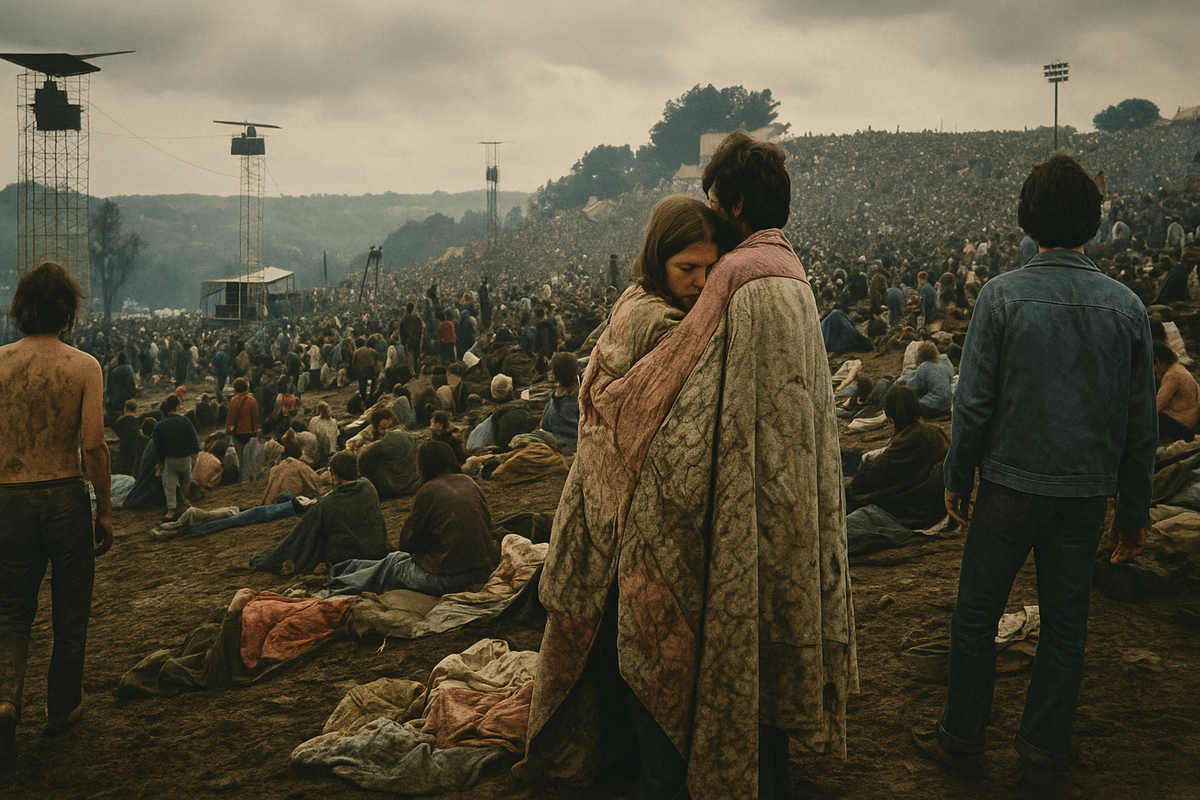
Stark, unposed documentary evidence showing Woodstock's contradictions: the joy and suffering, the music and mud, the triumph and near-collapse. These images became the festival's visual archive.
The Writing
"It Was Like Balling for the First Time" spoke in the voice of the people who lived it. Unapologetic, celebratory, defiant—where others saw disorder, Rolling Stone's writers saw resilience.
Raw Documentation
The interior images weren't press kit photos. They were documentary evidence—youth bathing in rivers (page 21), exhausted festivalgoers (page 20), helicopters over highways (page 24), makeshift food kitchens (page 23).
The Details That Made History
Rolling Stone captured the texture of Woodstock in ways no other publication attempted:
The Traffic Apocalypse: Cars abandoned for miles in every direction. People walking five, ten, fifteen miles through the New York countryside, guitars on their backs, sleeping bags in hand. Helicopters overhead, ferrying musicians and medical supplies while below, a generation marched toward the music.
Mud as Metaphor: Torrential rain turned Yasgur's farm into a swamp, but the photos in Rolling Stone show something unexpected—people laughing, sliding, dancing in the muck. The mud became the festival's equalizer. Rich and poor, famous and unknown, all reduced to the same filthy, joyful state.
The Collapse of Commerce: When the fences fell and tickets became meaningless, Woodstock transformed from a business venture into something closer to communal ritual. Rolling Stone understood this wasn't a failure of capitalism—it was capitalism's temporary defeat.
The Performances: Jimi Hendrix's dawn performance of "The Star-Spangled Banner," shredding the anthem into feedback and distortion. The Who's explosive set. Janis Joplin's raw, whiskey-soaked wail. Joe Cocker's spasmodic, career-defining "With a Little Help From My Friends." These weren't just concerts—they were transmissions from the future.
The Peaceful Miracle: Despite food shortages, water crises, inadequate sanitation, and a population larger than most American cities, Woodstock remained overwhelmingly nonviolent. No riots. No stampedes. Just collective endurance built on music and an unspoken pact: we're all in this together.
Rolling Stone's September 20 issue didn't just report these facts—it argued for their significance.
How Rolling Stone Became the Voice of a Generation
By devoting its September 20, 1969 issue to Woodstock, Rolling Stone completed its transformation from upstart music rag to cultural authority. The magazine was bold enough to treat rock music as serious subject matter, worthy of long-form journalism and critical analysis. It offered readers something mainstream publications couldn't: a view from inside the movement, not above it.
Where Life magazine had documented World War II, Rolling Stone documented the counterculture's defining moment. The magazine preserved Woodstock not as a messy festival that got out of hand, but as a historical turning point—the moment when youth culture proved it could create its own society, even if only for three days.
The Artifact as Time Machine
Scrolling through digital archives flattens history into pixels. Holding an original 1969 Rolling Stone does the opposite—it restores dimension. The paper stock, the typography, the advertisements for stereo equipment and underground albums, even the smell of aging newsprint—all of it returns you to the moment when Woodstock was still news, not legend.
For collectors, these magazines aren't reading material. They're transmission devices from a world that no longer exists.
Why Collectors Seek the September 20, 1969 Issue
Timing
Published just one month after the festival, it offered the first comprehensive national coverage—before the myths solidified, before the documentaries, before Woodstock became "Woodstock."
Primary Source Value
The photographs and reportage inside connect directly to one of the 20th century's most studied cultural events. For historians researching the 1960s, this issue is evidence, not commentary.
Visual Archive
The candid festival images—helicopters, mud-soaked crowds, food lines, scaffolding—exist nowhere else in this unfiltered form. These aren't retrospective shots. They're immediate, unprocessed, real.
Crossover Appeal
Music historians, Woodstock attendees, fans of Hendrix, Joplin, The Who, and students of 1960s counterculture all pursue this issue. Its value spans multiple collecting categories.
Owning the September 20, 1969 issue of Rolling Stone means owning a piece of Woodstock itself—not the sanitized memory, but the actual event, preserved in ink and paper.
Own This History
Original issues from Rolling Stone's legendary run—from Woodstock in 1969 through punk's explosion in the 1970s to grunge's breakthrough in the 1990s—are available through our archive.
Browse Rolling Stone Magazine CollectionThe September 20, 1969 issue of Rolling Stone remains what it was fifty-five years ago: the authoritative record of Woodstock. With its symbolic cover, unvarnished photography, and reportage that trusted its readers to understand the significance of what they were seeing, Rolling Stone elevated a muddy farm gathering into the defining moment of a generation.
Holding this issue today means holding proof—proof that 400,000 people converged on Bethel, New York, survived rain and shortages and chaos, and created something unprecedented. The highways choked with abandoned cars. The rain-soaked crowds refusing to leave. The music that carried them through.
For serious collectors and cultural historians, vintage Rolling Stone magazines represent more than journalism. They are the primary sources, the first witnesses, the unfiltered documents of an era when music, politics, and youth rebellion collided to reshape American culture.