
The Summer They Tried to Kill Babe Ruth's Ghost
How Life Magazine turned baseball's greatest chase into a mathematical prophecy—forty years before Moneyball
On August 18, 1961, Americans opened their mailboxes to find something unusual tucked inside Life Magazine: a mathematical death sentence for baseball's most sacred record.
The cover showed Mickey Mantle mid-swing, face twisted in violent effort, every tendon visible. Inside, editors had done the unthinkable—they'd run the numbers on whether two living Yankees could surpass Babe Ruth's 60 home runs in a single season. Using Bernoulli's Distribution, they calculated Mantle's odds at 7–2 in favor. Roger Maris, the quieter slugger, stood at even money.
This wasn't speculation. It was statistical prophecy, published forty years before "Moneyball" made such analysis routine.
For a nation still deciding whether computers belonged in American life, Life Magazine had just turned baseball—the game of gut instinct and mythmaking—into a problem set.
Archive Context
Historical Figures: Mickey Mantle, Roger Maris, Babe Ruth
Issue Date: August 18, 1961
Archive Source: Life Magazine
Feature Title: "Math Muscles"
Historical Significance: One of the first mainstream applications of probability theory to sports journalism
When Science Met the National Pastime
The early 1960s were hinge years. Kennedy was in the White House. The Cold War had gone nuclear. NASA was promising the moon. Yet none of this stopped the entire country from obsessing over two men with wooden bats.
Mickey Mantle was already a deity—the switch-hitting powerhouse whose injuries only made him more heroic. Roger Maris was the outsider, a workmanlike right fielder who had the audacity to challenge not just Ruth's record, but Mantle's claim to it.
Every morning, box scores became breakfast reading. Barbershops turned into statistical laboratories. Radios crackled with pitch-by-pitch updates. The chase wasn't just sports—it was a referendum on whether modern athletes could match the legends, whether 1961 could hold a candle to 1927.
Life Magazine understood this wasn't a story. It was a cultural flashpoint.
The Magazine That Photographed Pressure
By 1961, Life had mastered a specific alchemy: take a moment everyone knew about and make it unforgettable.
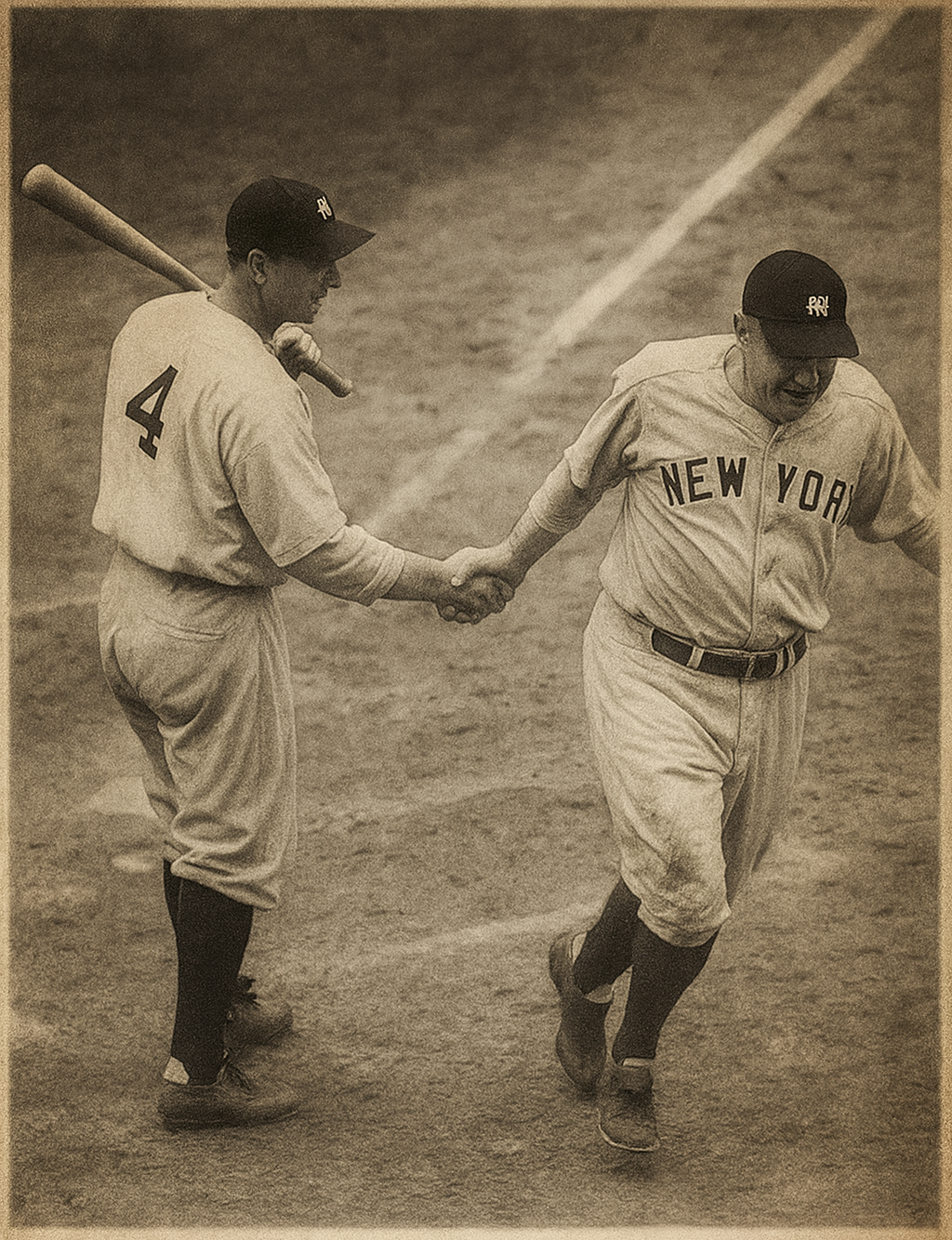
The "Math Muscles" photo-essay delivered visceral proof of what chasing immortality looked like. Black-and-white images captured Mantle checking a swing, jaw clenched against an inside pitch. Maris pulling toward right field, face locked in concentration. An archival shot of Ruth and Gehrig shaking hands—the ghosts these men were hunting.
But the photographs were only half the formula.
Life's editors embedded Bernoulli's Distribution formulas directly into the layout. They calculated Mantle's 18 home runs across 38 games and rated his chances better than 2–1. Maris's 14 homers over the same stretch? More than 3–1 against him.
This was radical. Sports journalism in 1961 trafficked in heroism and anecdote, not probability theory. Life was applying actuarial science to America's pastime, predicting the future while documenting the present. Readers were getting two narratives simultaneously: the raw physicality of bat meeting ball, and the cold logic of what the numbers suggested would happen next.
It was sabermetrics before the word existed. Nate Silver before Nate Silver.
What Made This Issue Different
Life Magazine never just covered events—it enshrined them. The August 18, 1961 issue demonstrated why:
Photography as Evidence
Unlike static portraiture, Life's photographers captured the decisive moment: Mantle's face contorted mid-swing, veins bulging, muscles torqued. These weren't publicity stills. They were evidence of human effort at its absolute limit.
Shakespearean Character Study
The writing explored the psychological toll of teammates competing for the same immortality. How did Mantle handle being the favorite who might lose? How did Maris cope with chasing a legend while his own teammate stood in the way?
Mathematics as Drama
By quantifying the odds, Life gave readers a framework for their own speculation. The numbers didn't diminish the drama; they amplified it. Now fans could argue probabilities alongside predictions.
Legacy vs. Modernity
Archival photos of Ruth weren't mere decoration—they were visual arguments about legacy. Life was asking: Can modernity surpass mythology? Should it?
Why This Issue Still Matters
Roger Maris finished the 1961 season with 61 home runs, breaking Ruth's record. The achievement came with an asterisk—literally. Baseball Commissioner Ford Frick ruled it didn't count as a "true" record because Maris needed 162 games while Ruth used only 154.
Life Magazine couldn't have known this controversy was coming when they went to press in mid-August. But their issue captured something more important than the final tally: the national obsession with whether the past could be beaten.
For collectors, the August 18, 1961 Life Magazine represents several converging values:
Historical Timing: Published during the chase, not after. This is live reporting of a legend in progress.
Statistical Innovation: One of the first mainstream publications to apply probability theory to sports performance.
Photographic Mastery: Among the most dramatic baseball action shots Life ever printed.
Cultural Archaeology: A record of how Americans consumed sports before instant replay, before analytics became orthodoxy, before the internet turned every game into a real-time data stream.
Holding this issue means holding the summer of 1961 in physical form—the uncertainty, the rivalry, the mathematics of heroism.
The Artifact That Outlasted the Season
Today's sports coverage drowns in statistics. Every swing generates launch angles, exit velocities, barrel rates. What Life Magazine did in 1961 seems almost quaint by comparison—just one probability distribution, elegantly deployed.
But that's precisely what makes the August 18, 1961 issue remarkable. It was the moment when American sports journalism realized numbers could tell stories just as powerful as narratives. That math and muscle weren't opposites—they were partners in understanding greatness.
For anyone who values the intersection of sports, science, and cultural history, this issue isn't just collectible. It's foundational.
Collector Significance
Original Life magazines from the 1930s through the 1970s remain among the most accessible windows into 20th century America. Unlike newspaper archives or television footage locked behind paywalls, these physical issues are tangible, displayable, and increasingly rare in pristine condition.
The August 18, 1961 edition sits at the convergence of several collecting categories: baseball history, statistical innovation, photojournalism, and Cold War-era Americana. It's equally at home in a sports memorabilia collection or a mid-century design archive.
Baseball History
Documents the Mantle-Maris chase during the actual summer of 1961, weeks before the record fell
Statistical Innovation
First mainstream use of Bernoulli's Distribution in sports journalism—decades ahead of its time
Photojournalism
Features some of Life's most dramatic action photography of America's national pastime
Cultural Archive
Captures how Americans experienced sports before the digital age transformed media consumption
Explore the Archive
Each issue is a primary source—history as it was first reported, before revisions, before hindsight, before the narrative solidified. Whether your interest is war, politics, culture, or the national pastime, Life captured it when it mattered most.
Browse Life Magazine Collection