
The Operating Room Killers
Inside Jet Magazine's 1958 Exposé That Medicine Tried to Ignore
On December 18, 1958, a pocket-sized magazine hit newsstands with a truth so dangerous that most of American medicine refused to speak it aloud: Black patients were dying under anesthesia at catastrophic rates, and nobody was counting the bodies.
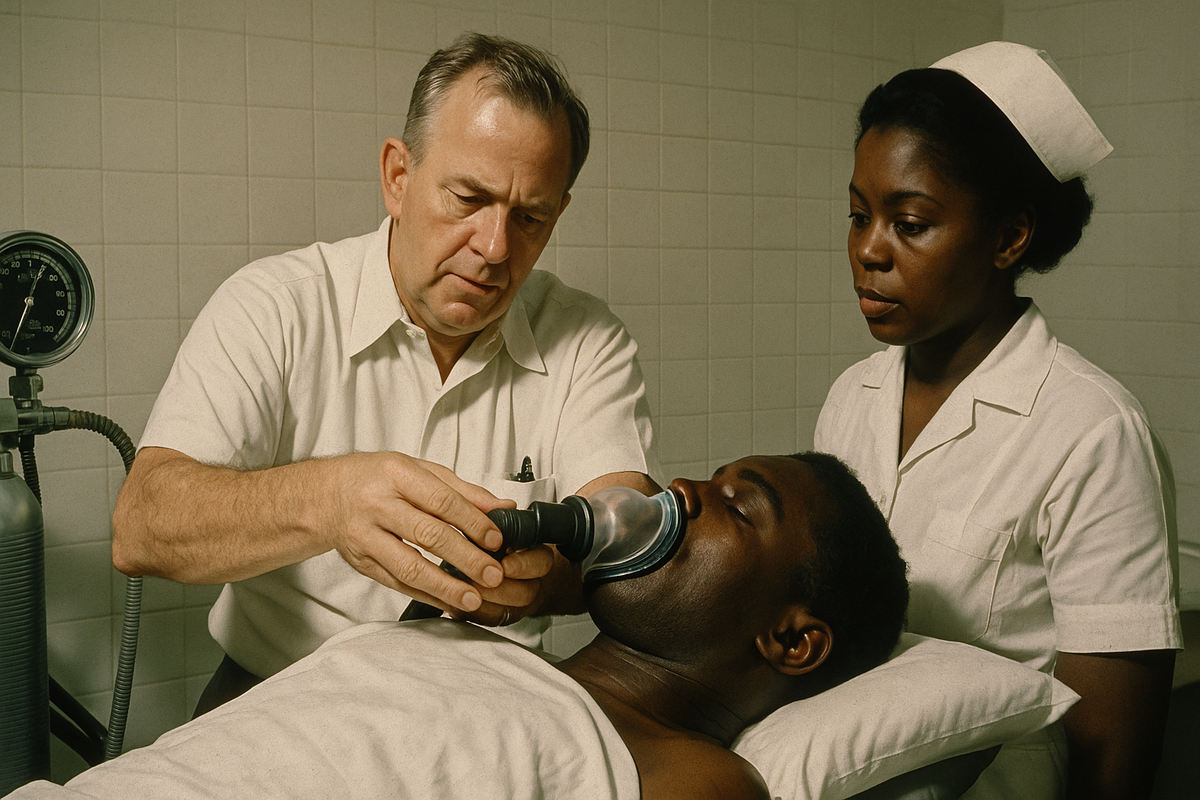
Inside that issue of Jet Magazine, past Coretta Scott King's dignified portrait on the cover, lay an article that should have detonated across every hospital in America. "White Medic Finds Way to Help Negroes Live Longer" documented what families had whispered about for generations—that entering an operating room while Black was a gamble with death itself.
The numbers were staggering: 27,000 African Americans died under anesthesia each year out of 670,000 who underwent the procedure. Not from surgical complications. Not from underlying illness. From anesthesia itself—the very thing meant to keep them safely unconscious while doctors worked.
For perspective, that death rate was several times higher than for white patients. These were preventable deaths during childbirth, routine surgeries, and standard procedures. Losses written off as "complications" in hospital records but understood as something darker by the Black nurses who watched it happen, the Black families who buried their dead, and the rare physicians willing to name what everyone else ignored.
Historical Record
Publication: Jet Magazine
Issue Date: December 18, 1958
Cover Feature: Coretta Scott King
Key Article: "White Medic Finds Way to Help Negroes Live Longer"
Featured Physician: Dr. Robert Hingson, Alabama
Historical Context: Three years after Brown v. Board of Education; weeks after the Little Rock Nine integration
The Invisible Epidemic
The 1950s medical establishment had perfected the art of not seeing. While white newspapers celebrated surgical miracles and medical breakthroughs, they maintained a studied silence about the bodies stacking up in segregated hospital wards. Black patients weren't just treated differently—they were treated as if their deaths didn't matter enough to investigate.
This wasn't neglect. It was structural violence wearing a white coat.
Jim Crow didn't stop at the hospital door. Black patients were shunted to underfunded segregated wards or entirely separate facilities. Medical schools barred African Americans, ensuring that fewer than 2% of physicians were Black. The doctors who did treat Black patients often brought their prejudices into the examination room, underestimating pain, dismissing symptoms, and—as Jet's reporting revealed—failing to recognize when dark-skinned patients were literally suffocating on the operating table.
The crisis was hiding in plain sight, visible only to those it was killing.
Enter the Alabama Maverick
Dr. Robert Hingson should have been an unlikely hero. A white physician from Alabama, he operated in a state where segregation was law and racial hierarchy was gospel. Yet Hingson looked at the death statistics and saw murder by indifference.
His innovation wasn't just technical—though he pioneered crucial devices including an oxygenator that supplied extra oxygen during operations and a jet injector needle designed for safe mass medication delivery. His real breakthrough was treating the crisis as what it was: a solvable medical emergency being perpetuated by racism.
Hingson identified the silent killer: cyanosis, the bluish skin discoloration that signals oxygen deprivation, was nearly impossible to detect on dark skin. Anesthesiologists trained exclusively on white bodies literally couldn't see when Black patients were dying in front of them. By the time other symptoms appeared, it was often too late.
Technical Innovations
Hingson developed the oxygenator device and jet injector needle, tools designed specifically to address the gaps in care for Black patients undergoing anesthesia and mass vaccination programs.
Protocol Reforms
His recommendations included maintaining at least 40% oxygen during procedures, specialized monitoring for dark-skinned patients, and specific training for recognizing cyanosis across different skin tones.
Systemic Solutions
Hingson called for increased recruitment and training of Black physicians and anesthetic specialists who could better recognize warning signs in patients who shared their complexion.
Psychological Medicine
Perhaps most radical: his insistence that hospitals cultivate "friendliness, tranquility, and fraternity" to address what he termed "racial melancholia"—the cumulative trauma of systemic oppression as a genuine health risk.
That last recommendation was more than bedside manner advice. Hingson argued that racism itself was killing people. He described "racial melancholia"—the cumulative psychological trauma of living under systemic oppression—as a genuine health risk that made Black patients more vulnerable to complications. Centuries of mistreatment had created a physiological burden that doctors needed to acknowledge and address.
His prescription wasn't just oxygen and better monitoring. It was dignity, respect, and equality as medical interventions.
Why Jet Told the Story Nobody Else Would
While mainstream publications ran cheerful features about miracle cures and medical progress, Jet was documenting the bodies those miracles left behind.
By 1958, Jet had built an unshakeable reputation for reporting that white newspapers wouldn't touch. Editor John H. Johnson understood that for Black Americans, healthcare wasn't separate from civil rights—it was survival itself. Three years after Brown v. Board of Education began dismantling school segregation, Jet was showing readers that separate was still very much unequal when it came to operating rooms.
The magazine's photographs captured Dr. Hingson working alongside Black medical staff, demonstrating his inventions, and explaining his techniques. These weren't just illustrations—they were proof that collaboration across racial lines was possible, even necessary, in 1958 America.
Jet's genius was making complex medical information accessible without condescension. Readers didn't need medical degrees to understand that their relatives were dying unnecessarily, or that solutions existed if anyone cared enough to implement them. The magazine translated technical medical language into plain truth: racism was a pre-existing condition that American medicine refused to diagnose.
The Issue That Captured Two Wars
The December 18, 1958 issue is a study in contrasts. Coretta Scott King graces the cover, her image radiating the cultural and spiritual power of the civil rights movement. Inside, the battlefield shifts to hospital corridors and operating theaters where a different kind of freedom struggle was playing out.
This duality was quintessential Jet: glamour and leadership on the surface, unflinching documentation of structural violence underneath. The pocket-sized format meant it could be read anywhere—on buses, in barbershops, at kitchen tables—carrying urgent news where other publications feared to go.
For Black readers in 1958, this wasn't investigative journalism. It was an instruction manual for staying alive.
The Long Shadow
What makes Jet's reporting on Dr. Hingson so haunting is how little has changed. Black women today are still three times more likely to die from pregnancy-related complications than white women. Studies still show that medical professionals underestimate Black patients' pain. Emergency rooms still provide different levels of care based on skin color.
The mechanisms have shifted, grown more subtle, wrapped themselves in new language. But the outcome remains: Black patients die at higher rates from preventable causes, and American medicine still struggles to name why.
Jet understood in 1958 what the medical establishment is only now beginning to admit: healthcare disparities aren't accidents or anomalies. They're the predictable result of a system built on inequality and maintained by indifference.
Why Collectors Prize This Issue
Historic Intersection
Documents the convergence of civil rights activism and medical justice, with Coretta Scott King on the cover and groundbreaking health reporting inside.
Editorial Excellence
Represents Jet at its peak: fearless investigative reporting combined with practical, life-saving information in an accessible format.
Prophetic Journalism
Addressed racial health disparities 50+ years before they entered mainstream medical discourse, proving some journalists refused to stay silent.
Cultural Timing
Published three years after Brown v. Board of Education and weeks after the Little Rock Nine, capturing a pivotal moment in American history.
The December 18, 1958 issue of Jet Magazine isn't just collectible ephemera. It's evidence. Proof that these deaths were documented, that solutions were proposed, that people knew and some even cared.
The Archive Speaks
For anyone building a collection of African American history, civil rights documentation, or medical humanities archives, this issue is essential. It captures the moment when journalism became lifesaving work, when a magazine smaller than a paperback novel took on the entire medical establishment and refused to blink.
Browse Jet Magazine CollectionThese aren't reproductions or digital scans. They're original issues, held by the people who first read them, carried through the decades as proof that someone was paying attention, that someone was counting the bodies, that someone refused to let these stories disappear.
Every issue is an artifact of resistance. Every page is testimony. And some stories—like the one from December 18, 1958—are too important to remain buried in archives.
They belong in the hands of people who understand that history isn't just what happened. It's what we refuse to forget.