
The Face That Wouldn't Fade
Time Magazine and the Man Who Survived Stalin
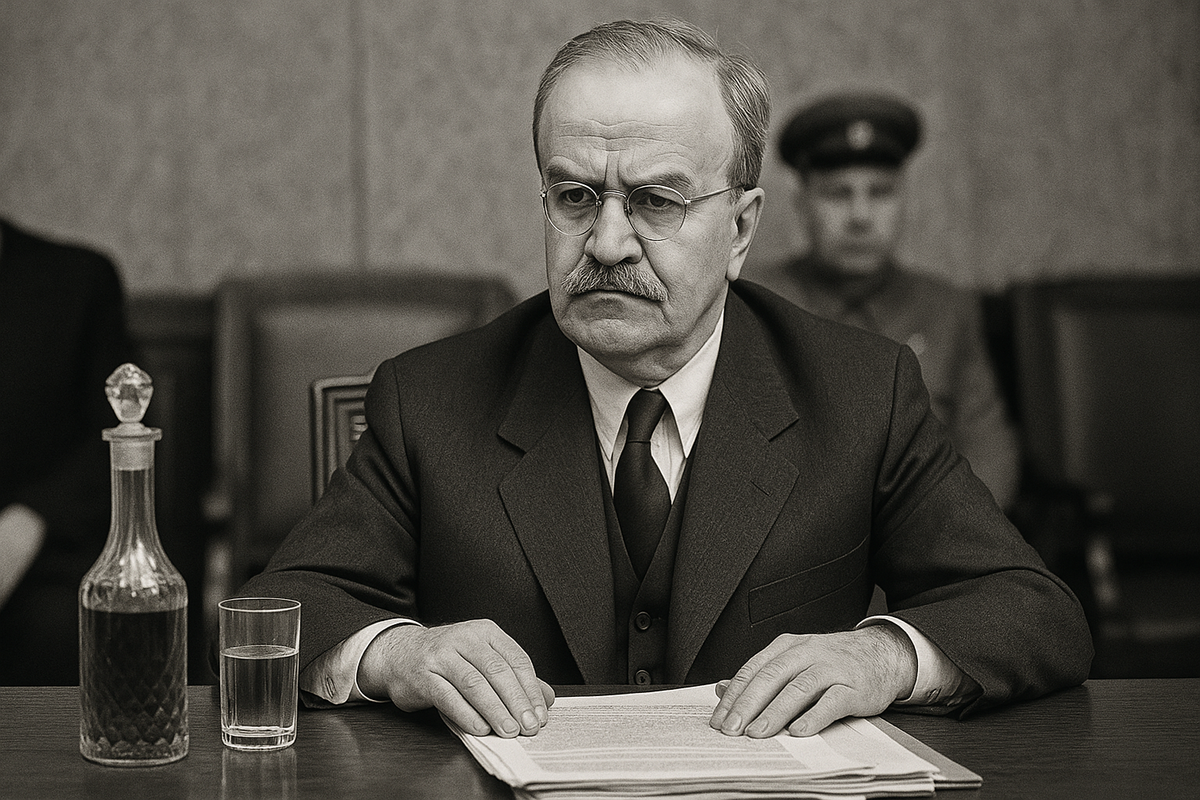
On the morning of April 20, 1953, Americans tore open their mailboxes to find Vyacheslav Molotov staring back at them.
Not a photograph. A portrait—severe, unflinching, rendered in Time's signature illustrative style and framed by that unmistakable red border. For readers eating breakfast in split-level homes across postwar America, the image carried a simple, chilling message: Stalin is dead. This man is not.
Six weeks had passed since the Soviet dictator's death on March 5. The world had been holding its breath. Would Moscow crack open? Would the Korean War end? Would the nuclear standoff ease? Time's cover story, titled "Old Reliable," delivered the answer: Don't count on it.
Historical Profile
Featured Figure: Vyacheslav Molotov, Soviet Foreign Minister
Issue Date: April 20, 1953
Archive Source: Time Magazine
Historical Context: Post-Stalin succession crisis, Korean War, Cold War escalation
The Survivor
Vyacheslav Molotov was 63 years old and had outlasted nearly everyone. He had stood beside Lenin during the Revolution. He had signed the Molotov-Ribbentrop Pact with Nazi Germany in 1939, the cynical treaty that carved up Eastern Europe and stunned the world. He had survived Stalin's purges—an achievement tantamount to walking through a minefield blindfolded. His wife, Polina Zhemchuzhina, had not been so fortunate; she had been arrested and exiled, yet Molotov remained.
Now, in the spring of 1953, as Georgy Malenkov, Nikita Khrushchev, and Lavrentiy Beria circled each other in the Kremlin's shadowy corridors, Molotov was back at the center. As Foreign Minister, he was the Soviet Union's voice to the world—a role he had played, on and off, since the 1930s.
The West knew him well. Too well. British and American diplomats had sat across from him at Yalta, Potsdam, and a dozen other conferences where the postwar order was hammered out. They had learned to dread his style: methodical, immovable, and ruthlessly patient. The British called him "Old Iron Pants." It was not a compliment.
What Time Saw
Time's reporters understood what their readers feared most: that Stalin's death would change nothing.
The magazine's profile of Molotov was a masterclass in character journalism. Instead of dry policy analysis, Time painted a portrait of a man who embodied Soviet constancy. "Old Reliable" was the bureaucrat who never wavered, never improvised, never showed flair—but never lost, either. He was gray in manner and disposition, the antithesis of Stalin's violent charisma, yet no less formidable.
The article dissected the post-Stalin power struggle with clinical precision. Malenkov held the premiership but lacked Stalin's authority. Khrushchev was maneuvering behind the scenes. Beria controlled the secret police and everyone's secrets. And Molotov? Molotov was Foreign Minister again, the position from which he could shape the Soviet Union's relationship with the rest of the world.
For Americans, this mattered viscerally. U.S. soldiers were still dying in Korea. Berlin remained divided and vulnerable. The arms race was accelerating, with both superpowers now possessing thermonuclear weapons. Understanding who held power in Moscow wasn't academic—it was survival.
The Magazine as Weapon
Time knew how to make foreign affairs urgent.
The issue opened with Molotov's face—no escaping it. Inside, photographs documented his long career: shaking hands with Western diplomats, standing beside Stalin, presiding over conferences where the fate of nations was decided. One image showed him with his wife before her arrest, a domestic detail that humanized the otherwise impenetrable figure.
The editorial approach was deliberate. Time didn't just report on Molotov; it decoded him. The magazine described his negotiating tactics, his reputation among Soviet colleagues, even his personal habits. Readers learned that Molotov was meticulous, humorless, and utterly loyal—first to Lenin's revolution, then to Stalin's terror, now to the Soviet system itself.
This was journalism as intelligence briefing. Few Americans had access to the Kremlin's inner workings. Time served as their periscope into an otherwise sealed world, translating Soviet politics into a narrative that middle-class readers could grasp over coffee.
The Hard Line Holds
The subtext of "Old Reliable" was grim: don't expect a thaw.
Molotov's return to the Foreign Ministry signaled continuity, not change. He had been Stalin's enforcer in international affairs, the man who said "no" at every negotiation, who walked out of conferences, who made Western diplomats want to tear their hair out. His presence at the top of Soviet foreign policy suggested that Moscow would remain as intransigent as ever.
Time's readers understood the implications. The Cold War would not end with Stalin. The ideological struggle, the nuclear brinkmanship, the proxy wars—all of it would continue. And the man ensuring that continuity was the gray, relentless figure on the cover.
Deep Dive: Key Themes
"Old Reliable"
Molotov was portrayed as the Kremlin's steady hand, a survivor of purges and shifting alliances, whose career stretched back to Lenin.
Kremlin Intrigue
The article explored the power struggle among Malenkov, Khrushchev, Beria, and Molotov, each vying for influence after Stalin's death.
Foreign Policy Continuity
Molotov was expected to maintain Stalin's hard line in negotiations with the West, dimming hopes for a sudden thaw in the Cold War.
The Global Implications
For Americans, the piece underscored that the Cold War would not end with Stalin. Instead, figures like Molotov ensured its continuation.
History You Can Hold
Vintage magazines are time machines.
The April 20, 1953 Time doesn't just inform us about Molotov—it shows us how Americans experienced the post-Stalin world in real time. The tone of the coverage, the choice of photographs, even the advertisements for Cadillacs and cigarettes—all of it reveals a nation grappling with existential dread while trying to live normal lives.
This is why original magazines matter. Digital archives capture content but lose context. Holding the physical issue, feeling the paper, seeing the original color balance of the photographs—this is how history becomes tangible.
The Molotov cover reminds us that the Cold War was fought not just with missiles and spies but with images and narratives. Time helped Americans understand who their adversaries were, what they wanted, and why it mattered. That coverage shaped public opinion, influenced policy debates, and created the mental map by which a generation navigated global politics.
The Man Who Stayed
Molotov would outlive Stalin by three decades. Khrushchev eventually sidelined him, stripping away his power in the late 1950s. But he never left the stage entirely. He lived until 1986, dying at 96, the last Old Bolshevik, a relic of Lenin's revolution and Stalin's terror, a man who had seen it all and survived it all.
But in April 1953, he was simply "Old Reliable"—the face on Time's cover that wouldn't fade, the reminder that Stalin's death had changed everything and nothing at all.
Collector Significance
Post-Stalin Transition
Captures one of the most important turning points of the Cold War: the leadership struggle after Stalin's death.
Molotov Feature
As one of the USSR's most notorious figures, Molotov's cover story is a prime example of how the U.S. press portrayed Soviet leaders.
Cold War Artifact
A primary document of the anxieties of 1953, reflecting American fears of nuclear war, global communism, and Soviet expansion.
Visual Appeal
With striking photography and period advertisements, the magazine doubles as a cultural time capsule of mid-century America.
Collector Demand
Issues tied to major Cold War milestones are highly sought after, especially those featuring key Soviet figures like Stalin, Khrushchev, or Molotov.
Historical Documentation
Owning this issue is like holding a piece of Cold War history—an artifact from the moment the world asked: "What comes after Stalin?"
Explore the Archive
The April 20, 1953 issue is one entry in a vast collection of cultural history. From the 1920s through the late 20th century, thousands of issues covering politics, culture, music, art, and world events await. Each one is an artifact, a snapshot, a piece of the past preserved.
The Molotov issue captured a world on edge—Stalin gone, the Cold War raging, and the face of Soviet power staring back from breakfast tables across America.
Don't just read history. Hold it in your hands.
Browse Time Magazine Collection