
The Woman Life Called "The Most Powerful in the World"
Madame Chiang's 1937 Portrait of a Nation at War
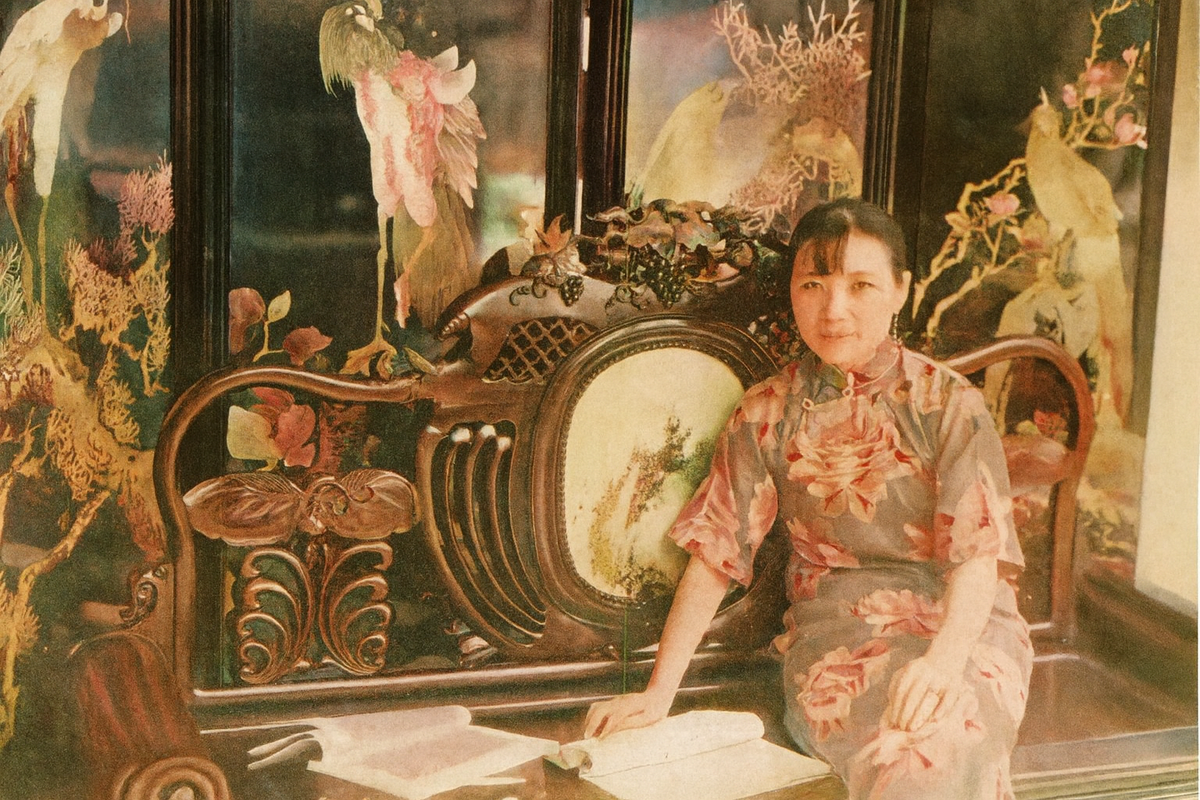
On August 16, 1937, American newsstands offered something extraordinary: a full-page portrait of a woman in an embroidered qipao, seated against screens of cranes and flowers, her gaze steady and unyielding. The caption beneath her image made a staggering claim—she was "the most powerful woman in the world."
Her name was Soong Mei-ling. Americans knew her as Madame Chiang Kai-shek. And the week this issue of Life Magazine reached readers, Japanese forces were tightening their grip on Shanghai.
The timing was not coincidental. This was Life's introduction of China's First Lady to the American public at the precise moment her country faced annihilation. The photo-essay, titled "Mei-ling ('Beautiful Mood') Helps Her Husband Rule China," was as much political briefing as it was portraiture—a calculated effort to put a human face on a war most Americans barely understood.
What made this issue remarkable was not simply its subject, but what it revealed about how modern warfare would be fought: not just with troops and artillery, but with images, diplomacy, and the strategic cultivation of international sympathy. Madame Chiang understood this. So did Life. And together, they created one of the most significant pieces of wartime media in pre–World War II America.
Archive Details
Historical Figure: Madame Chiang Kai-shek (Soong Mei-ling)
Issue Date: August 16, 1937
Archive Source: Life Magazine
Historical Context: Published weeks after the Marco Polo Bridge Incident, documenting the outbreak of the Second Sino-Japanese War
When the Bridge Burned: China's Summer of 1937
July 1937 shattered any illusion of peace in East Asia. The Marco Polo Bridge Incident—a nighttime clash between Japanese and Chinese troops outside Beijing—ignited what would become the Second Sino-Japanese War. Within weeks, the conflict metastasized. By August, Japanese forces were advancing on Shanghai, China's commercial heart, in what would become one of the bloodiest urban battles of the century.
Chiang Kai-shek commanded roughly 500,000 troops. Japan's military was better trained, better equipped, and battle-hardened from years of expansion. The odds were brutal.
Into this crisis stepped Madame Chiang—not as ornamental consort, but as operational partner. On August 1, 1937, she issued a public appeal for China's 400 million citizens to unite against the invasion. She addressed mass rallies. She attended strategy sessions with generals and politicians. She became the voice of Chinese resistance in a way her husband, constrained by military protocol and political maneuvering, could not.
But her most critical role was the one Life was documenting: she was China's ambassador to the West, fluent in English, educated at Wesleyan College in Georgia and Wellesley College in Massachusetts, and capable of translating Chinese determination into a language Americans could understand and support.
The Soong Dynasty: Power as Family Business
To understand Madame Chiang's position in 1937 is to understand the Soong family—arguably the most influential political dynasty in modern Chinese history.
Her father, Charlie Soong, had been a Methodist missionary turned industrialist and revolutionary financier. Her brother, T.V. Soong, served as Finance Minister and would later become Prime Minister. Her sister, Soong Ching-ling, was the widow of Sun Yat-sen, the founder of the Republic of China and a figure of near-mythic status. Another sister, Soong Ai-ling, had married H.H. Kung, one of China's wealthiest financiers.
The Soongs were not simply connected to power—they were power. They controlled finance, diplomacy, revolutionary ideology, and now, through Mei-ling's marriage to Chiang Kai-shek, military strategy. Life's coverage emphasized this network, presenting readers with family trees and photographs that mapped influence as much as lineage.
What Life understood—and what made this issue so potent—was that Madame Chiang was not an accident of marriage. She was the product of a family that had spent decades positioning itself at the intersection of China's transformation from empire to republic. Her role in 1937 was both inheritance and innovation.
Life's Visual Argument: Photography as Statecraft
The August 16, 1937 issue demonstrated why Life had become the most influential magazine in America within a year of its launch. Founded by Henry Luce in 1936, Life pioneered a new form of journalism: the photo-essay as narrative architecture.
The layout worked in layers. The opening portrait established Madame Chiang as regal yet accessible—traditional dress, modern bearing. Subsequent photographs showed her in motion: conferring with officials, addressing crowds, seated beside her husband in military councils. The captions did not merely describe; they contextualized, mixing biography with political analysis.
One spread showed her praying with Methodist women, emphasizing her Christian faith—a detail calculated to resonate with American readers. Another captured her in conversation with military leaders, visual proof that she was not decorative but operational. The cumulative effect was a portrait of leadership that transcended gender without erasing it. She was powerful because of her unique position, not despite it.
This was visual persuasion at its most sophisticated. Life was not simply documenting Madame Chiang; it was arguing for her significance, and by extension, for American attention to China's struggle.
The Translation of "Mei-ling": Morale as National Strategy
The article made much of her given name, Mei-ling, explaining it meant "beautiful mood." In the context of August 1937, this was more than linguistic curiosity—it was thematic framing.
China needed morale. Its armies were outgunned. Its cities were being bombed. Its government, already fractured by civil war between Nationalists and Communists, faced the existential threat of foreign conquest. Madame Chiang's role was to project confidence, resilience, and the possibility of victory.
Her August 1 appeal to China's millions was an exercise in psychological warfare. She spoke of unity, resistance, and sacrifice. She invoked both traditional Chinese values and modern nationalist sentiment. And she did so in a voice that carried authority—not just because she was the Generalissimo's wife, but because she had earned credibility through education, eloquence, and an understanding of both Eastern and Western political theater.
For American readers, the "beautiful mood" was also aspirational. If China could maintain morale against such odds, perhaps it deserved American sympathy, and eventually, American support.
Key Themes from the Archive
Madame Chiang's American education at Wesleyan and Wellesley positioned her as translator between Eastern determination and Western understanding—a role Life emphasized throughout the feature.
The photo-essay combined regal portraiture with action shots, proving she was both symbol and strategist—traditional qipao paired with modern political authority.
The Soong family network—spanning revolutionary ideology, finance, and military power—was mapped through family trees and photographs, showing power as inheritance.
Her August 1, 1937 appeal to 400 million Chinese citizens demonstrated morale-building as military strategy—confidence projection in the face of overwhelming odds.
The Aftermath: From Magazine Feature to Historical Force
The woman Life profiled in August 1937 would spend the next decade leveraging exactly the skills that issue documented. During World War II, Madame Chiang toured the United States, addressed Congress, appeared at rallies, and helped secure American aid for China. She became a celebrity, a diplomat, and a symbol of the Allied cause in Asia.
The photographic language Life established in this issue—Madame Chiang as bridge between East and West, as voice of resistance, as embodiment of China's modernity—would be repeated and amplified throughout the war. Other publications followed Life's lead, but this August 1937 feature set the template.
For historians studying how public opinion was shaped in the lead-up to World War II, this issue is essential primary source material. For collectors, it represents a convergence point: a significant historical figure, a pivotal moment, and a magazine at the height of its cultural influence.
Why This Issue Endures: Historical Artifacts as Living Documents
For collectors of vintage magazines, the August 16, 1937 issue of Life occupies a singular position. It is one of those rare publications where subject, timing, and execution converge to create something beyond journalism—a historical artifact that still speaks with urgency.
Published just weeks after the Marco Polo Bridge Incident, this issue documents the moment China entered total war. Readers were not learning about history; they were watching it unfold in real time.
Madame Chiang would go on to address the U.S. Congress in 1943, appear on the cover of Time magazine multiple times, and become one of the most photographed women of the 20th century. This Life feature was her American debut.
This issue demonstrated Life's editorial formula at its peak—visual storytelling that combined intimacy with geopolitical analysis. The full-page portrait alone remains one of the most iconic images of Madame Chiang ever published.
Before television made world leaders familiar, Life performed this function through photography. This issue showed Americans that China's leadership was modern, sophisticated, and capable of speaking directly to Western audiences.
Where History Lives: The Case for Original Magazines
There is something irreplaceable about holding an original issue—the paper stock, the ink saturation, the advertisements that frame the editorial content, the material evidence of how information was consumed in 1937. Digital archives serve scholarship, but they cannot replicate the physical encounter with history.
Original issues of Life Magazine from the 1930s through the 1970s remain among the most accessible collectibles from the 20th century. They chronicled wars, social movements, technological revolutions, and cultural transformations. Each issue is a time capsule, and many—like this August 16, 1937 edition—capture moments that still resonate.
Whether you are a collector building an archive of World War II media, a student of Asian history, or someone drawn to the intersection of photography and politics, these magazines offer direct connection to the century that shaped our present.
Explore the Archive
From the Great Depression through the Cold War, Life documented America's view of itself and the world. These are not reproductions or digital facsimiles—they are the actual objects that sat on coffee tables, that were discussed over dinner, that informed how millions of people understood their moment in history.
Browse Life Magazine CollectionFinal Reflection: When Magazines Made History
The August 16, 1937 issue of Life Magazine stands as one of the most significant pre-war publications in American media. Its coverage of Madame Chiang Kai-shek—Soong Mei-ling—presented her not as curiosity but as political force, not as symbol but as strategist.
By capturing her at the outbreak of the Second Sino-Japanese War, Life gave American readers a window into a conflict that would eventually consume the world. And by choosing to tell China's story through Madame Chiang, the magazine demonstrated how modern warfare would be waged: through images, narratives, and the strategic cultivation of international support.
Today, this issue remains what it was in 1937—evidence of power, documentation of crisis, and proof that magazines once did more than report history. Sometimes, they helped make it.