
For $112.75, You Could Buy a Year of Respectability
Inside the 1950 wardrobe that defined a generation of college women—and the cultural price tag attached
The price was printed in black and white: $112.75. Not for a single coat or a luxury handbag, but for an entire year's wardrobe—every blouse, skirt, suit, and accessory a college woman would need to navigate 1950 with her reputation intact.
When Cynthia McAdoo's feature "American Beauty's Year-Round $112.75 Wardrobe" appeared in the January 1950 issue of Ladies' Home Journal, it wasn't just fashion advice. It was a blueprint for survival in an era when a woman's clothing was her calling card, her armor, and her résumé all at once. This wasn't about self-expression. It was about meeting expectations—and doing it on a budget.
Archive Details
Publication: Ladies' Home Journal
Issue Date: January 1950
Feature: "American Beauty's Year-Round $112.75 Wardrobe" by Cynthia McAdoo
Model: Francine de Fère, Junior at Scripps College
Photographer: Lloyd Bruns-Robi
Total Wardrobe Cost: $112.75 (approximately $1,400 in 2026 dollars)
The Postwar Bargain: Style as Currency
America in 1950 was five years out from war and deep into reconstruction—not just of cities and factories, but of gender roles. Women who had worked in munitions plants and kept the home front running were being ushered back into domestic life. Yet something had shifted. College enrollment among women was climbing. Independence, however tightly leashed, was no longer unthinkable.
Enter the paradox: young women were attending universities in unprecedented numbers, but campus dress codes remained unyielding. Jeans were forbidden. Casual didn't mean comfortable—it meant a coordinated skirt-and-blouse ensemble that signaled discipline, femininity, and middle-class respectability. Fashion wasn't optional. It was the uniform of ambition.
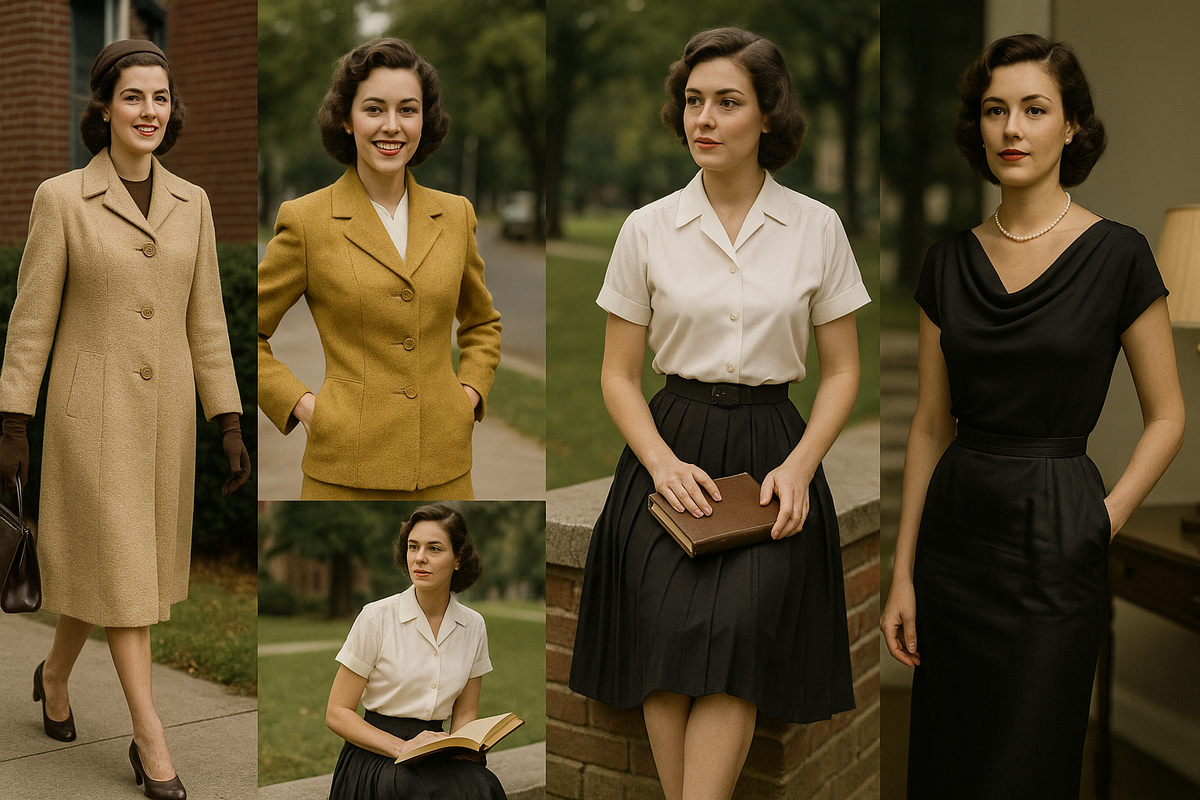
The model for McAdoo's feature was Francine de Fère, a junior at Scripps College in Claremont, California. Photographer Lloyd Bruns-Robi captured her not in sterile studio poses, but in the rhythms of actual campus life: walking to class in a beige basket-weave coat ($39.95), studying in a pleated chiffon skirt with taffeta underskirt ($15.95), attending church in a four-pocket yellow rayon suit by Alvin Handmacher ($25). Each photograph was a stage direction for how to be seen, how to belong.
The wardrobe's total cost—$112.75—translates to roughly $1,400 today. But adjusted for cultural weight, the real cost was far higher. This wasn't just about dollars. It was about the invisible tax of being a woman in public: the expectation that you would always look "put together," that your appearance would never betray effort or scarcity.
The College Woman Emerges
Large numbers of young women attending universities for the first time, navigating new social spaces with clothing as their passport.
Documented Affordability
Every item priced to the cent—from the $39.95 coat to the $7.95 linen blouse—making this a rare economic snapshot of mid-century fashion.
Designer Attribution
Specific designers named: Alvin Handmacher's $25 rayon suit, Stanley Wyllins' $8.95 black jersey blouse—evidence of emerging American fashion industry.
Photojournalistic Realism
Lloyd Bruns-Robi's photographs showed real campus scenarios—studying, walking, attending church—not detached glamour shots.
The Magazine That Shaped Millions
By 1950, Ladies' Home Journal had become one of the most powerful voices in American domestic life, with a circulation reaching millions of households. Unlike The Saturday Evening Post with its painted covers, the Journal embraced photojournalistic realism—images that felt like documentation, not fantasy.
This was strategic. The magazine didn't just sell products; it sold systems. Readers learned not only what to buy, but how to organize their lives around those purchases. The wardrobe feature was a masterclass in this editorial philosophy: here's your coat for winter ($39.95), here's your daytime blouse ($7.95), here's your transition into evening (black jersey blouse by Stanley Wyllins, $8.95). Every item had a purpose. Every dollar had a script.
The Journal understood something crucial: women wanted elegance, but they needed permission to pursue it economically. By breaking down costs and showing how a few smart pieces could stretch across seasons, the magazine gave readers a framework for aspiration that felt achievable. It was aspirational realism—a genre the publication perfected.
But beneath the practical advice was a deeper curriculum. The wardrobe spread reinforced what postwar culture demanded: tailored waists, structured silhouettes, clothing that kept femininity under tight control. This was the bargain of the era. Women could go to college, could enter the workforce—but they had to look like they weren't trying too hard, like their ambition came naturally wrapped in pleats and pressed linen.
Why This Issue Still Matters
For collectors and historians, the January 1950 Ladies' Home Journal is more than a magazine. It's evidence.
It documents a turning point. This wardrobe feature captures the exact moment when women's fashion pivoted from wartime utility to postwar abundance—but not excess. The clothes had to be practical, affordable, and above all, respectable.
It names names. Designers like Alvin Handmacher and Stanley Wyllins are credited. Prices are listed down to the cent. The model, Francine de Fère, is identified along with her college affiliation. These specifics make the issue invaluable for researchers reconstructing the material culture of the era.
It reveals the rules. Reading this spread is like finding the instruction manual for mid-century womanhood. The feature doesn't just show clothes—it shows how women were expected to move through the world, what spaces they were permitted to occupy, and how much it cost to belong.
It's rare to find college women centered. Most 1950s fashion coverage focused on homemakers or society women. A feature explicitly designed for a college student's wardrobe was unusual, reflecting the growing—but still contested—presence of women in higher education.
Owning this issue means holding a piece of that negotiation in your hands. It's a window into the cultural math women had to perform: how to be modern without being rebellious, how to be stylish without being frivolous, how to be visible without being threatening.
Collector Significance
Historical Snapshot
Exact documentation of what it cost to dress stylishly in 1950, creating an invaluable primary source for fashion and economic historians.
Fashion Milestone
Captures the transition from wartime utility to postwar consumer culture, when women sought both beauty and practicality.
Cultural Documentation
Rare focus on college women's wardrobes reflects the growing presence of women in higher education during the postwar era.
Designer Attribution
Named designers (Alvin Handmacher, Stanley Wyllins), specific prices, and identified model make this highly sought after by collectors.
Explore the Archive
The January 1950 issue with "American Beauty's $112.75 Wardrobe" is just one chapter in the sprawling chronicle of women's cultural history preserved in Ladies' Home Journal.
Browse Ladies' Home Journal Magazine CollectionEvery issue is an artifact—not just of fashion, but of the unspoken rules, invisible labor, and quiet revolutions that shaped women's lives across the 20th century.
The Legacy of a $112.75 Revolution
What makes the "American Beauty's Year-Round $112.75 Wardrobe" feature so enduring isn't just its practicality—it's what it reveals about the price of permission.
Permission to attend college. Permission to be taken seriously. Permission to occupy space as a young woman with aspirations beyond marriage. That permission came with a dress code, a budget, and a set of unspoken rules about how to be feminine without being frivolous, ambitious without being aggressive.
The wardrobe wasn't just clothes. It was camouflage for ambition. It was the cost of entry into a world that was slowly, grudgingly opening its doors.
Today, when we read this feature or hold this magazine, we're not just looking at fashion. We're looking at the terms of a negotiation that women had to accept—and the quiet ingenuity they used to meet those terms on their own.
That's why this issue still matters. Not because it's pretty, though it is. But because it's true—a snapshot of what it actually cost, in dollars and dignity, to be a woman building a life in 1950.
And that truth is worth preserving.