
When America Needed Mickey Most
The 1973 Birthday That Became a Cultural Lifeline
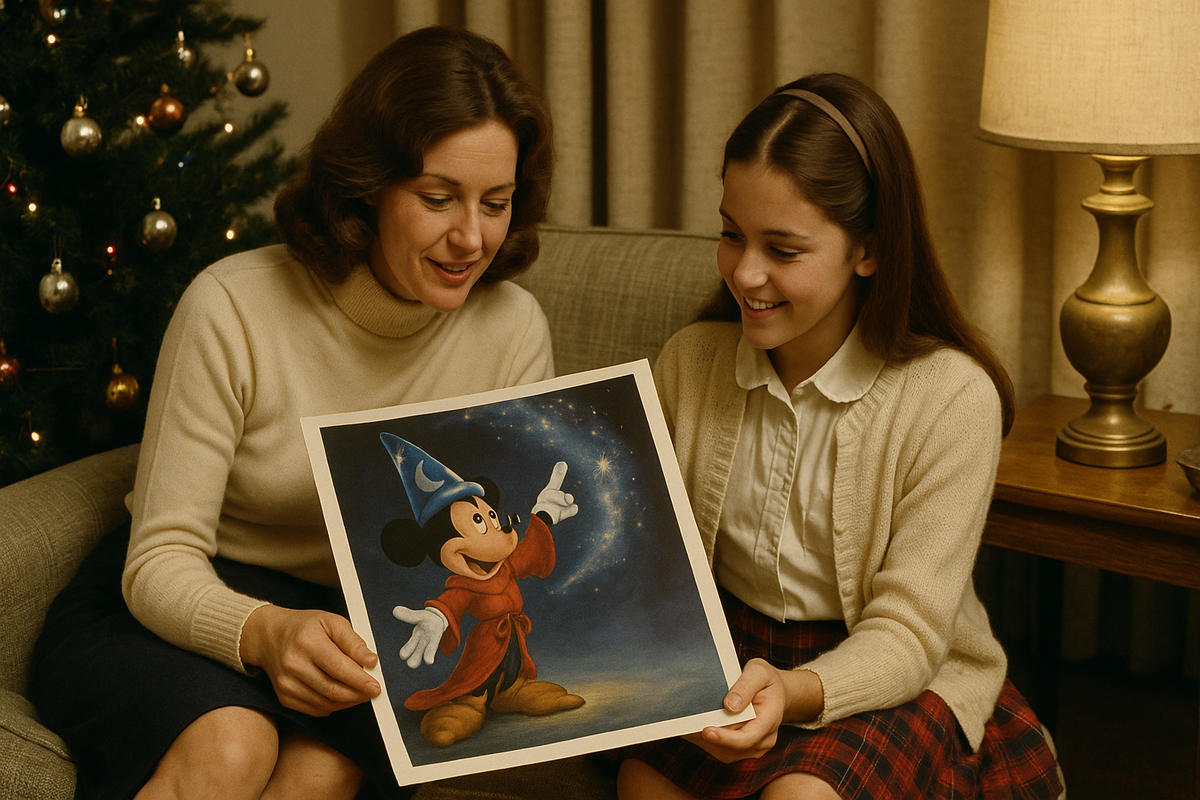
December 1973. Watergate hearings drone from television sets. Gas lines snake around city blocks. The evening news counts casualties from a war that won't end. And there, on coffee tables across America, sits the latest issue of Ladies' Home Journal—featuring Mickey Mouse in a wizard's hat, pointing toward a constellation of stars.
This wasn't escapism. This was survival.
The magazine's celebration of Mickey's 45th birthday landed at a moment when American optimism had become a scarce resource. What looked like a lighthearted tribute was actually something far more deliberate: a cultural anchor thrown to a nation adrift. By positioning Mickey alongside holiday recipes and family features, the Journal wasn't just covering entertainment—it was prescribing a remedy for collective exhaustion.
Archive Details
Cultural Icon: Mickey Mouse
Milestone: 45th Birthday Celebration
Publication: Ladies' Home Journal, December 1973
Featured Contributors: Charles Schulz, Annette Funicello, Jonathan Winters
Historical Context: Watergate Era, Post-Vietnam America
The Character Who Grew Up With America
Mickey Mouse arrived in 1928 with Steamboat Willie, the first widely successful synchronized-sound cartoon. His timing was impeccable—or perhaps inevitable. As the Jazz Age peaked and the Depression loomed, Americans would need a figure who could whistle through catastrophe without losing his grin.
By 1973, Mickey had witnessed more American history than most living citizens. He'd provided Depression-era audiences with affordable joy for a nickel. He'd been painted on bomber jackets during World War II. He'd become the face of a media empire that redefined family entertainment. And unlike politicians, celebrities, or institutions, he'd never disappointed anyone.
The Ladies' Home Journal understood this. Their December issue didn't frame Mickey as a cartoon character marking another year. They positioned him as a mirror—one that reflected 45 years of American resilience back at readers who desperately needed to remember what resilience looked like.
The Magazine That Made Icons Personal
Ladies' Home Journal had spent decades mastering a particular editorial alchemy: transforming cultural phenomena into intimate, domestic conversations. The magazine didn't cover Hollywood from a distance—it invited celebrities into readers' living rooms, positioned alongside sewing patterns and parenting advice.
Their Mickey feature exemplified this craft. Rather than using his original 1928 appearance, the editors chose the Sorcerer's Apprentice image from Fantasia—Mickey at his most elevated and artistic. The message was clear: we've all matured since 1928, and so has he.
The voices assembled for the tribute added depth across generations:
Charles Schulz, creator of Peanuts, confessed that Mickey inspired his earliest artistic ambitions, recalling childhood longings for Mickey toys before Snoopy ever existed in his imagination.
Annette Funicello, one of the original Mickey Mouse Club stars, spoke of Mickey as both childhood idol and career catalyst, embodying how he shaped entire generations of performers.
Jonathan Winters brought his comedian's perspective, reinforcing Mickey's role as a distributor of joy even in difficult times.
Together, these reflections constructed Mickey not as entertainment but as infrastructure—a foundational element in the architecture of American childhood and memory.
Why This Issue Mattered Then (And Now)
The placement of this feature within the December 1973 issue reveals editorial sophistication. Surrounded by holiday traditions, fashion, and family advice, Mickey became part of the domestic ecosystem rather than a celebrity spectacle. The Journal had always excelled at this—making cultural history feel like family history.
This approach had particular power in 1973. The women's movement was reshaping traditional roles. Political scandals were eroding institutional trust. The certainties that had defined postwar America were fracturing. In this context, Mickey's birthday wasn't nostalgia—it was evidence that some foundations still held.
The article traced his journey from Steamboat Willie's technical revolution through his transformation into a national symbol during the Depression and World War II. It acknowledged his evolution from simple cartoon to sophisticated icon, represented by the Fantasia imagery. Most importantly, it positioned him as more familiar than baseball, more reliable than politics, more enduring than any single generation.
Historical Convergence
This issue captures a precise moment when nostalgia became therapeutic necessity during America's crisis of confidence.
Cross-Generational Record
The Schulz-Funicello-Winters trio spans three distinct entertainment eras in a rare multi-perspective document.
Disney Archival Significance
Mickey milestone celebrations are consistently sought by serious collectors, elevated by Fantasia artwork.
Women's Media History
The Journal shaped how millions understood culture, domesticity, and national identity at their crossroads.
The Enduring Relevance
This issue survives in collector consciousness because it captured what 1973 demanded: proof that imagination survives disillusionment. While Watergate unfolded and geopolitical certainties crumbled, Mickey remained universal. His birthday wasn't mere celebration—it was reassurance that optimism could still be legitimate.
The Ladies' Home Journal knew its readers needed more than news. They needed continuity. They needed to remember that joy wasn't naive—it was radical.
The Collector's Perspective
The December 1973 Ladies' Home Journal occupies a specific intersection of cultural value, representing a trifecta of Disney history, 1970s cultural documentation, and women's publishing legacy.
Historical Convergence
This issue captures a precise moment when nostalgia became therapeutic necessity. The decision to celebrate Mickey's 45th during America's crisis of confidence makes this more than memorabilia—it's a document of how culture responds to trauma.
Disney Archival Significance
Mickey milestone celebrations are consistently sought by serious collectors. The Fantasia artwork elevates this beyond standard licensing into artistic territory.
Cross-Generational Documentation
The Schulz-Funicello-Winters trio spans three distinct entertainment eras, making this a rare multi-perspective historical record.
Women's Media History
As one of America's most influential women's magazines, the Journal shaped how millions of American women—and their families—understood culture, domesticity, and national identity. This issue stands at the crossroads of those conversations.
Explore the Archive
Ladies' Home Journal offers an unparalleled lens into 20th-century American life—how women and families processed cultural shifts, political upheavals, and changing social landscapes. Each issue functions as a time capsule, preserving not just events but the emotional texture of entire eras.
From Elizabeth Taylor profiles to Mickey Mouse's 45th birthday, from Vietnam-era homemaking to women's liberation discourse, these magazines document the intersection of domestic life and national identity across decades of American transformation.
Browse Ladies' Home Journal Magazine Collection