
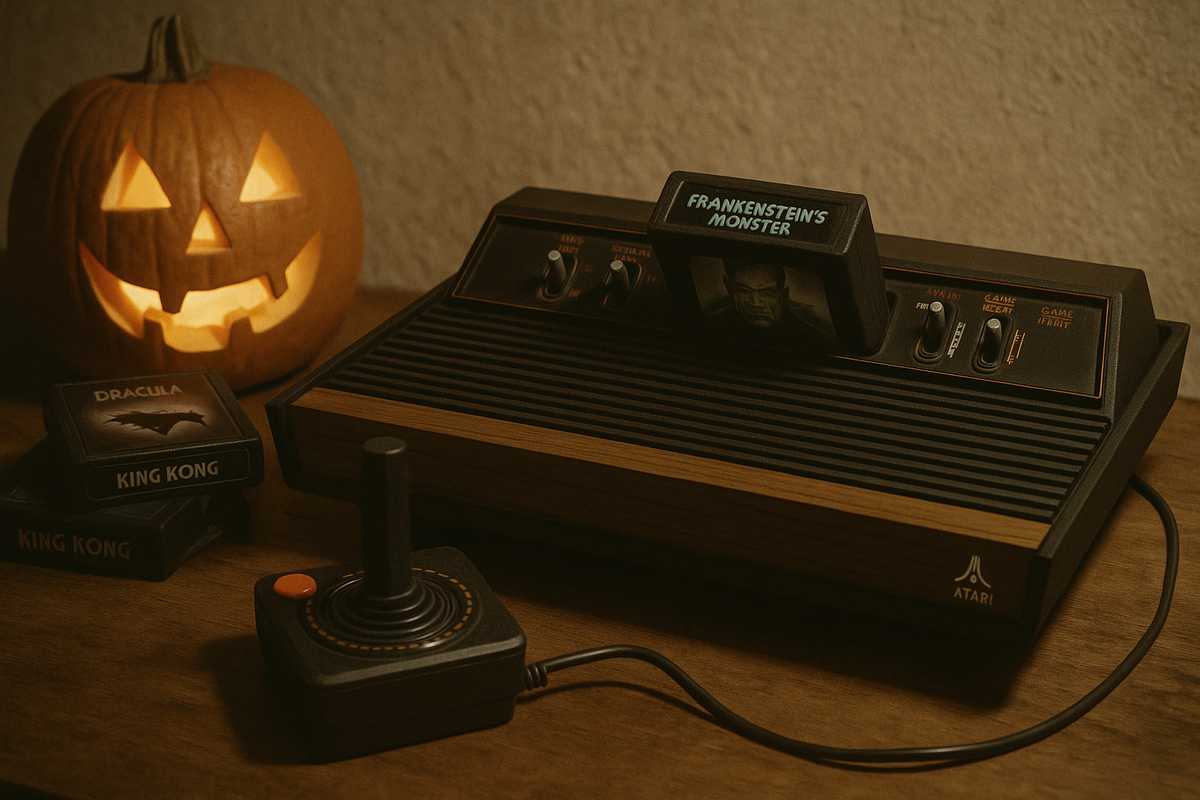
When Video Games Learned to Scream
How Electronic Games Magazine's November 1983 issue captured the birth of horror gaming—and documented an industry discovering it could make you afraid
November 1983. The arcade boom was dying. Atari's empire was crumbling. And on newsstands across America, a jack-o'-lantern grinned from the cover of Electronic Games Magazine, announcing something the industry hadn't yet named: horror as play.
Inside that issue—now one of the most sought-after artifacts in retro gaming circles—was "Scary Videogames: Games That Go Bump in the Night," a feature that documented the exact moment monsters crawled out of cinema and into cartridges. This wasn't just seasonal filler. It was the birth certificate of a genre.
Archive Spotlight
Publication: Electronic Games Magazine
Issue: November 1983
Feature: "Scary Videogames: Games That Go Bump in the Night"
Editors: Bill Kunkel, Arnie Katz, Joyce Worley
Historical Context: Published during the North American video game crash of 1983
The Crash and the Creatures
By late 1983, the North American video game industry was hemorrhaging. Too many consoles. Too many terrible games. Consumer confidence evaporating. Companies were collapsing, and analysts were writing obituaries for what they assumed was a fad.
Yet even as the market imploded, creativity spiked. Developers weren't retreating to safe territory—they were summoning Dracula, Frankenstein's Monster, and King Kong into living rooms. Electronic Games, founded by Bill Kunkel, Arnie Katz, and Joyce Worley, recognized what was happening: games were no longer just reflex tests. They were becoming vehicles for atmosphere, suspense, and the same primal thrills that had made Universal Pictures rich.
The magazine's Halloween issue didn't just catalog these experiments. It legitimized them, treating modest 2600 cartridges with the same cultural seriousness usually reserved for Hitchcock or Romero.
The Monsters in the Machine
The feature spotlighted titles that now read like early sketches of a medium finding its voice:
Frankenstein's Monster
Atari 2600 — Turn Mary Shelley's gothic nightmare into a puzzle: stack bricks to seal the creature's chamber before it awakens. Gothic architecture rendered in blocky sprites, suspense built through a ticking clock and the player's own dread.
Dracula
ColecoVision — The script flipped entirely—players didn't hunt the vampire, they were the vampire, transforming into a bat, terrorizing villagers. One of the first games to let you embody evil.
Revenge of the Beefsteak Tomatoes
Giant killer vegetables. B-movie absurdity weaponized. Games learning to wink at their own conventions before those conventions even solidified.
King Kong
Tigervision — Borrowed Donkey Kong's structure but reframed it through monster movie menace, connecting the arcade's biggest hit to Hollywood's most iconic beast.
These weren't technical marvels. But together, they signaled that games could evoke mood, not just motion. That fear—like joy, competition, or exploration—was now playable.
Why This Issue Endures
For collectors, the November 1983 Electronic Games occupies rare territory. It's simultaneously a historical document and a cultural rosetta stone.
Timing: Published at the nadir of the crash, it captures an industry experimenting its way through catastrophe, proving that creativity doesn't wait for market stability.
Iconography: That Halloween cover—glowing pumpkin, cartoonish monsters—remains one of the magazine's most visually distinctive, a piece of pop art in its own right.
Genre archaeology: Horror gaming would eventually birth Resident Evil, Silent Hill, Amnesia. This issue caught the genre's first breath, when "scary" meant a bat sprite and a timer, not polygonal gore.
Cultural bridge: It documents the exact transfer point between Hollywood's monster pantheon and gaming's interactive future, a moment when two entertainment industries collided and created something neither had imagined alone.
Owning this issue isn't nostalgia. It's holding evidence of transformation—the moment video games realized they could make you feel something other than the urge to beat a high score.
The Magazine That Saw It Coming
Electronic Games never treated cartridges as mere products. From its 1981 launch, Kunkel, Katz, and Worley approached games as cultural artifacts worth serious analysis. They drew lines from Dracula to Universal Pictures to ColecoVision, showing readers that their joysticks connected them to a century of storytelling.
That editorial philosophy is why these magazines survive as more than curiosities. They're primary sources, capturing the exact moment when an industry discovered its own expressive range. When players realized fear could be interactive. When developers learned that Mary Shelley's monster and Bram Stoker's count translated just fine to 128 bytes of RAM.
Collector Significance
Historical Timing
Released at the height of the 1983 crash, this issue captures an industry experimenting with creativity even as its foundations shook—a snapshot of resilience in chaos.
Seasonal Distinction
The Halloween cover is among the most distinctive in the magazine's history, with its jack-o'-lantern imagery standing as an iconic piece of gaming pop culture.
Genre Origins
By covering Frankenstein's Monster, Dracula, and other titles, this issue captured the first stirrings of horror gaming—a genre that would later produce billion-dollar franchises.
Cultural Artifact
It bridges monster movies and early home consoles, making it a piece of pop culture history as much as gaming history—connecting Universal Studios to Atari cartridges.
Epilogue: Before the Screaming Got Loud
Long before Resident Evil weaponized tank controls and fixed cameras, before Silent Hill wrapped psychological terror in fog, kids in 1983 were stacking bricks against Frankenstein's Monster and guiding Dracula through pixelated villages.
The November 1983 Electronic Games captured that moment—not yet a genre, just a collection of experiments unified by a single radical idea: that video games could make you afraid.
Hold a copy today, and you're holding more than a magazine. You're holding proof that even as an industry collapsed, imagination expanded. That monsters always find new worlds to haunt. And that sometimes, the scariest thing is realizing how much potential has been waiting, all along, for someone to press start.
The Archive Lives
Explore the complete collection of Electronic Games Magazine—from its founding through the transformative 1980s. Each issue traces the evolution of arcades, consoles, and the genres that would define gaming for decades.
Browse Electronic Games Magazine Collection