
The Moment the World Order Cracked
Inside Life Magazine's January 3, 1938 Chronicle of Mussolini's Defiance
On a winter morning in 1938, Americans opened their mailboxes to find something more ominous than news—they found prophecy.
The January 3rd issue of Life Magazine arrived with Swedish skating star Vivi-Anne Hultén gracing its cover, a vision of grace and athleticism that promised respite from a darkening world. But inside, spread across multiple pages, lay something far more consequential: a photographic record of the moment Benito Mussolini severed Italy from the League of Nations and pushed Europe one step closer to catastrophe.
The feature, titled "Benito Mussolini Tells His Fascist Grand Council and the World," was not merely reporting. It was witnessing. Through Life's lens, American readers watched the League of Nations—that great experiment in collective security born from the ashes of World War I—crack apart in real time. What they saw was not just Italy's withdrawal. They saw the collapse of an idea: that nations could be persuaded to choose peace over conquest, dialogue over defiance.
They were watching the prelude to a second world war.
Historical Reference
Historical Figure: Benito Mussolini, Prime Minister & Il Duce of Italy
Issue Date: January 3, 1938
Archive Source: Life Magazine
Key Event: Italy's withdrawal from the League of Nations, December 11, 1937
The Architecture of Fascist Theater
Life's photographers captured three acts of a carefully choreographed drama, each more revealing than the last.
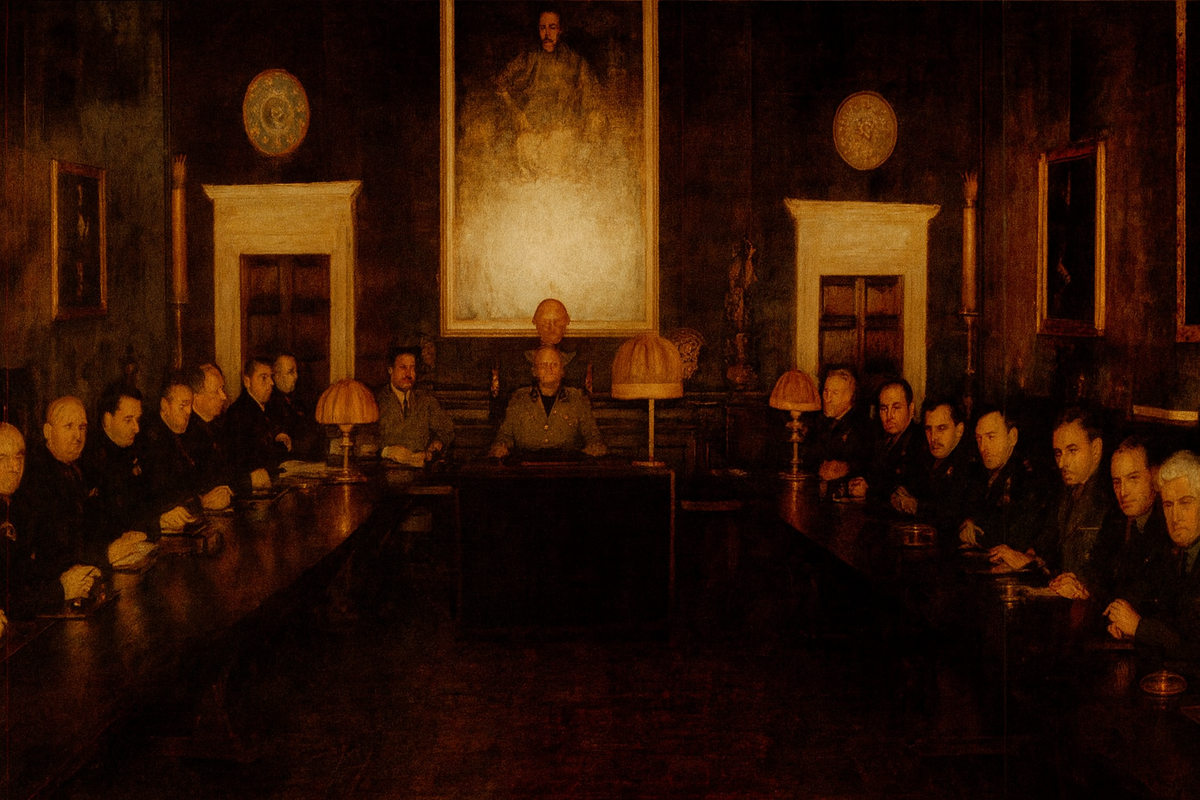
Act One: The Council Chamber. Inside Rome's Palazzo Venezia, Mussolini presided over the Fascist Grand Council. Around the long table sat the regime's inner circle—Foreign Minister Count Ciano, Propaganda Minister Alfieri, Finance Minister Thaon di Revel—their faces set in expressions that suggested gravity but allowed no dissent. This was not a debate. It was a ratification ceremony, political theater staged to grant legitimacy to a decision already made.
Act Two: The Balcony. Five minutes after the council's vote, party secretary Achille Starace emerged onto the palazzo's famous balcony. Below, 30,000 Italians packed the piazza, their presence compulsory, their enthusiasm orchestrated. Then Mussolini himself appeared, boots planted firmly on the stone, and delivered his lines: "Inside or Outside [the League]? Shall it be inside? No! Shall it be outside? Yes!"
The crowd roared its approval. The script was perfect.
Act Three: The Mass Rally. Life's most arresting images captured the scale of this mobilization—tens of thousands of helmeted figures illuminated by floodlights, their individual faces lost in the mass, their chants rising to meet Mussolini's words. Behind them loomed the Monument to Victor Emmanuel II, a deliberate visual linking Mussolini's imperial ambitions to the legacy of Italian unification.
For American readers accustomed to town halls and congressional debates, these images revealed something alien and unsettling: politics as spectacle, governance as performance art, power expressed not through persuasion but through the sheer force of synchronized human movement.
Why Italy Broke
The immediate cause was Ethiopia. Italy's 1935 invasion and brutal conquest of that East African nation had drawn League condemnation and economic sanctions. The sanctions failed to halt Mussolini but succeeded in humiliating him. When the League refused to recognize Italy's annexation of Ethiopia, Mussolini had his pretext.
On December 11, 1937, Italy formally withdrew, joining Germany and Japan in abandoning the institution. In his balcony speech, Mussolini dismissed international criticism with theatrical contempt: "The threatening voices from the herds of the great democracies leave us perfectly indifferent."
But this was about more than wounded pride. By 1937, the League had become a symbol of everything Mussolini's Fascism opposed—collective decision-making, negotiated compromise, the subordination of national will to international consensus. His withdrawal was not just a policy shift. It was an ideological declaration: might makes right, empire is destiny, and Italy would forge its future through conquest, not cooperation.
The alignment was unmistakable. Italy was now firmly in the orbit of Berlin and Tokyo, the three revisionist powers united in their rejection of the post-1918 order. The Rome-Berlin Axis, formalized the previous year, was hardening into the alliance that would soon engulf the world in war.
What Life Understood
Life Magazine, launched barely a year earlier in November 1936, had already established its revolutionary formula: photojournalism that didn't just document events but made readers feel present at them. Where newspapers offered columns of text, Life offered visual immersion.
The Mussolini spread exemplified this approach. The magazine's photographers captured not just the announcement but its texture—the gleam of helmets under artificial light, the rigid formality of the council chamber, the calculated theatricality of Mussolini's gestures. Readers didn't simply learn that Italy had left the League. They watched it happen, felt the crowd's manufactured fervor, sensed the regime's obsession with spectacle over substance.
This was Life's genius: understanding that Fascism was, above all, a visual ideology. Mussolini governed through images—the jutting jaw, the military uniform, the masses in formation. Life exposed this machinery by documenting it so thoroughly that American readers could see both the spectacle and the calculation behind it.
The magazine's captions and text anchored the images in historical context, noting that the League was "already crippled by Japan and Germany's exits" and that Italy's departure marked another fracture in the international order. But the photographs carried the emotional weight. They showed Americans what authoritarianism looked like when it seized control of a nation's public square.
Reading the Signposts in 1938
For contemporary readers, this issue arrived at a moment of mounting anxiety. Spain was in the throes of civil war, with Fascist Italy and Nazi Germany supporting Franco's Nationalists. Japan was expanding across China. Hitler had already remilitarized the Rhineland and would soon annex Austria.
The League of Nations, founded in 1920 as humanity's insurance against another catastrophic war, was revealed as impotent. Its failure to prevent or punish aggression in Manchuria, Ethiopia, and Spain had exposed the fatal flaw in collective security: it only works if nations are willing to enforce it. By 1938, the major powers were not.
Life's coverage of Mussolini's withdrawal thus functioned as both news and warning. The magazine was showing Americans a world where international law was collapsing, where strongmen were ascendant, where the careful diplomatic architecture built after World War I was being dismantled piece by piece.
Within twenty months of this issue's publication, Germany would invade Poland. The war that Life's photographs seemed to portend would become reality.
Visual Themes & Historical Significance
The Council Meeting
The Fascist Grand Council convened in Palazzo Venezia to ratify Mussolini's decision. The image of men in dark suits around the table conveyed both authority and rigidity—a decision staged, not debated.
The Balcony Speech
Mussolini's fiery words, amplified by Life's captions, showed how he staged the moment for maximum drama. Details like his boots on the balcony captured the regime's obsession with spectacle.
The Mass Rally
Photographs revealed the scale of Italy's mobilization: tens of thousands in the square, helmets gleaming under lights, flags waving—politics as synchronized human performance.
Symbolism of Empire
The Monument to Victor Emmanuel II in the background tied Mussolini's Fascism to the story of Italian nationalism and the legacy of unification.
Mussolini's Defiance
Life quoted his words directly: "The threatening voices from the herds of the great democracies leave us perfectly indifferent"—theatrical contempt for international opinion.
International Impact
The article noted that Italy's withdrawal further weakened the League, already crippled by Japan and Germany's exits—collective security collapsing in real time.
African Conquest
The refusal of the League to recognize Italy's hold on Ethiopia was the immediate cause of the break, exposing the institution's inability to enforce its own principles.
Foreshadowing War
For readers in 1938, the images suggested not just Italian independence but the looming collapse of peace in Europe—prophecy captured in photographs.
Why This Issue Endures
Historical Inflection Point
The January 3, 1938 Life Magazine captures the moment when the post-World War I order definitively failed and the world began its slide toward a second, even more devastating conflict.
Primary-Source Photojournalism
These images were not created by historians looking backward. They were made by photographers present in the moment, documenting a regime that was still confident, still ascendant.
Visual Evidence of Fascism
For historians, the issue provides visual evidence of how Fascism functioned as political theater—spectacle weaponized to legitimize conquest and silence dissent.
Direct Connection to 1938
For collectors, it offers direct connection to the anxieties of 1938, preserved in the original pages that Americans held in their hands as Europe moved toward war.
Institutional Fragility
For anyone seeking to understand the fragility of international institutions, it serves as a case study in how quickly cooperation can collapse when powerful nations pursue unilateral force.
Preserved Uncertainty
Unlike books written after the fact, magazines capture the uncertainty of the moment—readers didn't know what was coming. That uncertainty is preserved in every photograph, every caption, every page.
The January 3, 1938 issue of Life Magazine is more than a chronicle of Mussolini's defiance. It is a record of the moment when the international order established after World War I proved unable to contain the ambitions of authoritarian regimes. It is visual evidence of Fascism's seductive power—the way spectacle and nationalism and carefully orchestrated mass emotion could be weaponized to legitimize conquest and silence dissent.
To hold this issue is to hold a turning point: Italy breaking with the League, collective security collapsing, the path to global war accelerating.
The photographs still carry their charge—the helmeted crowds, the balcony gestures, the solemn faces around the council table. They remind us that history does not move smoothly or inevitably. It fractures. It breaks. And sometimes, those fractures are documented so vividly that we can still see exactly where and how the world came apart.
Original Access to History
Authentic issues of Life Magazine from the 1930s through the 1970s remain available to collectors, researchers, and anyone seeking direct connection to 20th-century history as it unfolded.
These are not reprints or digital facsimiles—they are the original artifacts, the same pages readers handled in real time, now preserved as primary historical sources.
Browse Life Magazine Collection