
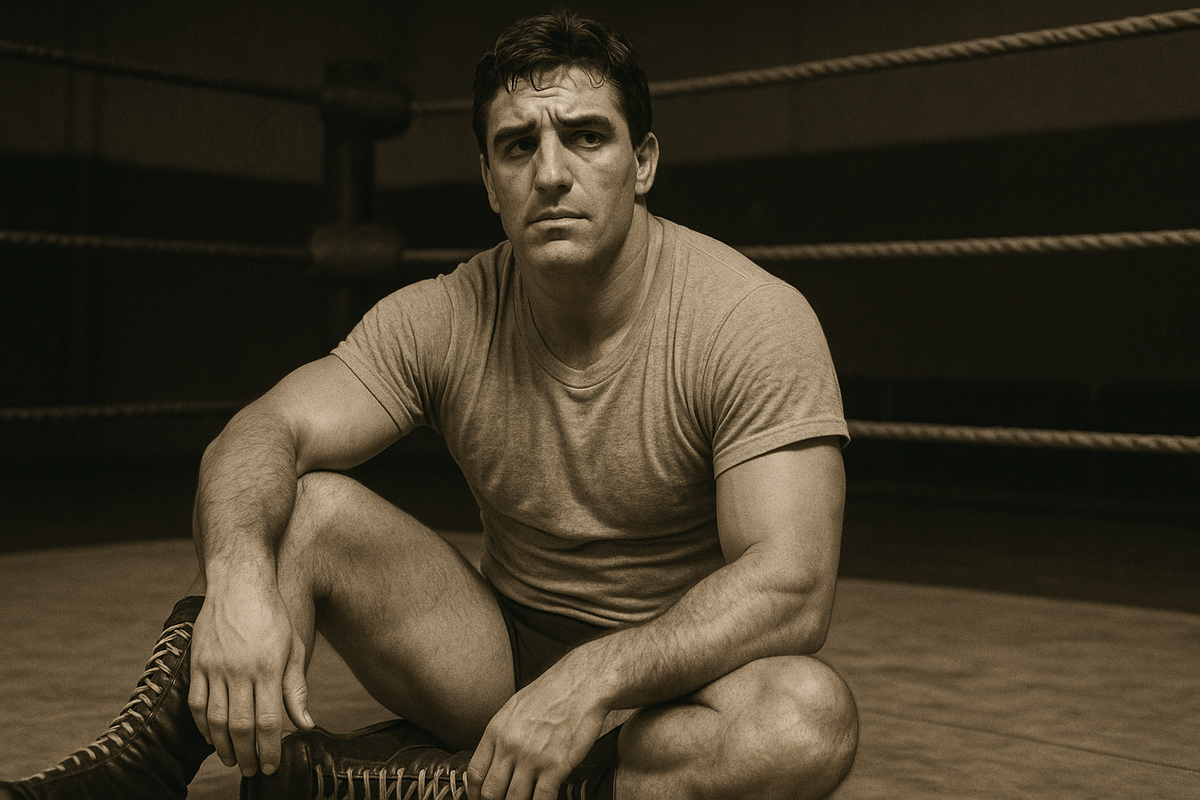
Rick Martel, AWA Ambition, and the Struggle for Wrestling Greatness
How a January 1984 Pro Wrestling Illustrated feature captured a champion's crisis in wrestling's most turbulent era
When Rick Martel cocked his fist and stopped it inches from reporter Liz Hunter's face in January 1984, laughing through gritted teeth about what a hell of a story it would make—"Down-and-Out Wrestler Kayos Female Reporter"—he wasn't joking about the frustration. He was bleeding it.
The French-Canadian star had clawed his way to the number one contender's spot in the American Wrestling Association, faced champion Nick Bockwinkel multiple times, and lost. Then he lost to Mr. Saito. Then he watched his ranking plummet to fourth. By the time Pro Wrestling Illustrated ran "Is AWA Wrestling Too Tough for Rick Martel?" in its January 1984 issue, the question wasn't rhetorical. It was survival.
This wasn't just another wrestler profile. It was a document of crisis—a man caught between ambition and obsolescence in an industry about to tear itself apart. And for fans watching the territorial wrestling model collapse under Vince McMahon's national expansion, Martel's struggle mirrored their own uncertainty about what came next.
Archive Details
Historical Figure: Rick Martel
Issue Date: January 1984
Archive Source: Pro Wrestling Illustrated
Feature Article: "Is AWA Wrestling Too Tough for Rick Martel?" by Liz Hunter
The Territorial System's Final Act
By early 1984, professional wrestling was fracturing. Verne Gagne's AWA still commanded respect—Nick Bockwinkel remained one of the sport's most cerebral champions, Mad Dog Vachon was a living legend, and Hulk Hogan was months away from his WWF defection. But the old order was dying. McMahon was stockpiling talent, preparing to launch WrestleMania, and the regional promotions that had sustained wrestling for decades were starting to bleed out.
Rick Martel arrived at the top of the AWA hierarchy just as the ground was shifting beneath it. A polished babyface with international credibility, he represented the future Gagne needed—young, athletic, charismatic, capable of carrying the company into a new era. But potential doesn't survive losses. In the unforgiving logic of territorial wrestling, a few bad nights could erase months of momentum.
And that's exactly what happened.
Martel had earned his title shot. He faced Bockwinkel. He lost. He faced him again. He lost again. Then came the Saito match—a critical opportunity to reassert himself—and Martel made the mistake of letting his opponent control the pace. Another loss. By the time PWI published this feature, Martel had dropped to fourth in the rankings, behind Bockwinkel, Hogan, Vachon, and Saito. The golden boy was tarnishing in real time.
This wasn't just one man's crisis. It was the fragility of the territorial system made flesh. Wrestlers lived and died by momentum, by crowd reactions, by the whims of promoters trying to fill arenas in shrinking markets. One slump could end a career. And Martel knew it.
PWI's Gift: Kayfabe Meets Confession
What made Pro Wrestling Illustrated essential reading in the 1980s was its ability to walk the line between theatrical mythology and raw honesty. The magazine didn't break kayfabe—it bent it just enough to let readers feel like they were seeing backstage.
Liz Hunter's article exemplified this balance. The tone was sympathetic but unflinching. PWI didn't sell Martel as an invincible hero. It showed him doubting, angry, searching for answers. The interview quotes felt unguarded:
"I'm so mad I could just…" and then the mock punch, the laugh that didn't quite hide the desperation.
He admitted tactical errors. He confessed to letting Saito dictate the match. He described how one mistake—allowing an opponent to isolate his arm—could drain his energy and cost him everything. He even floated the idea of leaving the AWA entirely, hinting at tag team possibilities with Dino Bravo or exploring options outside Gagne's orbit.
But he refused to surrender hope. "I can't be negative about the future," he told PWI. "I have a lot to look forward to. I still contend that I will be a world champion."
That sentence—stubborn, almost defiant—was the heartbeat of the article.
The photography reinforced the narrative. Action shots of Martel grappling with Ken Patera and Mr. Saito captured both his athleticism and his struggle. The cover line—"Is AWA Wrestling Too Tough for Rick Martel?"—framed him as a man fighting uphill with the summit slipping further away.
This was wrestling journalism at its peak: drama grounded in something real.
Ten Truths Buried in the Feature
The PWI article revealed the anatomy of a wrestling career in crisis. Here's what it documented:
A Rankings Collapse
Martel had been the number one contender. Now he was fourth, watching others claim the spotlight he'd earned.
Frustration Laced with Humor
His willingness to joke about punching a reporter showed both his charm and the psychological toll of the slump.
Self-Critique
Martel didn't make excuses. He admitted he let Saito control the match, a tactical failure that cost him.
Career Uncertainty
He openly discussed leaving the AWA, acknowledging the reality many wrestlers faced: loyalty didn't pay the bills.
The Bobby Heenan Problem
Martel singled out the legendary manager as a manipulative presence, underscoring how managers shaped storylines and locker room politics in this era.
Tag Team Escape Route
He floated the idea of returning to tag action, possibly with Dino Bravo, as a way to rebuild credibility.
Veteran Resilience
Despite everything, Martel insisted he'd stay in the fight. This wasn't a man quitting. This was a man recalibrating.
The Physical Toll
He described how small mistakes compounded—losing control of a limb, running out of gas, losing the crowd's energy.
The Mental Game
More than strength or technique, Martel emphasized confidence. And he admitted he was searching for it.
Unshakable Belief
He ended with a declaration: all the struggle would be worth it when he finally won the World title.
Visual Language of an Era
The January 1984 issue of PWI looked nothing like modern wrestling media. No glossy airbrushing. No corporate branding. Just bold headlines, gritty black-and-white action photography, and dramatic framing that made every match feel like a war.
The shots of Martel against Saito and Patera highlighted the physicality of AWA wrestling—sweaty, brutal, real. The headline "Is AWA Wrestling Too Tough for Rick Martel?" suggested vulnerability in a man fans had been told was destined for greatness. And the blend of kayfabe storytelling with genuine emotional stakes gave readers a deeper connection to his journey.
This was the visual grammar of 1980s wrestling journalism: spectacle rooted in struggle, mythology grounded in sweat.
Legacy of the Feature
Looking back, the Rick Martel article reads like prophecy. His frustration, his tactical mistakes, his determination to stay in the fight—all of it foreshadowed his eventual championship run. Pro Wrestling Illustrated didn't just report wrestling history. It captured it in motion, giving fans the emotional complexity that made the sport meaningful.
For modern readers and collectors, this issue offers a window into how wrestling was consumed before social media, before behind-the-scenes spoilers, before every narrative was deconstructed in real time. It was storytelling that demanded belief. And in January 1984, Rick Martel was asking fans to believe in him one more time.
Why This Issue Still Matters
Historical Pivot Point
This issue arrived at the exact moment wrestling's territorial system began its final collapse. McMahon's WWF expansion was underway, and the AWA was fighting to stay relevant.
The Martel Arc
Within months of this article's publication, Martel would rebound and capture the AWA World Heavyweight Championship (1984). This feature documents the low point before the triumph, making it an invaluable snapshot of his career trajectory.
AWA as Major Promotion
The action photography preserves an era when the AWA still stood as a legitimate rival to the WWF, featuring stars like Bockwinkel, Patera, and Saito at their peak.
Emotional Authenticity
For collectors, this issue represents more than results and rankings. It captures the psychological reality of being a wrestler in the territorial wars—the doubt, the resilience, the refusal to quit.
Explore the Archive
Original copies of Pro Wrestling Illustrated magazine remain highly sought after by collectors, historians, and wrestling enthusiasts. Each issue preserves a piece of the sport's golden age—the territorial battles, the larger-than-life personalities, the behind-the-scenes drama that shaped professional wrestling before the corporate era.
Browse PWI Magazine CollectionConclusion
The January 1984 Pro Wrestling Illustrated article "Is AWA Wrestling Too Tough for Rick Martel?" remains one of the most revealing documents of early 1980s wrestling. It showed a man at a crossroads—frustrated but unbroken, doubted but defiant. For fans then and collectors now, it captures the resilience required to survive in professional wrestling's most unforgiving era.
Holding this issue today is holding a fragment of history: not just Rick Martel's career, but the AWA's battle for survival, the fragility of the territorial system, and the storytelling power of Pro Wrestling Illustrated at its peak.