
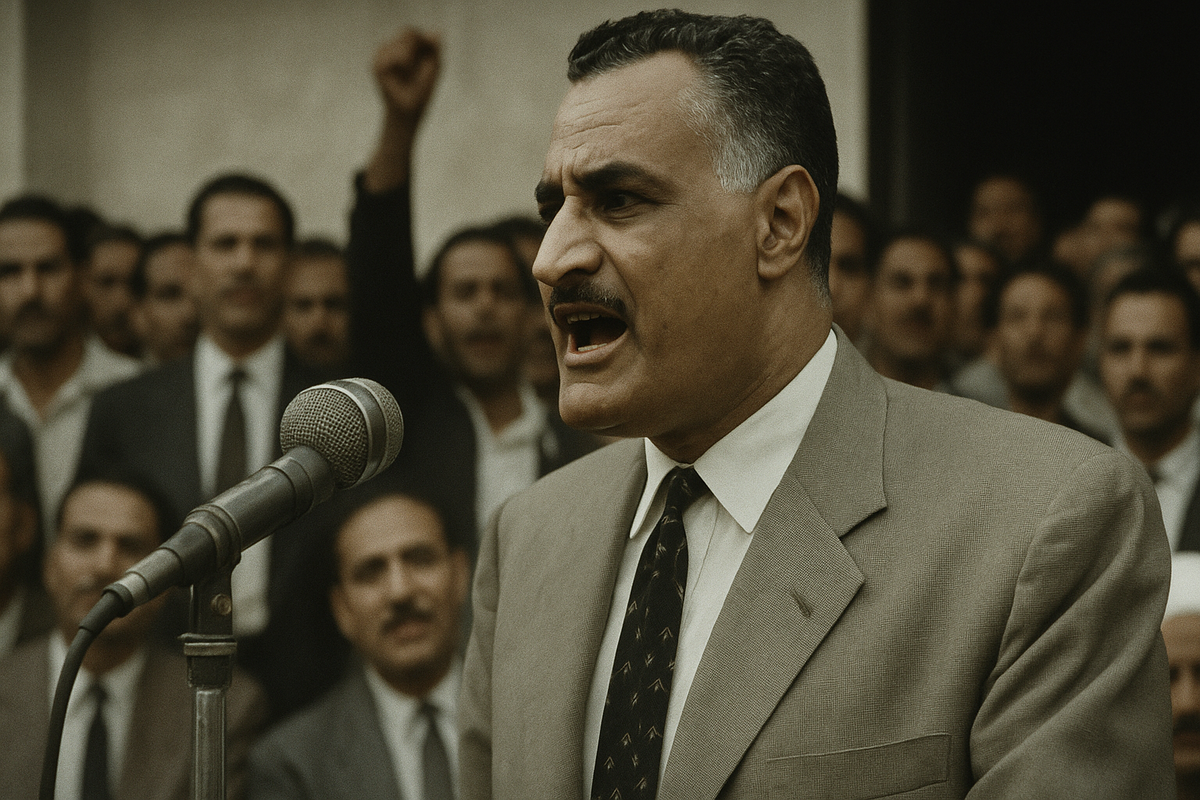
The Week Nasser Became the Most Dangerous Man in the Middle East
How Time Magazine's July 28, 1958 issue captured the moment Arab nationalism reshaped the Cold War—and why this vintage artifact remains essential for collectors and historians
When American breakfast tables received their copies of Time Magazine on July 28, 1958, they found themselves staring into the eyes of a man Washington feared more than any Arab leader before him: Colonel Gamal Abdel Nasser, President of Egypt and architect of the United Arab Republic. His face, framed by Time's iconic red border, signaled a seismic shift—the Middle East was no longer a map drawn in European capitals. It was being redrawn in Cairo.
Two weeks earlier, Baghdad had drowned in blood. Iraq's Hashemite monarchy—Britain's most reliable Arab ally—had been overthrown in a coup so violent that King Faisal II's body was dragged through the streets. In Beirut, civil war raged between pro-Western Christians and pro-Nasser Muslims. Jordan's King Hussein clung to his throne by his fingernails. And from Cairo, Nasser's "Voice of the Arabs" radio broadcasts poured into villages from Morocco to the Persian Gulf, preaching revolution in a voice that made empires tremble.
This wasn't just news. It was the moment the Cold War arrived in the Arab world—and Time was there to explain it to a nation that had barely begun to understand what "Middle East" meant.
Archive Details
Historical Figure: Colonel Gamal Abdel Nasser, President of Egypt
Issue Date: July 28, 1958
Archive Source: Time Magazine
Historical Context: Published two weeks after the Iraqi coup, during the formation of the United Arab Republic
The Summer the Old Order Collapsed
The Suez Crisis of 1956 had made Nasser a hero. When Britain, France, and Israel invaded Egypt to reclaim the Canal, Nasser stood firm—and won. The colonial powers retreated in humiliation. Overnight, he became the first Arab leader since Saladin to defeat the West on his own terms.
By February 1958, emboldened and untouchable, Nasser merged Egypt and Syria into the United Arab Republic. Pan-Arabism—the dream of a unified Arab nation stretching from the Atlantic to the Gulf—was no longer poetry. It was policy.
Western governments watched in horror. If Nasser could unite Egypt and Syria, what would stop him from absorbing Jordan? Lebanon? Iraq? The dominos were falling, and each one bore the hammer and sickle of Soviet influence. Moscow had already armed Nasser's military, financed the Aswan Dam, and opened diplomatic channels that bypassed Washington entirely.
Then came July 14, 1958. In a single morning, Iraqi revolutionaries executed the royal family, declared a republic, and aligned Baghdad with Cairo. The coup wasn't just a local mutiny—it was the ideological child of Nasserism, proof that his message had become a contagion.
Time published its Nasser cover two weeks later, not as a profile, but as a warning.
How Time Decoded Nasser for Middle America
Time in the 1950s possessed a singular gift: it could translate chaos into clarity without sacrificing drama. The July 28 issue didn't bury readers in diplomatic cables or UN resolutions. It gave them a man—flawed, fascinating, dangerous—and explained why his ambitions mattered to a housewife in Ohio or a steelworker in Pittsburgh.
The cover story opened with Nasser's rise from the Egyptian army, his discipline, his ruthlessness, his "courage, stamina, and stubborn will." But Time wasn't writing hagiography. The prose crackled with tension: Nasser was both liberator and demagogue, visionary and gambler. He fused populist charisma with military pragmatism, wielding radio broadcasts like a general commands artillery.
Inside, a map titled "Nasser's Coup" radiated arrows of nationalist influence across the Arab world—a visual earthquake that showed readers how far Cairo's reach extended. Photographs captured Nasser addressing roaring crowds, King Hussein isolated in Amman, pilgrims circling the Kaaba in Mecca. These weren't decorative. They reminded Americans that this wasn't a gentlemen's chess match—it was a revolution unfolding in real time, pulling millions into its orbit.
Time's editorial voice walked a fine line. It acknowledged Nasser's genuine appeal—decades of colonial humiliation had created a hunger for dignity that Nasser fed brilliantly. But it also warned that his ambitions could destabilize the region, empower Moscow, and threaten oil supplies that fueled the American economy.
For a readership still processing Hungary and Sputnik, Time reframed the Middle East as the Cold War's newest battlefield—and Nasser as its most unpredictable player.
What the Story Captured
The United Arab Republic's Fragile Promise
Egypt and Syria's merger represented Pan-Arabism's boldest experiment. Time treated it as both an idealistic dream and a logistical nightmare—two countries with different economies, political cultures, and military traditions forced into union by ideology alone.
The Iraqi Coup's Shockwaves
The violent overthrow of Iraq's monarchy wasn't just a coup—it was the template. Time explained how Nasser's rhetoric had emboldened Arab republicans across the region, turning kings into endangered species.
Hussein's Tightrope Walk
Jordan's twenty-three-year-old monarch was fighting for survival. Time depicted him as intelligent, Sandhurst-trained, and Western-aligned—but surrounded by a population intoxicated by Nasserism.
Propaganda as Weapon
Cairo's radio broadcasts reached deeper into Arab life than any army. Time grasped what many Western analysts missed: Nasser's true power wasn't his Soviet tanks—it was his voice, crackling through transistor radios in souks and coffee houses, promising a future without kings or colonialists.
The Man Behind the Movement
Time's profile avoided caricature. Nasser was disciplined—he woke at dawn, worked eighteen-hour days, rarely drank. He was also calculating, willing to imprison rivals, suppress dissent, and play Moscow against Washington with icy precision. The magazine portrayed him as a nationalist first, never a communist, but one whose ambitions made him Moscow's most useful ally.
The Aftermath Time Couldn't Foresee
Pan-Arabism's dream died slowly. The United Arab Republic collapsed in 1961 when Syria withdrew. Nasser's military defeat in 1967 broke the spell of Arab nationalist invincibility. Yet the ideological current he unleashed—anti-imperialism, Arab dignity, resistance to Israel—would shape the region for generations.
Ba'athist regimes in Syria and Iraq, the PLO's rise, Sadat's reversal toward the West, the Iranian Revolution's challenge to Arab nationalism—all carried Nasser's DNA. Even leaders who opposed him, like Saudi Arabia's monarchs, had to answer the question he posed: What does Arab sovereignty look like in a postcolonial world?
For modern readers, the July 28, 1958 issue offers something more valuable than nostalgia. It reveals how Americans first learned to see the Middle East—not as a backwater of camels and bazaars, but as a region capable of determining the Cold War's outcome. The article's blend of admiration and anxiety, its attempt to explain Nasser without demonizing or lionizing him, reflects a brief moment when American journalism tried to understand the Arab world on its own terms.
That moment wouldn't last. But it's preserved here, in ink and paper, waiting to be rediscovered.
Why This Issue Endures
Historical Compression
Published just fourteen days after the Iraqi coup, the issue captures the shock and confusion of events still unfolding. There's no retrospective wisdom here, no tidy conclusions—only the raw, uncertain journalism of correspondents filing from Beirut, Amman, and Cairo as history accelerated around them.
An Icon at His Apex
Nasser would remain in power until 1970, but July 1958 marked his ideological zenith. The United Arab Republic would dissolve in 1961. The Six-Day War would shatter his military prestige in 1967. But in the summer of 1958, he was the rider of the horse—and the world watched.
Cold War Artifact
This issue documents the moment Americans first confronted a Middle Eastern leader who defied the binary logic of the Cold War. Nasser wasn't a Soviet puppet, but he weaponized Moscow's support. He wasn't anti-Western, but he humiliated Western powers. Time's coverage reflects Washington's genuine bewilderment.
Design as Time Capsule
The magazine's mid-century aesthetic—bold typography, black-and-white photography, accessible maps—remains visually striking. Unlike digitized PDFs or microfilm reproductions, holding an original copy means touching the same inked pages that 3.5 million American households read in 1958. The texture matters.
For Collectors and Historians
Original issues of Time Magazine from 1958 command attention because they document turning points in real time. No historian's retrospective can replicate the immediacy of journalism written while outcomes remained uncertain.
Whether you're building a collection of Cold War media, researching Arab nationalism, or honoring a family member who lived through this era, vintage magazines like this transcend their function as periodicals. They become primary sources—artifacts that preserve not just facts, but the texture of how those facts were understood, feared, and debated.
Browse Time Magazine CollectionThese aren't reproductions or digital scans. They're the real thing—history you can hold in your hands.