
Stars, Solidarity, and the Stage: When Hollywood Stood with Martin Luther King Jr.
Inside the April 1961 Ebony Magazine that captured the night Carnegie Hall became a platform for freedom
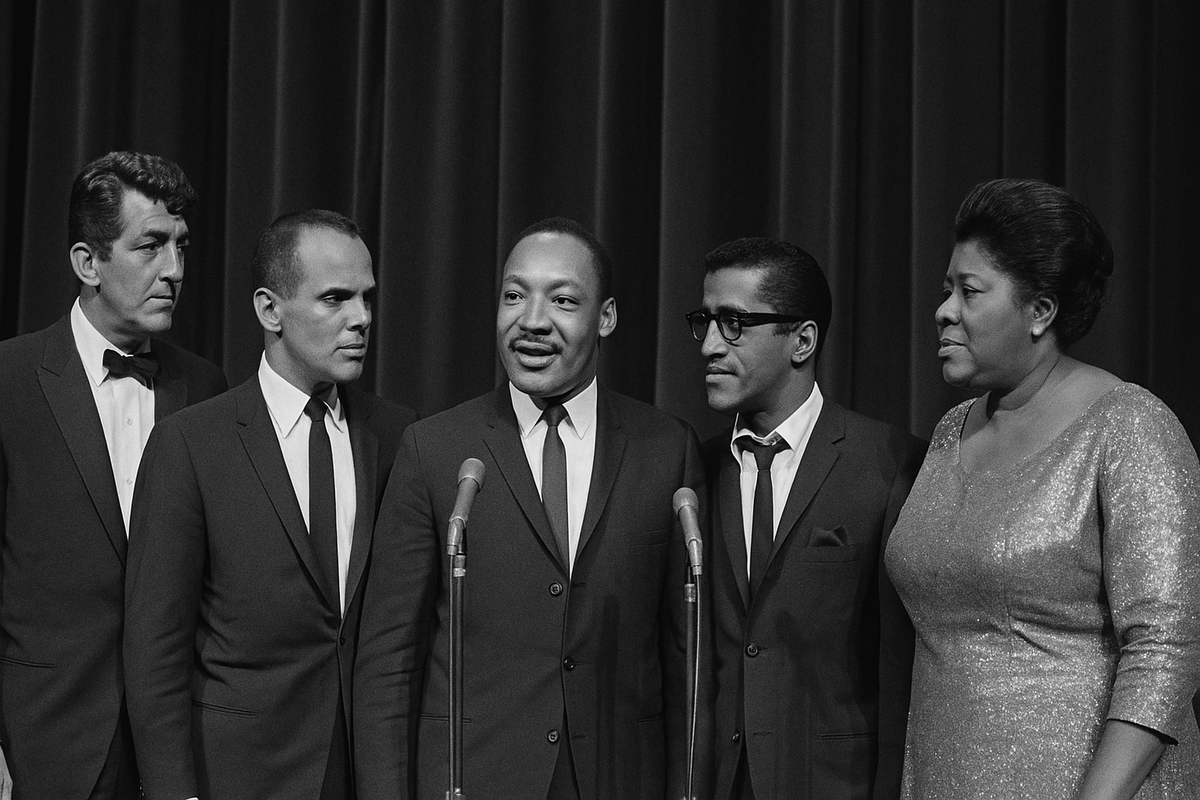
Carnegie Hall, January 1961. Frank Sinatra walked onto the stage alongside Dean Martin and Sammy Davis Jr.—not for a Rat Pack routine, but for revolution. That night, the most famous entertainers in America stood under the same spotlight as Martin Luther King Jr., and Ebony Magazine's photographers captured every moment.
When the April 1961 issue hit newsstands weeks later, it carried something unprecedented: proof that the civil rights movement had become impossible to ignore, even for those who'd built careers on escapism and glamour.
Archive Details
Historical Figure: Martin Luther King Jr., Frank Sinatra, Sammy Davis Jr., Harry Belafonte, Sidney Poitier, Mahalia Jackson
Issue Date: April 1961
Archive Source: Ebony Magazine
Historical Context: Published between the 1960 sit-ins and the 1961 Freedom Rides
The Night America's Stages Became Battlegrounds
Spring 1961 marked a rupture in American life. The student sit-ins that began in Greensboro, North Carolina in 1960 had ignited waves of nonviolent protest across the South. The Freedom Rides—where interracial groups would risk their lives challenging segregation on interstate buses—were only weeks away. Martin Luther King Jr., just 32 years old, had already emerged as the movement's most visible leader after the Montgomery Bus Boycott transformed him from pastor to prophet.
But something else was shifting. A new generation of Black entertainers—Sidney Poitier, Harry Belafonte, Sammy Davis Jr.—wasn't content to simply break barriers in film and music. They were leveraging their platforms, weaponizing their fame. The Carnegie Hall tribute wasn't a benefit concert. It was a declaration: the entertainment world recognized the stakes, and chose a side.
What Ebony's Cameras Saw
Founded by John H. Johnson in 1945, Ebony Magazine had become the nation's leading African American publication by documenting Black life in all its dimensions—triumphs, struggles, everyday dignity. The editors understood that photography could accomplish what prose alone could not.
The April 1961 coverage proved it:
Dr. King on stage, smiling as Harry Belafonte introduces him to a standing ovation—the movement meeting celebrity at eye level. Sidney Poitier greeting King with unmistakable warmth, bridging Hollywood and the freedom struggle in a single handshake. Frank Sinatra and Dean Martin flanking Sammy Davis Jr., their famous nightclub chemistry transformed into solidarity. At the reception, Shelley Winters, Juanita Poitier, and Julie Belafonte mingling—allies from every corner of American society. Count Basie and his orchestra caught mid-performance, their music carrying the rhythm of protest as much as entertainment.
High-contrast lighting emphasized both the glamour and the gravity. Candid shots brought readers into the room. Unlike mainstream outlets that presented civil rights as a distant Southern problem, Ebony made its readers witnesses.
The Architecture of the Night
Celebrity Leadership
Sammy Davis Jr. flew in from California to serve as impresario—negotiating schedules, organizing acts, commanding the stage.
Belafonte's Influence
Harry Belafonte leveraged his prestige and fundraising power to guarantee the concert's success.
Musical Power
Mahalia Jackson's gospel met Count Basie's swing in a performance that demonstrated music's central role in the movement.
Cross-Racial Unity
Eleanor Roosevelt sent a telegram of support. Shelley Winters attended. Hollywood, politics, and grassroots activism converged.
But Dr. King used the stage not to bask in celebrity admiration, but to issue a challenge: "If America is to remain a first-class nation she can no longer have second-class citizens."
The line between art and activism dissolved that night. What remained was a single, unified performance of American conscience.
The Magazine as Monument
The cover itself—featuring President Dwight D. Eisenhower and Andrew T. Hatcher, the first African American associate press secretary at the White House—already signaled political progress. But the Carnegie Hall feature was the issue's beating heart.
Ebony was never just a magazine. It was validation, documentation, and demand—a record keeper for a people whose stories mainstream media ignored or distorted. For African American readers in 1961, seeing their leaders and their allies celebrated in glossy pages was proof that their struggle mattered, that history was watching.
Today, as debates about celebrity activism and representation continue, this issue reminds us: these conversations aren't new. They're part of a long lineage of cultural figures choosing between comfort and conviction. Ebony was there to document which choice they made.
Why Collectors Hunt This Issue
Historical Timing
Published between the sit-ins and the Freedom Rides, it sits at a hinge point—after the movement gained momentum, before it exploded into national consciousness with Birmingham and the March on Washington.
Celebrity Intersection
Few other sources document the Rat Pack's involvement in civil rights with such intimacy. This wasn't press release activism—these were working performers risking backlash from white audiences and Southern venues.
Visual Archive
The combination of King, Belafonte, Poitier, Sinatra, Davis, Martin, and Mahalia Jackson in one issue makes it essential for both civil rights historians and entertainment archivists.
Cultural Turning Point
The issue captures the moment when supporting civil rights shifted from dangerous fringe politics to something Hollywood's biggest names would risk their reputations to defend.
Owning History
The April 1961 issue preserves the night when America's entertainers stepped into history, when solidarity became a performance, when the stage itself became a platform for freedom. Inside are images of Sinatra and Davis Jr. beside Belafonte and King. Mahalia Jackson and Count Basie as voices of the movement. Dr. King's uncompromising message delivered into living rooms across America.
Holding this issue means holding the memory of that convergence—when lunch counter protests and Carnegie Hall shared the same urgency, when fame became a tool rather than an escape.
Explore the Archive
From the 1940s through the 1970s, every issue of Ebony offers a time capsule of African American history—politics, style, music, and progress, documented in real time by those who lived it.
Browse Ebony Magazine Collection