
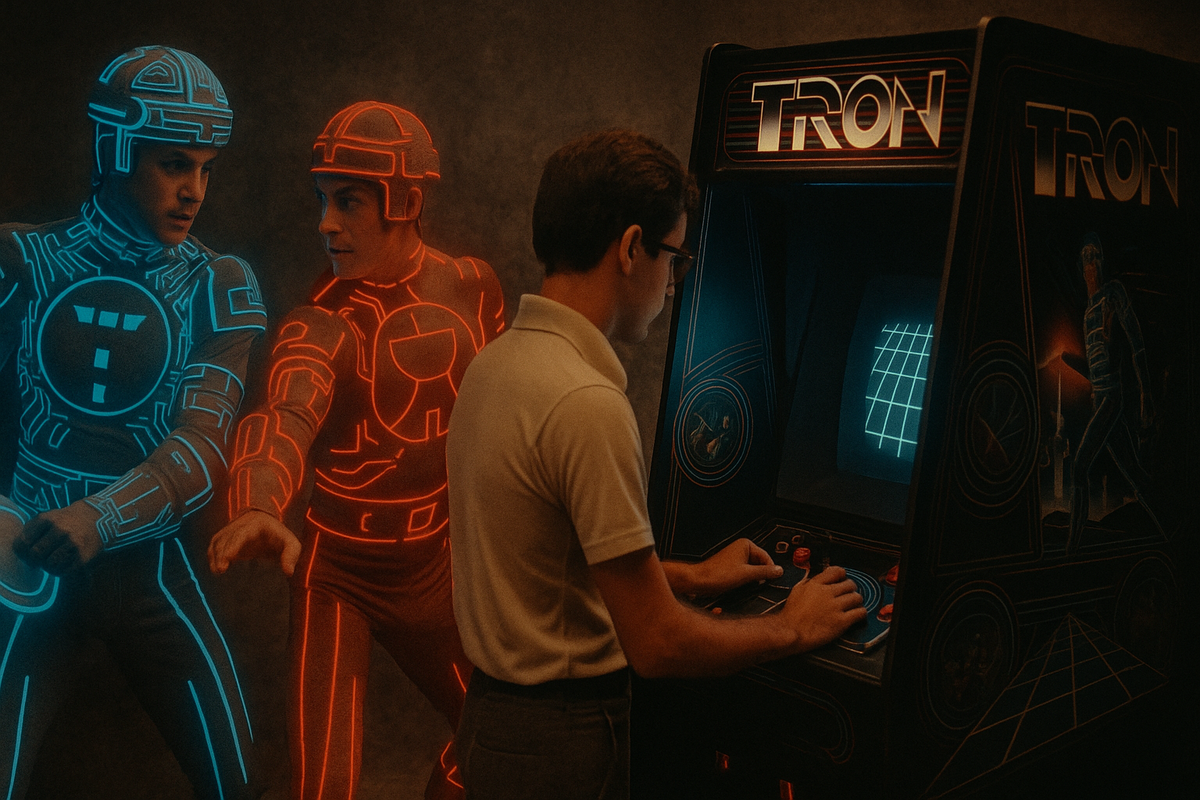
The Summer Video Games Invaded Hollywood
Inside the July 1982 Electronic Games Magazine That Prophesied TRON
July 1982. Quarters clinked into Pac-Man cabinets. Teenagers hunched over Donkey Kong joysticks in darkened arcades from coast to coast. And then Disney—Disney—released a film where the hero gets sucked into a computer and fights for his life in digital gladiatorial combat that looked exactly like the games consuming America's youth.
When Electronic Games Magazine hit newsstands that same month with an exclusive TRON preview, it wasn't just covering a movie. It was documenting the moment video games stopped being a subculture and became the blueprint for how Hollywood imagined the future.
This wasn't entertainment journalism. This was validation.
Archive Details
Publication: Electronic Games Magazine
Issue Date: July 1982
Featured Film: Disney's TRON
Historical Context: Peak of the Golden Age of Arcades
Archive Source: Original Magazines Collection
The Golden Age Peak
The summer of 1982 marked the apex of the arcade revolution. Pac-Man, Donkey Kong, Defender, Centipede, Space Invaders—these weren't just games. They were social infrastructure. Arcades functioned as competitive arenas, youth parliaments, and the closest thing teenage America had to a universal third place.
Home consoles—Atari 2600, Intellivision, Odyssey²—were exploding into living rooms, fueling a market teetering between exponential growth and the catastrophic crash that would arrive just twelve months later. No one saw 1983 coming. In July 1982, video games felt invincible.
Into this moment stepped Electronic Games, founded just a year earlier as the first publication to treat games as cultural artifacts worthy of serious analysis. Not high score lists. Not arcade gossip. Actual criticism. Actual journalism.
And when Disney bet millions on a film built entirely around arcade aesthetics, Electronic Games understood what was happening: the subculture had won.
"The Coming of TRON": What the Preview Revealed
The feature article gave readers an unprecedented look at Disney's gamble—a film where Kevin Flynn (Jeff Bridges), a computer programmer and arcade owner, gets digitized into a mainframe and must survive combat programs that fight like boss battles from coin-op machines.
The magazine detailed Disney's radical production techniques: backlit photography, blue-screen compositing, and pioneering computer-generated imagery that made actors look like they were glowing from within. Characters moved through wireframe landscapes. Light cycles carved neon trails across digital grids. Identity discs spun through the air like luminous frisbees of death.
For readers who spent their evenings bathed in CRT glow, this was more than spectacle. This was proof that their world—the world of joysticks and high scores—had become the foundation of mainstream imagination.
A Cover That Captured the Convergence
The July 1982 cover didn't just feature TRON. It embodied the fusion the film represented.
Glowing warriors rendered in electric blue and red stood against digital landscapes that could have been ripped from an arcade monitor or a sci-fi paperback—or both at once. Earlier Electronic Games covers had showcased arcade cabinets or stylized gameplay illustrations. This one erased the boundary between cinema and gaming entirely.
Inside, production stills mixed with behind-the-scenes technical breakdowns. Disney's creative team was interviewed not as Hollywood royalty slumming in youth culture, but as peers who understood that arcade design was legitimate art.
Most crucially, the preview connected TRON to tangible arcade experiences. Bally/Midway was releasing a TRON cabinet. Light cycle duels. Disc battles. The same sequences flickering on movie screens would be playable in the arcade down the street. Film and game as simultaneous releases, each validating the other—one of the first times this cross-pollination had been executed at scale.
What Made the Coverage Revolutionary
The Electronic Arena Concept
The article framed TRON's battles as direct translations of arcade design language. Digital warriors locked in contests that mirrored coin-op genres. Every fight was a level. Every victory advanced the narrative.
Light Cycles and Disc Wars
Iconic sequences received detailed analysis. The light cycle grid battles. The identity disc duels. Readers got technical breakdowns of how these scenes were constructed before the film hit theaters.
Visual Innovation Decoded
Disney technicians combined computer-generated wireframes, live-action re-exposures, and optical effects to create characters who looked "electrified"—avatars rendered in phosphor and light.
The Multimedia Prophecy
Beyond the film, the article cataloged upcoming arcade cabinets, handheld versions, and console adaptations. TRON wasn't a movie with tie-in merchandise. It was a transmedia phenomenon where games and cinema fed each other.
Electronic Games wasn't covering a film. It was documenting a new ecosystem.
The Legacy TRON Built
TRON underperformed at the box office in 1982. But its visual language, conceptual framework, and integration of gaming culture into cinema proved prophetic. It paved the runway for The Last Starfighter (1984), The Matrix (1999), and every film since that has imagined reality as programmable space.
The July 1982 Electronic Games reminds us how experimental that moment was. How uncertain. How thrilling.
It wasn't about pixels or quarters. It was about a generation asking: what if the games we play are the future we're building?
Why This Issue Commands Collector Respect
Perfect Timing
Released the same month TRON opened in theaters, capturing the arcade generation's first glimpse of their culture reflected on the big screen with a major studio budget behind it.
Iconic Artwork
The TRON-themed cover, rendered in neon energy and digital mystique, ranks among the most recognizable and sought-after magazine covers of the early 1980s.
Historical Documentation
The exclusive preview captured not just the film but the technological breakthroughs of early CGI, years before it became cinema's default vocabulary.
Archival Demand
Issues tied to watershed moments—TRON, Pac-Man Fever, Nintendo's American arrival—remain the most valuable to retro gaming collectors, film historians, and scholars of digital culture.
This issue is a time capsule from the exact summer when arcades, Hollywood, and the digital future locked into alignment.
For Collectors, Historians, and Believers in the Neon Dream
If you're drawn to the intersection of arcade history, cinematic innovation, and the moment video games became culture rather than commodity, the July 1982 Electronic Games Magazine is essential.
Browse Electronic Games Magazine CollectionThe Moment the Future Flickered to Life
The July 1982 Electronic Games Magazine stands as one of the most significant publications in gaming journalism history. By previewing Disney's TRON, it didn't just cover a film release—it documented a cultural shift, a technological breakthrough, and arcade culture at its absolute peak.
To hold this issue is to hold a moment when arcade glow and cinematic light merged into a single vision. And thanks to Electronic Games' pioneering coverage, we can revisit that electrifying summer and trace the lineage of every digital world we inhabit today.