
The October Morning America Woke Up to the Atomic Mirror
Life Magazine, J. Robert Oppenheimer, and the issue that captured the exact moment American invincibility ended
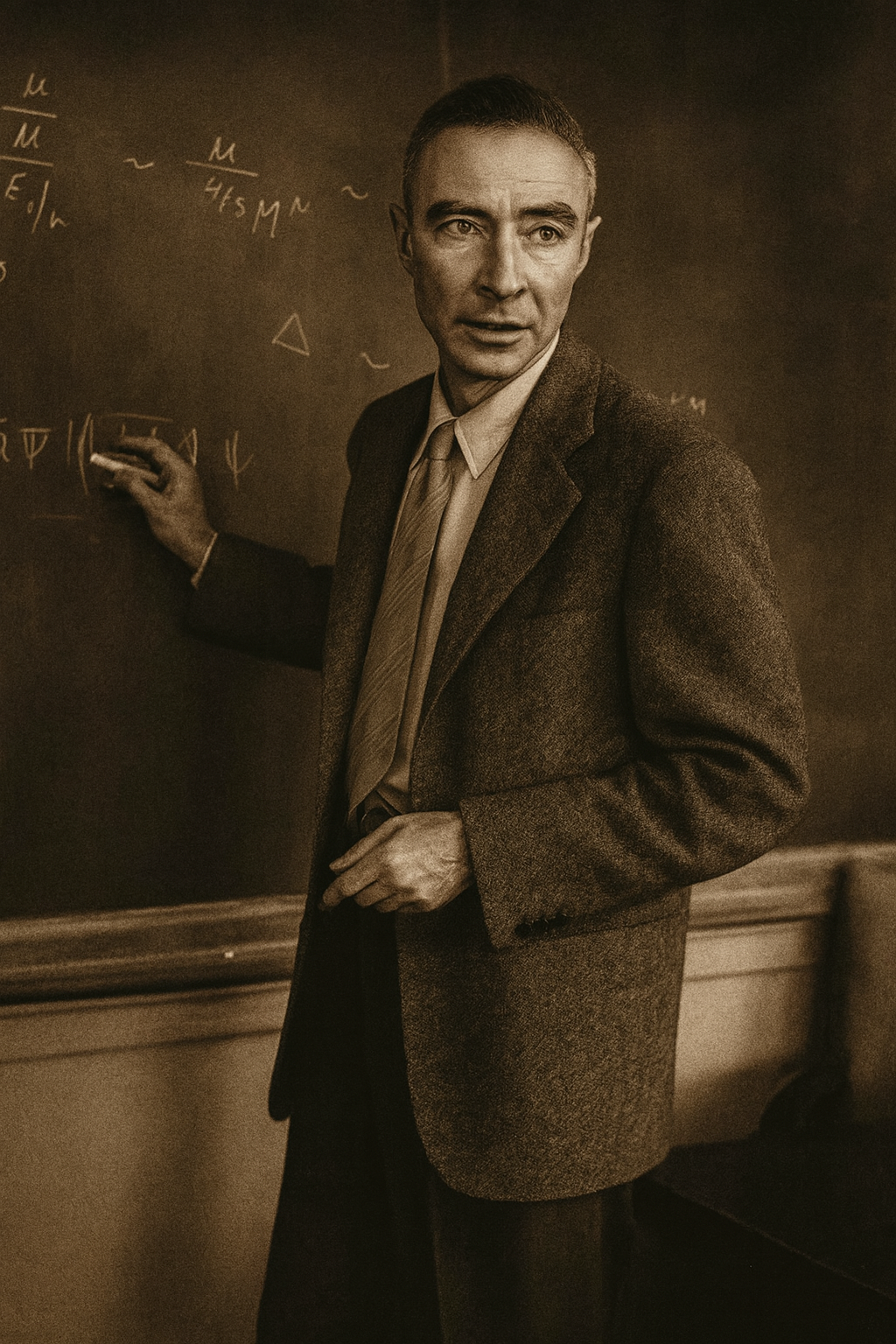
On October 10, 1949, Americans opened their mailboxes to find J. Robert Oppenheimer staring back at them.
Not smiling. Not reassuring. Just watching—cigarette between his fingers, eyes carrying the weight of what he'd built and what it had become. Arnold Newman's stark black-and-white portrait on that week's Life cover was a calculated departure from the magazine's usual fare of starlets and athletes. This was different. This was the face of a man who had cracked open the atom and couldn't close it again.
Inside, readers found something more unsettling than a profile. They found a mirror.
Three weeks earlier, the Soviet Union had detonated its first atomic bomb. The American monopoly—the thing that made victory in the last war feel like security in the next—had evaporated. Suddenly, Oppenheimer wasn't just the brilliant physicist who'd won the war. He was the prophet of a world where annihilation was mutual, where science had outrun morality, and where the next headline might be the last.
Life knew exactly what it was doing.
Archive Details
Historical Figure: J. Robert Oppenheimer, Director of the Manhattan Project
Issue Date: October 10, 1949
Cover Photographer: Arnold Newman
Article Author: Lincoln Barnett
Historical Context: Published three weeks after the first Soviet atomic bomb test
The Moment That Ended American Invincibility
September 1949 shattered assumptions. Pentagon planners had projected a decade before the Soviets could match American nuclear capability. They were off by years. When President Truman announced the test, the country's mood curdled from postwar optimism into something colder—a recognition that the victory of 1945 had merely opened the door to a more dangerous game.
This wasn't paranoia. It was math. Two nations, two arsenals, one planet.
Oppenheimer had seen it coming. As wartime director of Los Alamos, he'd led the secret laboratory that produced the bombs dropped on Hiroshima and Nagasaki. By 1949, he'd moved to Princeton's Institute for Advanced Study—America's most elite research sanctuary—but he couldn't escape what he'd helped create. His reflection on witnessing the Trinity test had already entered American consciousness: "Now I am become Death, the destroyer of worlds," he'd quoted from the Bhagavad-Gita, binding ancient Hindu scripture to the New Mexico desert where modernity's most terrible weapon first lit the sky.
That quote wasn't melodrama. It was prophecy coming due.
How Life Photographed the Unthinkable
By 1949, Life had mastered something no other publication could replicate: making the abstract immediate. The magazine didn't just report the atomic age—it showed you the man living inside it.
Lincoln Barnett's prose worked in tandem with an intimate photo essay that refused to mythologize. Here was Oppenheimer teaching seminars, surrounded by equations and younger physicists hanging on his words. Here he was at home with his wife Kitty and children Peter and Toni, reading to them, tending the garden—ordinary domesticity shadowed by extraordinary burden. Princeton lecture halls. Los Alamos flashbacks. The Trinity site, that crater of sand turned to glass.
Then came the chart.
Midway through the feature, Life published "The Elementary Particles"—a full-page table cataloging protons, neutrons, electrons, mesons, neutrinos, photons. For most Americans in 1949, this was their first encounter with particle physics, translated from chalkboard to coffee table. No textbook. No university lecture. Just Life, doing what it did best: democratizing the incomprehensible.
The magazine understood that to grasp the atomic age, readers needed to see both the science and the scientist. Not as separate realms, but as two faces of the same crisis.
The Cover That Broke the Formula
Newman's cover portrait remains one of Life's most enduring images—not despite its severity, but because of it.
Where other covers that fall offered Hollywood glamour and sports heroes, this one offered no comfort. Oppenheimer's gaze is direct, unflinching, intelligent to the point of intimidation. The cigarette is a period detail, but the expression is timeless: this is what genius looks like when it knows too much.
Life wasn't selling hope. It was selling reality. And reality, in October 1949, looked like Oppenheimer—brilliant, indispensable, and deeply uncertain about what came next.
What the Profile Revealed
The article didn't canonize. It complicated.
Oppenheimer as Teacher
His reputation in the lecture hall was formidable. Demanding, sometimes withering, yet capable of inspiring absolute devotion from students who understood they were learning from someone who'd rewritten the rules of physics.
The Philosopher-Scientist
His study of Sanskrit and the Bhagavad-Gita wasn't academic decoration. It was how he processed the moral weight of Los Alamos. Where other physicists saw only equations, Oppenheimer saw karma.
The Frontiers of Particle Physics
By 1949, his work had shifted to mesons, positrons, neutrinos—the fundamental building blocks of reality. Princeton became his new laboratory, theoretical rather than explosive, but no less ambitious.
His Ambivalence About the Bomb
He called it a "gadget." Not out of flippancy, but precision—it introduced no new science, only new consequences. The technology was simple. The implications were infinite.
The Warning
Oppenheimer argued that atomic energy couldn't remain solely a weapon. It had to become a tool for progress, or the arms race would consume everything. Reading his words now, 75 years later, feels like listening to someone shout from the deck of a ship heading toward rocks.
This wasn't hagiography. It was autopsy on the future.
Why Physical Magazines Outlast Digital Memory
There's a reason these issues endure. They were designed to.
Life wasn't disposable media. It was meant to be kept, discussed, returned to. Families saved them in attics and basements, marking the weeks that mattered. No algorithm curated them. No server hosted them. They existed in three dimensions, ink on paper, fingerprints on edges.
Digital archives capture text. They don't capture texture—the weight of the page, the grain of the photograph, the smell of mid-century print stock. They don't capture the experience of sitting in 1949, turning these pages, and realizing your world had just changed.
That's what makes original issues irreplaceable. They aren't representations of history. They are history.
Why This Issue Commands Collector Attention
Historical Pivot Point
Published weeks after the Soviet test, it captures the exact moment American exceptionalism collided with Soviet capability. The nuclear monopoly ended here, on these pages.
Iconic Imagery
Newman's cover has been reproduced in documentaries, biographies, museum exhibits. Owning the original means owning the source.
Scientific Snapshot
That elementary particle chart is a window into mid-century physics, decades before CERN, before the Standard Model, when the subatomic world was still being named.
Cultural Resurgence
Renewed interest in Oppenheimer—through recent films and scholarship—has elevated this issue from historical artifact to cultural touchstone.
This isn't paper. It's evidence of the day America stopped pretending it could control the atom.
Where to Find the Archive
Thousands of original Life magazines spanning the 1930s through the 1970s are available for collectors, researchers, and anyone who wants to hold the 20th century in their hands. From the Great Depression to the Moon landing, every issue is a seat at the table where history was first served.
Browse Life Magazine CollectionThe Issue That Refused to Look Away
The October 10, 1949 Life remains singular in Cold War journalism—not because it celebrated Oppenheimer, but because it refused to simplify him. The profile gave readers a scientist who was also a moralist, a genius who was also a father, a man who'd built the bomb and now had to live with what it meant.
Newman's photographs and Barnett's prose worked in concert to show the paradox: brilliance and burden, power and peril, all contained in one human life.
To hold this issue now is to hold the moment when America stopped being the only nuclear power and started being one of two. It's a reminder that every scientific breakthrough carries a moral bill that eventually comes due. And thanks to Life's unmatched photojournalism, that reckoning is preserved—as urgent now as it was 75 years ago.
For anyone who values history as something more than data points, vintage Life magazines aren't collectibles. They're witnesses.